- HOME
- Revenue Recognition
- Revenue recognition for multi-entity and global businesses
Revenue recognition for multi-entity and global businesses
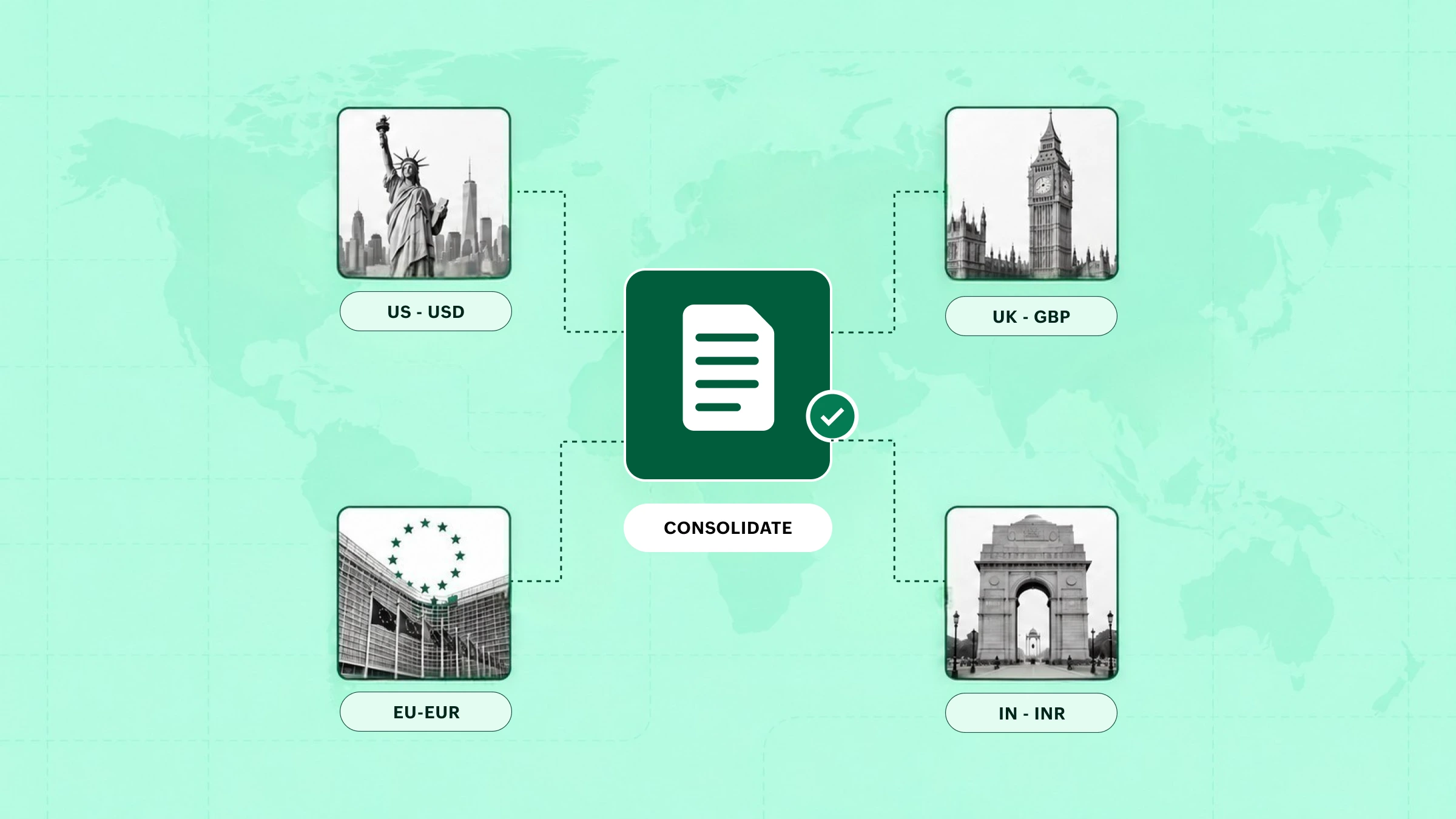
Complexity multiplies exponentially when it comes to large enterprises. Revenue recognition is no different. Organizations of all sizes follow the core five-step model, with regional variations layered on top of that. But managing it across subsidiaries, moving revenue between organizations, consolidating at the parent level, and keeping an audit of every such movement—along with the need to abide by different standards based on the jurisdictions—make it even more complex. On top of so many judgment calls being made, the systems are expected to push the data without any errors or issues at the right time.
Moreover, these entities will have processes of their own. Each team collates revenue data as they see fit if the data structure wasn't standardized in the beginning. This is a more than common occurrence in large enterprises, and it presents a tremendous headache during reconciliation.
Where do such complex revenue recognition cases arise?
Having subsidiaries in different regions and parent consolidation invites various cases of complexities in delivering services and revenue recognition. Here are some of the most common cases.
One contract handled by various entities
This is the most frequent one, and it creates the longest tail of work. The customer signs once, but the delivery gets divided across entities based on who has the capability, the headcount, or the local presence.
The recognition question that follows is a difficult one to answer consistently: if the obligations are being satisfied in two or three places, whose revenue is it as each one gets satisfied?
Primary entity with internal delegation (subcontracts to parent)
The subsidiary owns the customer relationship and the contract, and it passes the actual execution back to the parent or a sister entity.
For revenue recognition, this raises a question of role before anything else. If the subsidiary is the principal, it recognizes the full contract value, and the parent's work becomes a cost. If it is closer to an agent, only the margin belongs in its books. The two treatments produce very different entity-level revenue from the same contract.
There is also a second effect. The performance obligation is being satisfied by the parent, so the trigger for recognition stays with a team that is not the one actually recognizing. If delivery confirmation does not travel back promptly, that's another task at risk of being missed. The subsidiary recognizes on estimate and has to correct it later.
Explicit mentions in contract and child entities sign
Some agreements are signed by the local entity in its own name. Others are tripartite, meaning the parent, the subsidiary, and the customer all sign the same document.
What the contract says here largely determines who books the revenue. When the agreement spells out what each entity is responsible for delivering, then each of those entities recognizes its own share of the contract value.
The common contract value
Long-term contracts do not stay as signed anywhere. A seat count goes up mid-term, a renewal is pulled forward to bundle into a larger deal, or the term is co-terminated with another agreement.
Every one of these is a contract modification, and the treatment depends on the nature of the change. It gets treated as a separate contract or prospectively (the termination of the old contract and creation of a new one), or a cumulative catch-up adjustment.
For an organization with multiple subsidiaries, this becomes even more complicated. For a group, it's a schedule revision that has to reach every entity attached to the contract within the same period. If it reaches one entity and not the other, both are recognizing correctly in their perspective, but it's happening against different versions of the deal. The group figure starts to appear wrong without either book showing an error.
Juggling recognition events across different contract types
A group running subscriptions, milestones, usage, and professional services is running four different clocks.
Subscriptions recognize over time
Certain milestones recognize on acceptance
Usage recognizes on consumption
Services recognize as delivered
The complication is that these often live inside one contract, which means the allocated price has to be released on four separate patterns from a single arrangement.
Each model's trigger is fed by a different source. Usage data arrives from a metering system, and service hours come from whichever timesheet tool that region happens to use. Where the evidence does not arrive in time, the entity either accrues on an estimate or defers the revenue into the following period. The first has the probability of creating a true-up, while the second ends up understating the period.
Managing currency rate changes throughout the cycle
In multi-entity setups, it's natural for a parent company to operate in one currency while its subsidiaries operate in others. The breakdown begins to happen when fluctuating rates cause the group-wide numbers to waver.
In consolidated statements, the group is presented as a single economic entity, so a sale made by, say, a French subsidiary is part of group revenue and has to appear in the parent's reporting currency. The subsidiary keeps its own Euro books for local statutory purposes. The parent takes those same numbers and restates them in dollars.
For instance, consider a child subsidiary that bills a client upfront for a €3,000, three-month project. The accounting rule is simple: recognize €1,000 of revenue each month as the work is delivered. Let's assume it happens as planned.
However, looking through the lens of a parent company that reports in US dollars, $3,600 is recorded as deferred revenue, but the currency market starts distorting the recognition values.
Month 1 revenue: Earned when €1 = $1.20 ➔ $1,200 recognized
Month 2 revenue: Earned when €1 = $1.10 ➔ $1,100 recognized
Month 3 revenue: Earned when €1 = $1.00 ➔ $1,000 recognized
Even though the child entity delivered and recognized with no changes, the parent ledger is forced to measure this single contract across three different historical exchange rates, resulting in a total consolidated revenue of $3,300. The $300 difference shows up as a currency translation adjustment.
If systems are in place, this fluctuation is explained in a single line without having to rummage across rows of data.
Investing in other companies or any sort of money movement
Capital contributions and intercompany loan principal are balance sheet movements and never count as revenue or expense. Management fees, shared service charges, and loan interest are different: they are legitimate income and expense in each entity's own books, but they must be eliminated on consolidation so they don't inflate group revenue.
The impact on recognition is a classification one. A management fee booked as income in the receiving entity without the matching treatment on the other side inflates that entity's revenue and survives into the group number if the elimination misses it. The same applies to interest on an intercompany loan recorded as service income or a cost recharge invoiced through the billing system and picked up as customer revenue because it looks like every other invoice.
A higher level of complexity awaits in the cases of acquisition because each acquired company arrives with its own conventions already in place and its own view of what belongs in the revenue line.
What are the must-set operational foundations to ensure proper revenue data flow?
In all of these cases, the aim (and the struggle) is in achieving one goal: not counting and reporting revenue twice anywhere, even with so many back-and-forth movements. The subsidiaries earn, recognize, and report revenue, so does the parent, but there is a higher probability for the same cash to appear differently in each entity's ledger. While this is unavoidable and bound to happen, there are a few things that mush be operationally handled as the foundational work:
The currency needs to be managed accurately
Within what the accounting standards permit, the group decides which rate applies at which milestone, whether that is the invoice-date rate, a monthly average (where it approximates transaction-date rates), or the rate at each recognition point and configures it into the billing and ERP systems.
Policy needs to be enforced basis contract type
Default attribution rules are set per contract type, with documented exceptions. If every deal is settled from scratch, it gets settled differently each time, usually by whoever is closest to the customer and furthest from consolidation.
The data structure has to be standardized before the entity count grows
You need a shared chart of accounts, common dimensions, and one definition of what counts as a contract and a customer. This is cheap to agree on between two entities but becomes expensive to retrofit at higher numbers.
Intercompany movements need a standing treatment
Any form on internal capital movement should have a default treatment already decided. Eliminations to ensure that nothing is reported twice or more become mechanical work rather than demanding judgment calls under deadline.
The audit trail should be produced by the system
Every movement between entities needs to be traceable without anyone rebuilding the evidence later. If the pack has to be assembled manually, it will always cause unnecessary confusions and delays.
Getting the plumbing right first
Revenue recognition across entities does reward good judgment, but judgment alone won't carry it. What holds a global group together through close is consistency in how a contract is captured, attributed, scheduled, and translated, applied the same way whether the deal was signed in Chicago or Tokyo.
That consistency has to live in the systems. Policy documents cannot enforce themselves across time zones, and spreadsheets tend to create knowledge gaps, and hence become a bottleneck at scale.
If your billing platform can hold multi-entity contracts, generate compliant recognition schedules in local currency, and keep the audit trail intact as you expand, most of this stops being a monthly argument and becomes routine. Most groups arrive at this the hard way. The decisions that would have prevented it:
Which entity recognizes what
Which rate applies where
How an amendment travels
All look small when there are two entities on the chart. They stop looking small somewhere around the fourth or fifth. Simply put, settling them early may cost a few days or weeks, but settling them late costs a quarter that doesn't even guarantee the mistake to not happen again.
Frequently Asked Questions
That depends on whether the subsidiary is acting as a principal or an agent. A principal recognizes the full contract value; an agent recognizes only the margin. The two treatments produce very different entity-level revenue numbers from the same contract.
It should, and ideally within the same period the modification is made. But that only happens if the systems are built to push it through. When an amendment reaches one entity and not another in the same period, both entities can be recognizing correctly against their own version of the deal while the group figure starts to look wrong without either book showing an error.
The parent restates each subsidiary's recognized revenue at the exchange rate applicable at each recognition point, not a single rate for the full contract. This means the same contract can produce a different dollar figure every month at the group level, even if the subsidiary recognized exactly as planned.
A shared chart of accounts, common dimensions, and one agreed definition of what counts as a contract and a customer. This is straightforward when aligning two entities, but it becomes increasingly expensive to retrofit as the entity count grows. The earlier this is standardized, the cheaper it is.