What is Agentic AI? How AI agents are changing business
- Last Updated : July 16, 2026
- 286 Views
- 6 Min Read


For the last few years, AI conversations have mostly revolved around content generation. Businesses experimented with tools that could write emails, summarise meetings, generate reports, or answer customer questions. It was exciting, but for many teams, the experience still felt limited. AI could respond to prompts, but it could not truly take ownership of tasks.
Now, the conversation is shifting. Businesses are beginning to look beyond AI that simply reacts. They're exploring systems that can plan, decide, act, and complete workflows with minimal human involvement. This is where agentic AI enters the picture.
The term may sound technical, but the idea behind it is actually quite simple. Agentic AI refers to AI systems that can work towards a goal rather than just respond to a single instruction. Instead of waiting for users to guide every step, these systems can understand context, make decisions, connect with tools, and take action independently within defined boundaries. For businesses already dealing with operational overload, disconnected systems, and growing customer expectations, this shift is becoming increasingly important.
From AI assistants to AI agents
To understand why agentic AI matters, it helps to look at how most AI tools work today.
Traditional AI systems are usually prompt based. A person asks a question or gives an instruction, and the AI responds. Once the response is delivered, the interaction ends unless the user continues directing it.
Agentic AI works differently. Instead of handling isolated prompts, AI agents are designed to complete broader objectives. They can break tasks into steps, gather information from multiple systems, evaluate options, and continue working until the goal is achieved. Think about a customer onboarding process. In many businesses, onboarding still involves several manual steps. Teams collect customer information, create accounts, assign tasks internally, send welcome emails, schedule follow-ups, and update records across different systems. Even when automation exists, employees often still coordinate the process manually.
An AI agent can streamline much of this workflow. Once onboarding begins, the agent could verify customer information, create internal records, trigger approval processes, notify relevant departments, schedule onboarding calls, and monitor completion status automatically. If something is missing, it could flag the issue before it becomes a problem. The difference is not just automation. It is the ability to manage workflows intelligently and adapt based on context. That is what makes agentic AI stand out from earlier generations of AI tools.
Why businesses are paying attention now
Modern businesses are dealing with an increasing amount of operational complexity. Teams use dozens of applications every day, customer interactions happen across multiple channels, and employees spend significant time moving information between systems rather than doing high-value work.
At the same time, customer expectations continue to rise. People expect faster responses, personalised experiences, and seamless interactions regardless of how large or small the business is. This creates pressure on teams across every department. Sales teams are expected to follow up faster while managing more leads. Support teams must handle growing ticket volumes without compromising service quality. Marketing teams need to deliver personalised campaigns at scale. HR teams are managing larger employee experiences with leaner resources.
Businesses are starting to realise that traditional automation alone is no longer enough.
Simple workflows based on fixed rules can help with repetitive tasks, but they struggle when situations become dynamic or require contextual decision-making. Agentic AI fills that gap by bringing adaptability into business processes. Instead of employees constantly checking systems, assigning tasks, updating records, and following up manually, AI agents can take over parts of that operational coordination. For many businesses, this is less about replacing people and more about reducing operational friction.
What agentic AI looks like in real business environments
One reason agentic AI is gaining attention is because its use cases are practical, not theoretical.
- In sales, AI agents can monitor pipelines, identify deals that are losing momentum, recommend follow-up actions, schedule reminders, and surface insights from previous customer interactions. Rather than forcing sales reps to dig through dashboards, the system actively helps them prioritise what matters.
- In customer support, AI agents can analyse incoming tickets, detect urgency, classify issues, escalate complex cases, and even suggest responses based on previous resolutions. Over time, they can identify recurring problems and help businesses improve customer experiences proactively.
- Marketing teams can use AI agents to monitor campaign performance, analyse audience behaviour, adjust workflows, and personalise customer journeys automatically. Instead of manually pulling reports from multiple platforms, marketers receive actionable insights and recommendations in real time.
- In HR, AI agents can simplify onboarding, manage employee requests, coordinate interview scheduling, and guide employees through internal processes without requiring constant human intervention.
- Operations and finance teams are also beginning to explore how AI agents can support approvals, reporting, procurement workflows, and internal coordination.
The key pattern across all these examples is simple: AI agents are not just answering questions. They are actively participating in workflows.
The shift from disconnected tools to connected intelligence
One of the biggest operational challenges businesses face today is fragmentation.
Most organisations already have software for CRM, communication, project management, finance, support, and collaboration. The issue is that employees often become the link between these systems.
A customer updates their information in one platform, and someone manually updates another. A support issue comes in, and employees notify different teams separately. Reports are pulled from multiple dashboards and combined manually. This creates delays, inefficiencies, and room for error. Agentic AI changes this by helping systems work together more intelligently. AI agents can move across applications, access relevant information, trigger workflows, and coordinate actions automatically. Instead of employees constantly managing processes between systems, the systems themselves become more proactive. This is especially valuable for growing businesses that need to scale operations without endlessly increasing administrative overhead.
Where platforms like Zoho are heading with AI agents
For years, AI features mostly focused on predictions, recommendations, or content generation. While useful, these features often remained isolated within individual applications.
Now, companies are moving towards AI systems that can actively assist with business workflows across an entire ecosystem. That's the direction platforms like Zoho are taking with Zia Agents. Rather than functioning as standalone chatbots, these AI agents are designed to work within business applications and operational processes. They can access contextual data, interact with workflows, automate tasks, and support decision-making across departments.
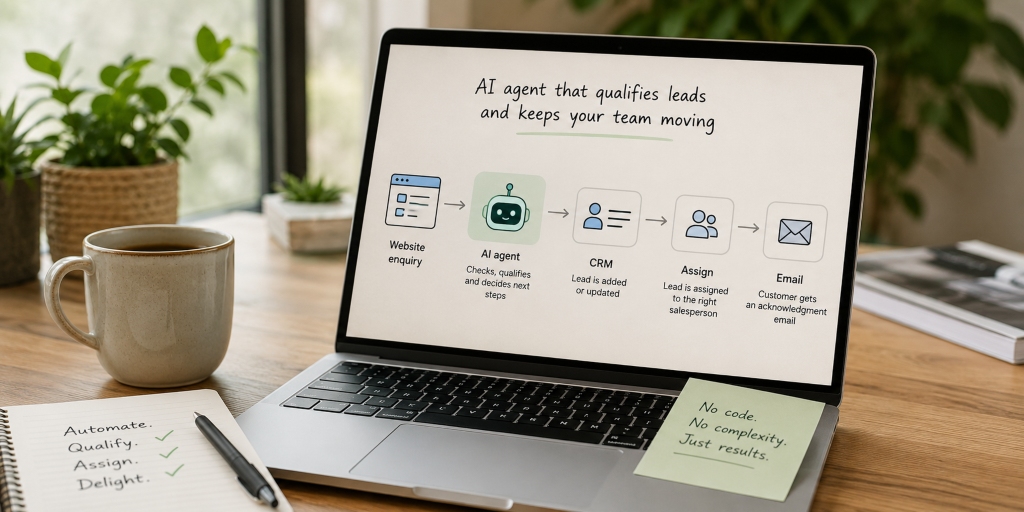
For example, an AI agent inside a CRM platform could monitor deal activity and alert teams when engagement drops. Another agent inside a support platform could identify patterns in customer complaints and escalate recurring issues before they affect larger groups of customers. The focus is no longer limited to generating responses. It's about enabling software to act with greater awareness and purpose. As AI agents become more capable, businesses are beginning to explore how these systems can support day-to-day operations in ways that feel practical rather than experimental.
The importance of balance and oversight
Despite the excitement around agentic AI, businesses also need to approach it carefully. AI agents should not operate without oversight, especially in areas involving customer relationships, sensitive data, approvals, or financial decisions. Clear permissions, human review processes, and transparency remain essential. Businesses must also think carefully about data privacy, security, compliance, and accountability. AI systems are only as reliable as the data and workflows behind them. The most effective implementations today are the ones where AI handles repetitive coordination work while humans remain responsible for judgement, strategy, and relationship management. In other words, AI agents work best as collaborators, not replacements.
Why this shift matters for the future of work
The rise of agentic AI represents a larger shift in how businesses think about technology. For years, software mainly acted as a system of record. Teams entered information, updated workflows, and manually coordinated actions between departments. Now, software is becoming more active.
Systems are starting to participate in workflows, identify issues, recommend actions, and help businesses move faster with less operational friction. That changes how work gets done. Employees spend less time managing repetitive administrative tasks and more time focusing on problem-solving, creativity, strategy, and customer relationships.
For businesses across Australia and New Zealand, where teams are often balancing growth with lean operations, this shift could become especially valuable. Companies are looking for ways to improve productivity without creating additional complexity, and agentic AI offers a practical path towards that goal.
The conversation around AI is becoming a conversation about how businesses operate, how teams collaborate, and how technology can actively support work rather than simply respond to it. And that is why agentic AI is becoming one of the most important developments in business technology right now.