





- HOME
- Payroll administration
- Full and final settlement (FnF): Rules, calculation, and payment deadline
Full and final settlement (FnF): Rules, calculation, and payment deadline
Letting an employee go is difficult for any business owner. It directly impacts daily operations and the company's work culture. But once you make the decision, you must ensure a thorough exit process. In India, labour laws govern the termination and exit process of employees. Having a smooth full and final settlement process keeps you legally compliant and reflects the respect you have for your employees.
Exit formalities vary from company to company. Generally, the process includes an exit interview, clearances from different departments, the full and final settlement (FnF), and the release of a relieving letter.
- Exit interviews help you identify the problems within your company and reduce attrition rates.
- Getting clearances from the IT, admin, and HR teams before letting your employee go prevents any issues between you and the employee in the future.
- Full and final settlement is one of the most crucial aspects of the process. The employer must pay the employee until their last day of work. The FnF amount can include incentives, gratuity, pension funds, and leave encashment.
- Once the final amount is processed, the relieving letter is sent to the employee's personal email.
With the Code on Wages now in force, the final settlement step looks very different from a few years ago. We've written this article to walk you through the components of a full and final settlement, including how to calculate the amount, when to pay the settlement, and how to format the final settlement letter.
FnF full form and meaning
The full form of FnF is Full and Final Settlement. It refers to the process of clearing all dues owed to the departing employee.
The final amount includes salary up to the last working day, encashment of unused leaves, gratuity, pension, and other incentives. Whether the employee resigns, retires, or is terminated, the FnF amount must be paid within a specific time to ensure all financial obligations are settled.
When do you pay an FnF?
Full and final settlement timelines have changed. Under the earlier norm, companies in India commonly took 45 to 60 days to process FnF after an employee's last working day, sometimes longer. That's no longer compliant.
The Code on Wages, 2019 has been in force since 21 November 2025, replacing the Payment of Wages Act and three other wage-related laws. Section 17(2) of the Code requires employers to pay all wages due to an employee within two working days of their last working day, regardless of whether the employee resigned, was terminated, or was retrenched.
The Ministry of Labour and Employment notified the central rules operationalizing this on 8 May 2026, and several states have since notified their own rules, though rollout across all states is still ongoing.
This 2-day window covers wage components: salary, leave encashment, bonus, and similar dues. It doesn't cover everything in an FnF payout. Gratuity has its own statutory deadline of 30 days under the Payment of Gratuity Act, 1972, and EPF transfers or withdrawals follow EPFO's own timelines, typically 15 to 20 working days. If your FnF includes gratuity or PF components, plan for those separately rather than assuming the 2-day rule applies across the board.
The practical shift here is significant. A process that used to run over 45 to 60 days now needs to close in 2 working days for the wage portion. That means the FnF working sheet has to be ready before the employee's last working day, not started after it.
Clearances required to process the FnF
The following clearances are required to process the final and full settlement:
| Department | Required clearance |
| IT |
|
| Admin |
|
| HR |
|
Components of an FnF
Unpaid salary
As per the Payment of Wages Act, companies with less than 1000 employees should pay wages before the 7th day after the last day of a wage period. In companies with more than 1000 employees, wages should be paid before the 10th day. However, in the case of employee resignation, termination, or retirement, companies must calculate their salary until their exit date and pay that amount along with the final settlement.
Leave encashment
Leave encashment is the amount received by an employee in exchange for any unused paid leaves provided by the organization. Calculation of leave encashment varies from one company to another because of different leave policies. During the employee's exit from the company, the encashed amount is settled along with the final pay.
Read our detailed article on computation and taxation of leave encashment here.
Bonus and incentives
Many organisations offer bonuses and other incentives based on employee performance and the company's revenue. In the case of a departing employee, employers will award the bonus amount to the employee along with the FnF settlement.
Gratuity
Gratuity is a one-time monetary benefit paid to long-serving employees. According to the Payment of Gratuity Act, 1972, employees who have completed five years of continuous service with one employer are eligible for gratuity pay.
Try Zoho Payroll's free gratuity calculator tool and compute gratuity pay now.
When an employee who is eligible for gratuity leaves your organisation, you have 30 days to pay the gratuity amount to them. If there is any delay in the payment, you will need to pay the interest along with the sum to your employee.
Read more about gratuity rules here.
Employees' Provident Fund
The employees' provident fund (EPF) is a retirement benefit scheme maintained by the Employee's Provident Fund Organisation (EPFO), the social security body of India. Under this scheme, all companies with more than 20 employees should register for EPF voluntarily. Both the employer and employee must contribute 12% of the employee's PF wage per month towards the retirement fund.
It is the employer's responsibility to let the departing employee know about the status of their PF account while settling final dues. At the time of retirement, the fund is payable to the employee. If the employee resigns to take a new job, the PF account will be transferred to the new company. The employer must update the employee's exit date on the EPFO portal.
Read more about the EPF scheme here.
Deductions
Employers can deduct professional tax, income tax, and monetary compensation for any portion of the notice period the employee does not serve from the FnF amount. Employers can also deduct the appropriate amount from the final settlement if the employee has any outstanding loan from the company.
Business owners or payroll professionals must calculate and deduct tax from the final settlement amount. Tax on gratuity and encashed leave is fully or partially exempt based on the computation provided by the labour law. The remaining FnF amount is taxable according to the income tax slab the employee falls under.
Once the payroll department makes the relevant deductions, the FnF amount is credited to the employee.
Get hand-picked resources from Academy

Final settlement letter
An FnF letter notifies the departing employee that they have received all dues from the company, and that they do not have any grievances against the employer. This letter officially validates the employee's exit from your company.
The format of the FnF letter varies from organisation to organisation. The letter can be well-detailed and can list out all the components for which the employee is getting paid. A final settlement payslip should have the following information:
- Employee name and ID number
- Date of joining
- Final settlement date
- UAN number
- Final settlement amount
- Tax deducted
- Declaration by the employee
Full and final settlement sample
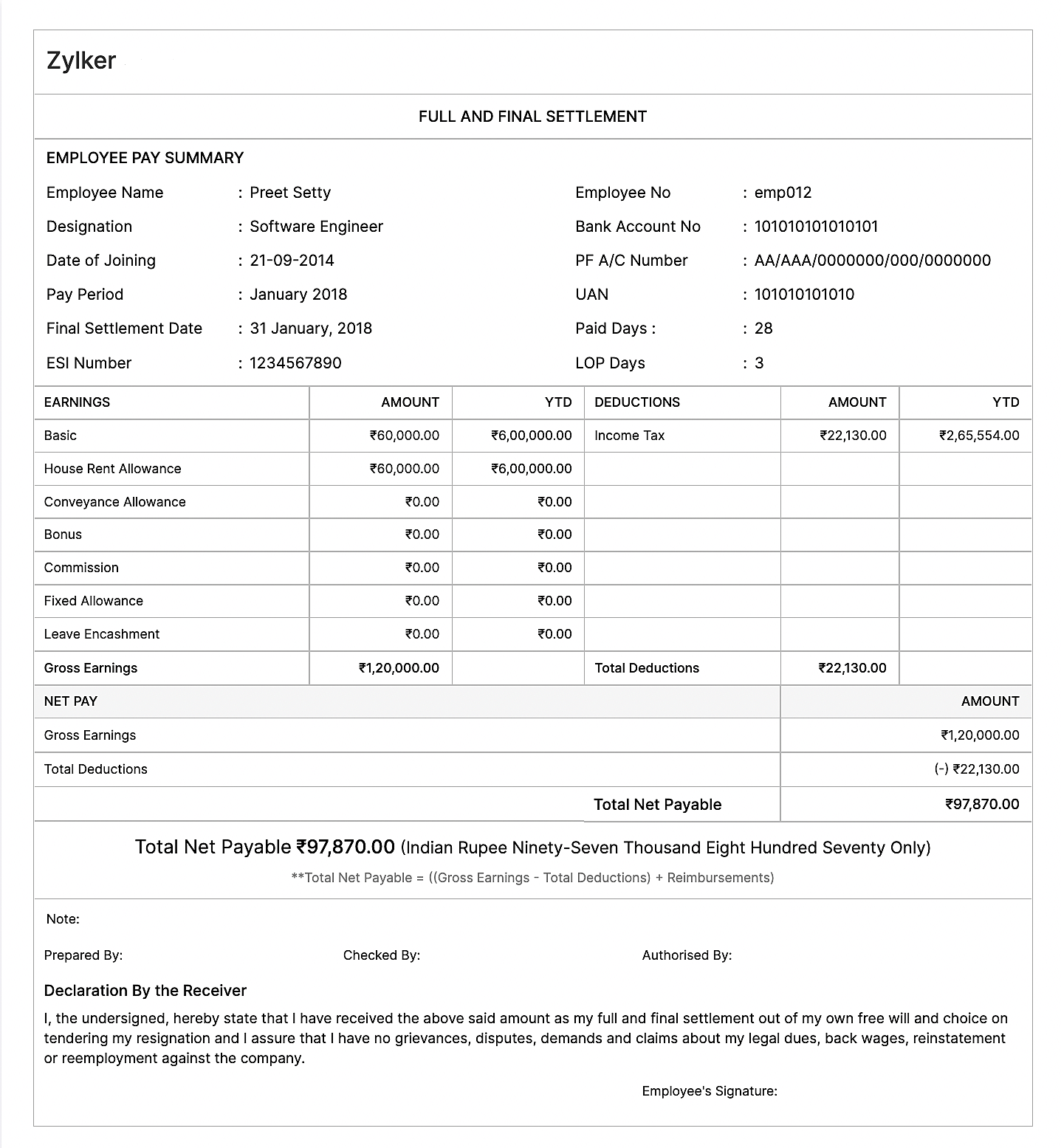
Note: Form 16 is a certificate issued by the employer that contains information related to the employee's salary and income tax deductions made at source. The employer should send this form to the employee's personal email when sending the final payslip.
To sum up
Full and final settlement is the process of paying all of the balances due to a departing employee. It includes the employee's unpaid salary, leave encashment amount, bonuses, gratuity, provident fund contributions, and deductions. The payroll team should get clearances from the HR, admin, and IT teams before processing the FnF amount.
Settling final dues can be a tedious exercise when done manually, but payroll software can streamline the process and ensure timely FnF payouts.
Zoho Payroll, a cloud-based payroll software, helps automate calculations and makes the offboarding process easy. Once you enter your employee's last working day, reason for exit, and the final settlement date, the software will run the termination payroll for you.
Zoho Payroll allows you to configure gratuity, loss of pay, and notice pay systematically. The software helps you to generate and send Form 16 along with a customizable final settlement payslip to the employee's email.
Take Zoho Payroll for a spin today and effortlessly manage all payroll-related activities!
Frequently asked questions
What is the legal timeframe for FnF settlement in India?
Under Section 17(2) of the Code on Wages, 2019, wage components of the FnF, such as salary, leave encashment, and bonus, must be paid within two working days of the employee's last working day. Gratuity follows a separate 30-day timeline under the Payment of Gratuity Act, and EPF transfers follow EPFO's own timelines.
Is the FnF amount taxable?
Most of it, yes. Unpaid salary, bonus, and most incentives are taxed according to the employee's income tax slab. Gratuity and leave encashment get partial or full tax exemption depending on the computation under the relevant labour law, but any remaining balance is taxable as regular income.
What happens if an employer delays the FnF payment?
A delay beyond the two-working-day window is a compliance breach. Employees can raise the issue with the Labour Commissioner or approach a labour court, and employers may owe interest on the delayed amount. Keeping the FnF working sheet ready before the employee's last working day is the most reliable way to avoid this.
Can FnF be processed before the employee's last working day?
The calculation can start earlier, but the final amount usually can't be locked until the last working day, since attendance, leave balances, and any last-minute deductions or clearances can still change up to that point. Preparing the sheet in advance is what makes it possible to actually pay out within two working days.