Automating SEO metadata for large websites with Zoho RPA

- Key takeaways
- Problem statement
- How Zoho RPA helps
- What changed with Zoho RPA
- How Zoho RPA empowers marketing and IT teams
- Ready to automate your SEO updates?
Key takeaways
- Updating SEO metadata across many web pages can be tedious and difficult to manage, especially when titles and descriptions must be edited manually.
- In this workflow, the SEO team uses AI models to generate page titles and meta descriptions, helping prepare SEO metadata for multiple pages quickly.
- Zoho RPA drives the automation process, logging in to the website management interface and navigating to the metadata settings for each page.
- The bot retrieves the AI-generated titles and descriptions and enters them into the appropriate metadata fields, updating and saving changes across multiple pages.
- By combining AI-assisted content generation with RPA-driven updates, teams can apply metadata changes faster without manually editing every page.
- This approach helps organizations scale SEO updates efficiently, maintain consistent metadata, and reduce repetitive operational work.
Problem statement
Maintaining accurate SEO metadata across a large website is essential, yet for marketing teams it remains a repetitive and time-consuming task. As page counts increase, manual updates become harder to track and more prone to small errors that affect search performance.
A growing B2B company with a constantly evolving website faces this challenge regularly. New product pages, updated blogs, and ongoing campaigns all require fresh, optimized metadata.
At regular intervals, often during monthly optimization cycles, the team encounters a long list of pages awaiting review. This is where the process begins to slow.
To keep everything optimized, the team needs to:
- Pull existing titles and descriptions from the site.
- Revisit keyword priorities with content and product teams.
- Review competitor pages to identify strong search terms.
- Manually draft or refine metadata for each page.
- Log in to Zoho Sites and apply updates one record at a time.
- Track approvals and document each change for auditing.
These small, repetitive tasks accumulate quickly and take valuable time away from strategic initiatives.
The result? Outdated metadata on important pages, uneven optimization across the site, and missed opportunities to improve visibility when potential customers are searching.
How Zoho RPA helps
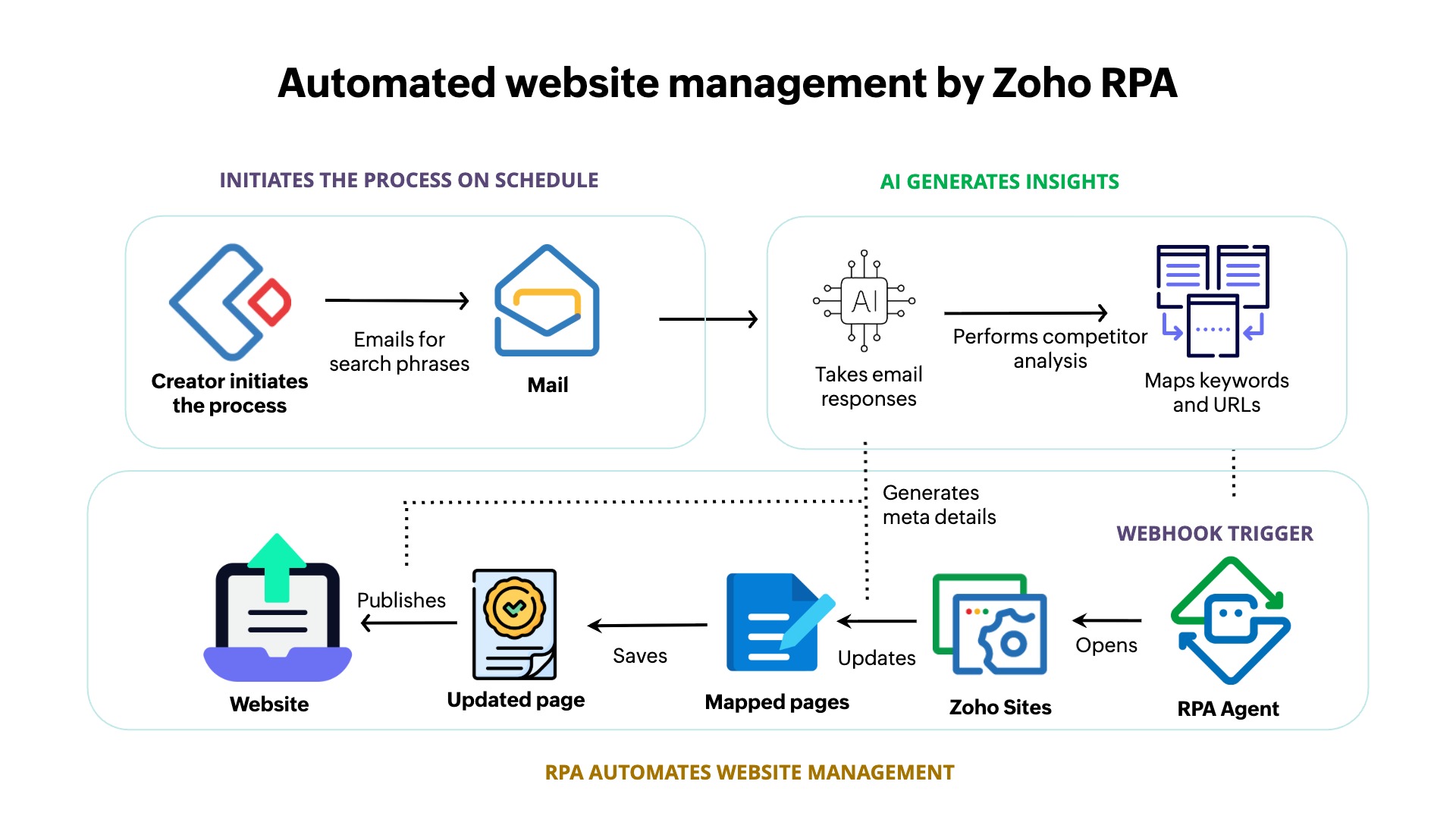
Zoho RPA transforms this traditionally manual process into a fully automated, end-to-end SEO workflow by orchestrating Zoho Creator, AI (LLM), and Zoho Sites into a single streamlined process. Human involvement drops to the bare minimum, and every update happens accurately and consistently.
Here’s how this end-to-end automation works:
1. Centralized data setup and stakeholder inputs
A content admin loads metadata from sitemap.xml into a central repository in Zoho Creator. Then they set up a process that runs on a fixed schedule, and stakeholders automatically receive prompts to provide or confirm the search phrases that need optimization.
2. AI-driven competitor insights and keyword generation
The system sends the confirmed search phrases to the LLM. The model analyzes them, identifies competitors, gathers keyword trends, and produces optimized metadata suggestions. It then maps the generated keywords and descriptions to the relevant URLs.
3. Webhook trigger to start RPA execution
Once the keywords and URLs are mapped, Zoho Creator passes this data to Zoho RPA through a webhook trigger. This activates the automated update cycle in Zoho Sites.
4. RPA login and site navigation
Zoho RPA signs in to Zoho Sites, navigates through the CMS, and opens each page in edit mode—following the same steps a human would, but with complete accuracy.
5. RPA reads existing metadata
The bot retrieves the current meta description on each page and prepares it for validation and update.
6. RPA updates metadata fields
Zoho RPA inserts the AI-generated meta description into the correct field for every URL. Each update is precise and consistently applied across all pages.
7. RPA publishes updates at scale
The bot saves and publishes every updated page automatically, enabling hundreds of metadata updates to be completed in a single run.
To see this process in action, watch the demo video here.
What changed with Zoho RPA
| Before RPA | After RPA |
| Competitor research and keyword collection done manually | AI generates fresh competitor insights and optimized keywords instantly |
| Writers drafted meta descriptions page by page | Optimized meta descriptions are ready for deployment automatically |
| CMS logins, edits, and publishing handled manually | Zoho RPA updates and publishes every page automatically |
| Monitoring and follow-ups done manually | Zoho RPA executes the process consistently for all pages without manual intervention |
How Zoho RPA empowers marketing and IT teams
- Unified workflow: From data collection to publishing, every step is connected and automated.
- Consistent SEO quality: AI-generated meta descriptions follow the same optimization logic site-wide.
- Hands-free execution: Once triggered, the RPA bot handles everything from login to publishing.
- Scalable and repeatable: The workflow can be rerun for new campaigns, keywords, or periodic SEO refreshes.
Ready to automate your SEO updates?
With Zoho RPA, your website’s SEO maintenance becomes truly autonomous.
Want to see the workflow in action?