- HOME
- BI & Analytics
- Zoho Analytics vs. Reveal BI: Embedded Analytics Comparison (2026)
Zoho Analytics vs. Reveal BI: Embedded Analytics Comparison (2026)
- Last Updated : April 9, 2026
- 352 Views
- 9 Min Read
If you're building a SaaS product and need to ship embedded analytics to your customers, you've probably narrowed it down to Zoho Analytics or Reveal BI. On the surface, they may seem comparable, as both support white-labeling, both can embed dashboards inside your application, and both market themselves as developer-friendly. But once you look deeper, the differences are significant: in breadth of functionality, data connectivity, AI capabilities, deployment philosophy, and total cost of ownership.
This comparison breaks down both platforms across the dimensions that matter most to ISVs, SaaS providers, and solution builders.
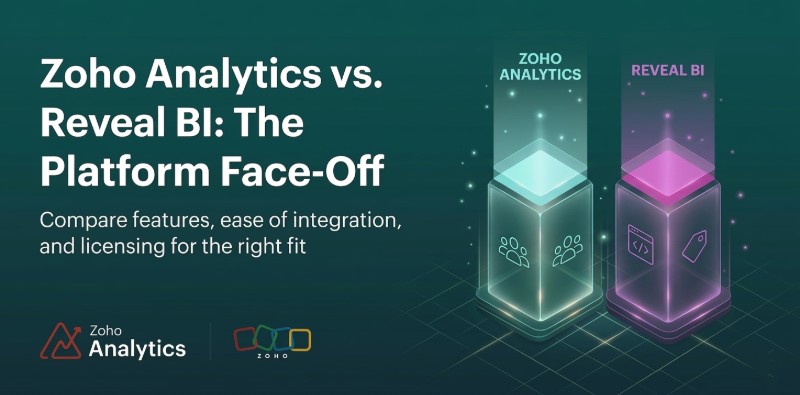
Zoho Analytics is a full BI platform with 500+ data connectors, deep AI via Ask Zia, and a cloud-hosted deployment model. Reveal BI is a developer-first embedded analytics SDK with ~30 data sources and native SDK rendering. For most ISVs needing broad data connectivity and self-service analytics, Zoho Analytics is the stronger fit; for developer teams that want full infrastructure control, Reveal BI is the leaner choice.
Quick Overview
Zoho Analytics is a full-featured, AI-powered BI and analytics platform that has evolved over more than 17 years into a comprehensive data intelligence suite. It serves internal analysts, business users, and ISVs equally well. Its embedded and white-label offering allows ISVs and SaaS vendors to deliver a complete analytics experience under their own brand, without building a BI engine from scratch.
Reveal BI (developed by Infragistics) is a purpose-built embedded analytics SDK. Its core value proposition is developer control: embed dashboards inside your app using native SDKs, avoid iframes, and deploy within your own infrastructure. It's focused on the embedding use case.
1. Platform Depth: BI Tool vs. Embedded Analytics SDK
This is perhaps the most important distinction between the two platforms.
Zoho Analytics is a complete BI platform, and not just an analytics engine. It includes a full data pipeline builder, an augmented analytics layer, collaborative workspaces, mobile analytics, a semantic metrics layer, AutoML and predictive modeling, AI-powered report generation, and enterprise governance. ISVs get all of this capability when they embed Zoho Analytics into their product.
Reveal BI is an embedded analytics SDK. It is explicitly designed for developers who want to wire dashboards into their application. It provides a rich SDK for React, Angular, Vue, Blazor, .NET, Java, and Node.js. But it is not a standalone BI tool in the same sense; it is an analytics component for developers to embed, not a platform business users navigate independently.
For ISVs who want to offer their customers a full self-service analytics experience - including data uploads, blending, exploration, and AI-driven insights - Zoho Analytics provides far more out of the box. For teams who want maximum developer control over a narrower analytics surface, Reveal BI is a leaner fit.
2. Data Connectors: Depth and Breadth
This is one of the most consequential differences between the two platforms.
Zoho Analytics connects to 500+ data sources natively. This includes:
- 100+ business app integrations: Salesforce, HubSpot, Google Analytics, Shopify, Stripe, QuickBooks, Jira, Zendesk, Monday.com, Pipedrive, NetSuite, and many more, each with pre-built domain-specific dashboards
- Databases and data warehouses: MySQL, PostgreSQL, SQL Server, Oracle, BigQuery, Snowflake, Redshift, Databricks, Dremio, and more
- Streaming data: Kafka, Google Pub/Sub, PubNub, and other real-time pipelines
- Files and cloud storage: CSV, Excel, JSON, Google Drive, OneDrive, SharePoint, Amazon S3, Dropbox, and more
- Custom connectors: Build your own with a no-code connector builder or the full SDK; connectors can even be listed and monetized on Zoho Marketplace
Reveal BI supports approximately 30+ data sources, primarily focused on databases and developer-centric sources: MS SQL Server, MySQL, PostgreSQL, Oracle, Snowflake, BigQuery, Google Sheets, Amazon S3, REST APIs, JSON, Excel, MongoDB, and a handful of others. It does not offer native integrations with business SaaS applications like CRMs, marketing platforms, or support tools.
This gap is critical for ISVs whose customers use diverse business systems. When your end users need analytics on their Salesforce pipeline, their HubSpot campaigns, or their Shopify store, Zoho Analytics handles that natively. With Reveal BI, you would need to build and maintain those data pipelines yourself.
3. Architecture and Deployment: SDK Integration vs. Hosted Platform
Here the two platforms diverge most sharply in terms of what "embedded" means.
Reveal BI requires you to install a server-side SDK component (available in .NET Core, Java, or Node.js) directly inside your application's backend. Your application servers become part of the analytics infrastructure, as they handle data source credential management, data querying, and dashboard serving. This gives developers deep control over the experience and data security, but it also means:
- Your engineering team owns the installation, maintenance, and upgrading of the SDK server components
- Any bugs or performance issues in the SDK become your team's problem to resolve
- Scaling the analytics layer means scaling your own infrastructure
Zoho Analytics offers a cloud-hosted SaaS model as its primary deployment path. You embed reports and dashboards via APIs, iframes, or its JavaScript Client SDK, using SSO or SAML authentication, while Zoho handles all the underlying infrastructure. There is no server-side component to install inside your application. For ISVs who don't want to manage analytics infrastructure, this is a significant operational advantage.
That said, Zoho Analytics also supports on-premise deployment and private/public cloud deployment (AWS, Azure, Google Cloud), making it suitable for enterprise ISVs with strict data residency requirements. This flexibility is built in at the platform level.
4. AI and Agentic Analytics: A Category Difference
If AI-powered analytics is on your roadmap (or in your customers' wishlist) this section is decisive.
Zoho Analytics has made AI a core, deeply integrated part of the platform, and not an add-on.
- Ask Zia is a conversational AI agent that can build data pipelines, create reports and dashboards, generate SQL queries, and deliver insights, all in natural language. As of Q3 2025, it has evolved into a full Agentic AI assistant with a human-in-the-loop design.
- Zia Insights automatically surfaces diagnostic, historical, and predictive insights in the form of textual and visual narratives, with no manual analysis required.
- Predictive AI models include ARIMA, ETS, STL, regression models, and anomaly detection, accessible to non-technical users.
- AutoML and Code Studio allow businesses to build, deploy, and operationalize custom machine learning models within the platform.
- MCP Server allows AI agents and LLM clients to interact with Zoho Analytics programmatically, enabling custom agentic solutions.
- Ask Zia can be embedded directly into your application, so your end users get contextual AI analytics inside your product. It's role-aware, permission-aware, and fully integrated.
- Ask Zia is included at no extra cost in paid plans. You can also bring your own LLM (OpenAI or Zoho LLM).
Reveal BI has added AI capabilities more recently, including natural language Q&A (converting questions into embedded analytics insights), KPI summaries, and anomaly detection. It supports an API-driven intelligence model where you choose your AI provider and manage the billing. Reveal describes this as an approach that avoids a "black box AI tax."
While Reveal's AI positioning is developer-friendly, it is considerably narrower in scope than what Zoho Analytics offers. Zoho's AI spans the entire analytics workflow - from data preparation through insight delivery - whereas Reveal's AI capabilities are primarily surfaced at the embedded dashboard level.
5. White-Label and Branding
Both platforms support white-labeling, but with different mechanics.
Zoho Analytics allows ISVs to replace the Zoho branding entirely - logo, domain, footer attribution - and set up a fully branded analytics portal or microsite, accessible via web and native mobile apps. SSO and SAML integration ensure your users never leave your branded experience. The white-label solution supports both embedded (within your app) and standalone (dedicated analytics portal) delivery models.
Reveal BI also includes full white-labeling - fonts, colors, themes, and UI components - as part of its core SDK subscription. Because it operates as a native SDK (not an iframe), the analytics experience can be designed to feel genuinely native within your application, with no visual boundary between your app and the analytics layer.
Both platforms handle white-labeling well. Reveal has a slight edge in UI native-ness thanks to its SDK-based rendering. Zoho Analytics has an edge in branding flexibility for portal-based deployments.
6. Pricing and TCO
This is where Zoho Analytics delivers one of its most powerful competitive advantages.
Zoho Analytics uses a transparent, tiered subscription model based on plan features and user licenses. Pricing is publicly available. The white-label and embedded analytics offering is available along with an affordable licensing fee. Crucially, the total cost of ownership (TCO) - including licensing, implementation, training, and support - is widely recognized as among the lowest in the embedded BI market. There are no surprise usage-based fees or hidden data charges. Ask Zia AI is included in the plan.
Reveal BI uses a fixed annual license model with pricing that is not publicly disclosed, and you must contact sales. The upside is that the pricing is not usage- or user-tiered, which can be advantageous if your application scales significantly. However, the lack of transparent pricing makes budget planning harder upfront, and there is no self-serve trial or public starting price.
For ISVs evaluating embedded BI on a budget, or those with multi-tiered customer pricing models, Zoho Analytics' transparent, flexible pricing structure often delivers a lower TCO and more predictable margin arithmetic.
7. Self-Service Analytics for End Users
This is a critical consideration for ISVs: how much can your customers do on their own?
Zoho Analytics is built for self-service analytics from the ground up. End users (and not just data teams) can explore data, build reports, drag-and-drop dashboards, ask Zia questions in natural language, and derive insights without any SQL knowledge. The 50+ visualization types, pre-built domain-specific dashboards (for 100+ apps), and AI-generated report suggestions make it immediately useful even for non-technical users.
Reveal BI also offers self-service dashboard creation with drag-and-drop functionality, calculated fields, data blending, drill-down, and interactive filtering. However, it is oriented more toward developers building controlled analytics experiences than toward fully open self-service exploration by end users.
8. Security, Compliance, and Governance
Both platforms support role-based access control and row-level security, which is essential for multi-tenant ISV deployments.
Zoho Analytics holds ISO/IEC 27001, 27017, 27018 certifications and is compliant with GDPR, SOC 2 Type II, and HIPAA. This is important for ISVs serving regulated industries like healthcare or finance.
Reveal BI supports enterprise-grade security including row-level security, authentication frameworks (Bearer Token, Username/Password), and flexible deployment models. Its self-hosted architecture means your data never leaves your own infrastructure, a meaningful advantage for security-sensitive use cases.
Head-to-Head Summary
| Dimension | Zoho Analytics | Reveal BI |
|---|---|---|
| Platform type | Full BI + Embedded Analytics Platform | Purpose-built Embedded Analytics SDK |
| Data connectors | 500+ (files, feeds, databases, 100+ business apps, streaming) | ~30+ (primarily databases and files) |
| Architecture | Cloud SaaS + on-prem option; no server SDK required | Client+server SDK installed inside your app |
| AI capabilities | Deep (Agentic AI, NLQ, Predictive, AutoML, MCP) | Moderate (NLQ, anomaly detection, KPI summaries) |
| White-labeling | Full branding, SSO/SAML, portal + embedded | Full branding, native SDK rendering |
| Self-service for end users | Very strong | Moderate |
| Pricing model | Transparent tiered plans + custom ISV pricing | Fixed annual license, contact sales |
| TCO | Among the lowest in market | Not publicly disclosed |
| Compliance | ISO 27001/17/18, GDPR, SOC 2 Type II, HIPAA | Enterprise security; deployment-dependent |
| Deployment options | Cloud (Zoho-hosted), on-prem, public/private cloud | Cloud or self-hosted via your own infrastructure |
| Gartner recognition | Yes (Magic Quadrant, 4 consecutive years) | Not listed |
Who Should Choose Zoho Analytics?
Zoho Analytics is the right choice if you:
- Need to connect your embedded analytics to a wide variety of data sources (especially SaaS business apps) without building custom data pipelines
- Want a complete BI platform that gives your end customers real self-service analytics capabilities, including AI-powered insights
- Are looking for the lowest TCO in the embedded BI market with transparent, scalable pricing
- Need flexible deployment options (cloud, on-prem, or hybrid) without managing a server-side analytics SDK inside your codebase
- Want to offer your customers an AI-powered analytics assistant (Ask Zia) as part of your product's value proposition
Who Should Choose Reveal BI?
Reveal BI is a better fit if you:
- Are primarily a developer-led team that wants maximum SDK-level control over the embedded analytics experience
- Prefer all analytics infrastructure to live within your own application environment, with no dependence on an external SaaS platform
- Have a small set of well-defined data sources (primarily databases) and don't need broad SaaS app connectivity
- Value a flat-rate pricing structure that doesn't scale with user growth
- Need a native (non-iframe) analytics experience with deep UI-level customization
Final Verdict
For most ISVs and SaaS companies looking to add embedded analytics to their product, Zoho Analytics offers a significantly broader value proposition. The depth of data connectivity alone - 500+ sources versus ~30 - is often the deciding factor. Add in the full-fledged AI capabilities via Ask Zia, a mature BI platform that has earned four consecutive Gartner Magic Quadrant recognitions, transparent pricing with a low TCO, and a no-server-SDK deployment model, and Zoho Analytics becomes the clear choice for teams who want to move fast and deliver maximum value to their customers.
Reveal BI earns its place in the market for developer teams that prioritize infrastructure control and SDK-level embedding, but it's a narrower tool built for a narrower use case.
Zoho Analytics has been recognized in the Gartner® Magic Quadrant™ for Analytics and Business Intelligence Platforms for four consecutive years. It is trusted by 22,000+ businesses worldwide.
 Aravind
Aravind leads content and inbound marketing for Zoho Analytics, where he's focused on the embedded analytics and ISV segment. He's been writing about business intelligence, SaaS, and data products for Zoho since 2005, making him one of the longest-running voices in the Indian B2B SaaS content space. Connect with him on LinkedIn.