- HOME
- Revenue Recognition
- Revenue recognition for subscription businesses: Key challenges & solutions
Revenue recognition for subscription businesses: Key challenges & solutions
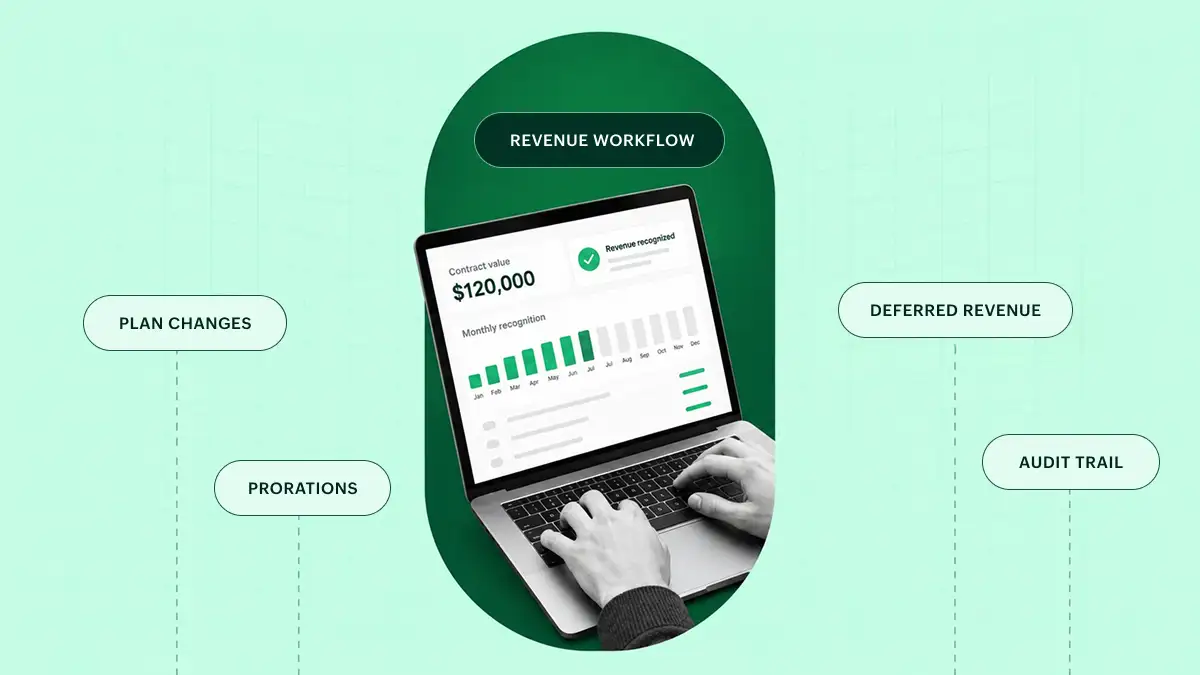
Revenue from subscriptions looks simple from the outside. A customer subscribes, pays the subscription fee and the business earns it as long as the subscription is active. In reality, revenue recognition for subscription businesses is everything but straightforward. Customers change plan mid-cycle, cancel early, pay upfront for an annual subscription, and even slip through failed payments. Each of these events add complexity to how revenue should be recognized, and most of them happen constantly, at a scale that makes manual handling difficult.
This is why revenue recognition for subscription businesses tends to be harder than for one-time sales, even though the underlying standard (IFRS 15, ASC 606, and others) remains the same. Understanding the rules of revenue recognition is the easy part. Applying them consistently to customer behaviors that keep changing is the tricky part. This article covers the key challenges faced by subscription businesses in recognizing revenue and how to soften them.
Upfront billing doesn't mean upfront revenue
Most subscription businesses bill their clients upfront. Payment received can't be counted as revenue until the service is delivered. This mismatch in dates between when the payment reaches the cash register and when it counts as revenue in financial statements is the first thing a business has to solve.
Solution: Revenue needs to be recognized proportionately over the service period. It has to be recorded as deferred revenue at the beginning and makes its way as earned revenue over time. This process can be accurate only if the recognition schedule is tied to the contract's start and end dates, not to the invoice date.
Mid-cycle upgrades and downgrades
It's common for customers to change plans during the course of the billing cycle. It's not only the plan that changes, but also the transaction price and remaining service obligation. Businesses need to prorate the difference and decide whether the change has to be applied prospectively or retrospectively to the revenue that is already recognized based on the revenue recognition standard they are following.
Solution: Calculate the prorated amount and decide on the allocation treatment as soon as the change happens. Certain plan changes may need prospective treatment and some may need to be handled retrospectively. Mapping them in advance makes handling plan changes easy and it also removes any inconsistency that may show up when changes are handled case by case.
Free trials and freemium conversions
Revenue recognition shouldn't start during a free trial. In that stage, there is no paid performance obligation yet and the user is not a customer yet. The complexity is in pinpointing when a trial user becomes a paid customer.
Solution: The trigger for revenue recognition should be an actual conversion event. That's why the date the paid contract goes into effect is important. A trial that extends or converts earlier will throw off the recognition schedule if the trigger is not tied to the actual date the prospect becomes a customer.
Cancellations, refunds, and unused prepaid balances
When a customer cancels their subscription and requests a refund, the portion that sits as deferred revenue needs to be reversed. Any prepaid balance the customer may have paid for needs to be written off or refunded, too.
Solution: Cancellation and refund events needs to flow directly into the recognition schedule. Both recognized and deferred revenue need to be adjusted at the time of cancellation. Handling this incorrectly results in overstating earned revenue.
Bundled plans and add-ons
Subscription plans usually bundle the main product with add-ons, priority support, onboarding, training, and similar additions. Each of these should be treated as a separate performance obligation as per the five-step model of revenue recognition.
Solution: Each performance obligation should have a standalone selling price and the contract value should be proportionally allocated to them. In cases where add-ons are billed separately, they need to follow their own recognition timeline instead of being combined with the core plan's schedule.
Failed payments and involuntary churn
When a payment fails and the subscription moves into dunning, the business will attempt charging the customer for a limited period of time before canceling their subscription. After the subscription has been suspended, continuing recognizing revenue results in overstating it.
Solution: Revenue recognition should be tied to the status of the service and not just the billing status. Subscription status and dunning details should flow into the recognition engine. This will ensure revenue is not counted from the moment the service is suspended and resumes correctly later if the payment is processed.
Subscription pauses
When a customer pauses a subscription, no service is being delivered during that period. Usually subscription businesses extend the contract term by the paused duration and pause revenue recognition during that period. Getting this wrong inflates revenue during a period the customer didn't actually receive service.
Solution: Recognition needs to stop for the paused period and resume when service does, while the recognition schedule itself is extended to reflect the new end date. The paused period shouldn't be treated as lost revenue and the service period shouldn't be shortened either.
Doing all of this at scale, consistently
None of the above points are a challenge for a business with few customers. The real problem is applying the treatment consistently to similar contracts as the customer base grows into thousands.
Solution: This is the point where manual handling of revenue recognition becomes unsustainable. Subscription revenue recognition stays reliable only when the billing event and recognition schedule are connected in the same system. Billing solutions with built-in revenue recognition help maintain this connection at scale.
How Zoho Billing helps with subscription revenue recognition
Zoho Billing includes a revenue recognition module, so the recognition process stays connected to what's actually happening in the customer contract. Customer payments are proportionately distributed across the service period instead of being counted as revenue as soon as the payment is received. Deferred and recognized revenue are tracked automatically when plans change, and detailed recognition reports give a clear view of how much of each period's revenue came from new activity versus previously deferred amounts.
The Enterprise Edition of Zoho Billing, specifically designed for larger operations, adds customizable rules aligned with IFRS 15 and ASC 606, comes with an audit trail behind each performance obligation, and supports manual revenue recognition in scenarios that go beyond automation.
Frequently asked questions
A one-time sale usually has a single, straightforward recognition event. A subscription involves a long-term agreement that is not uncommon to changes like upgrades, downgrades, cancellations, and the like. Each of these actions affects the revenue recognition schedule and must be handled appropriately and consistently across contracts.
Revenue should not be recognized during the trial. Revenue recognition begins only when the trial converts to a paid subscription.
For mid-term cancellations, deferred revenue needs to be reserved and any prepaid balance needs to be written off or refunded.
Revenue recognition should ideally stop when the service is suspended due to failed payments. Recognizing revenue for a subscription that is no longer being served overstates unearned revenue.
Yes. Zoho Billing supports revenue recognition for plan changes, with prospective and retrospective treatment based on the nature of the change. This helps maintain accurate revenue recognition when subscriptions are modified or cancelled.