
- HOME
- Ecommerce business
- 10 must-have AI tools for ecommerce businesses in 2026
10 must-have AI tools for ecommerce businesses in 2026
The world has started relying heavily on AI, and businesses have long started tapping into its advantages. According to Stanford’s 2025 AI Index Report, 78% of businesses reported using AI in some form in 2024, highlighting how deeply AI has become embedded in everyday business operations.
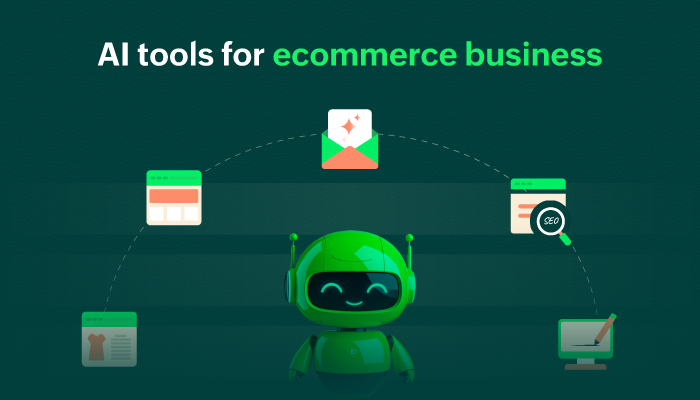
For ecommerce businesses, AI can be applied in many powerful ways, from content creation and marketing to design, customer engagement, and SEO optimization. This article will break down the main use cases of AI tools for ecommerce businesses and explain the best tools for each one.
Key benefits of using AI tools in ecommerce
Saves time: Automates repetitive tasks like product descriptions, emails, and support
Reduces costs: Minimizes the need for large teams or outsourcing
Boosts productivity: Lets you focus on strategy instead of manual work
Improves SEO: Helps generate optimized content and keyword suggestions
Enhances customer experience: Enables faster responses and personalization
Data-driven insights: Provides analytics for smarter decisions
Consistent output: Maintains uniform tone, quality, and branding across content
How to use AI tools for ecommerce businesses
Nearly every function can be automated with available AI tools for ecommerce businesses. That said, maximum impact comes from using the right tools for the right tasks.
The top use cases of AI in ecommerce are:
Customer support automation
Sales and performance analytics
Workflow and task automation
Creating content for marketing collateral
Product description generation
Personalized marketing campaigns
Inventory demand forecasting
Product recommendation engines
Dynamic pricing optimization
Fraud and risk detection
Search and discovery optimization
Top AI tools for ecommerce businesses (Classified according to use case)
Among the many AI applications, the most essential use cases have been compiled here. Two of the best AI tools for ecommerce business are highlighted in each category. These tools were tried, tested, and carefully filtered by our team.
Each tool is clearly explained, including essential information about its core function, key features, and pros and cons to help you make an informed decision.
Categories | AI tools recommended |
Product titles & description generation | 1. Copy.ai 2. Zoho Commerce's free product description generator |
Product/banner images creation | 1. Midjourney 2. Mockup Generator |
High-engagement email generation | 1. Anyword 2. Lavender.ai |
Social media content creation | 1. ChatGPT 2. Jasper.ai |
SEO-optimized content & blogging | 1. Surfer SEO 2. Frase.io |
AI tools to generate product titles & descriptions
Writing product description and titles is often a repetitive task that is heavily driven by product data. This makes it well-suited for AI automation. AI tools can process product details quickly and easily transform them into clear, consistent, and SEO-optimized titles and descriptions in large numbers.
1. Copy.ai
Specifically designed for sales content, Copy.ai is a native go-to-market (GTM) AI tool that helps online businesses create clear, engaging, and SEO-optimized product titles and descriptions for ecommerce listings.
Key features
Dedicated templates for product titles and product descriptions.
Instant generation for multiple title and description variations.
Custom tone selection (professional, casual, persuasive, etc.).
Bulk content generation for multiple products.
Pros and cons
Pros | Cons |
|
|
2. Zoho Commerce's product description generator
Among some of the best free AI tools for ecommerce is Zoho Commerce's product description generator. This is a completely free AI-powered tool that instantly creates SEO-optimized product descriptions. By using simple inputs such as the product name, target keywords, and preferred tone of voice, the tool automatically creates descriptions within seconds.
Key features
Instant AI-powered product description creation with no cost.
Copy generated with just the product name, keywords, and desired tone.
Multiple tone options (informative, promotional, persuasive, etc.) for tailored output.
SEO-optimized output to help visibility in search results.
Simple, form-based interface with no sign-up or complex setup needed.
Pros and cons
Pros | Cons |
|
|
AI tools for creating product/banner images
For any online business, having high-quality product visuals makes a big difference in their ecommerce website. Even without traditional product photography, businesses can now use AI image creation tools to generate product images, visuals, and promotional banners.
3. Midjourney
Midjourney is a powerful AI image-generation tool that can create visually striking product concepts, promotional imagery, and banner visuals for ecommerce websites. By generating high-quality images from simple text prompts, it allows brands to experiment with different styles, themes, and layouts.
Key features
Custom images generated from simple text descriptions.
Images can be created in multiple artistic styles and visual variations.
Prompts can be adjusted for preferred lighting, composition, and mood.
Supports upscaling and refinement of generated images.
Community prompt libraries are present for ecommerce use cases.
Pros and cons
Pros | Cons |
|
|
4. Mockup Generator
With Mockup Generator, you can automatically generate product mockups with pedestrian text descriptions or images. From product and apparel mockups to frames, phones, and laptops mockups, it offers extensive creative flexibility at no cost.
Key features
AI-generated product mockups from text or simple inputs.
Includes a huge variety of mock-up styles.
Options are available to adjust backgrounds, angles, and display settings.
Generates a professional mock-up within 30 to 60 seconds.
Pros and cons
Pros | Cons |
|
|
AI tools to write high-engagement emails
Email marketing remains as one of the most effective channels for targeting and retargeting customers. While many AI tools can generate email content, tools that are specifically designed for email marketing can deliver far better results. By using these purpose-built AI email tools, businesses can improve open rates, click-through rates, and overall conversion performance.
5. Anyword
By connecting AI-generated content with real-world performance data, Anyword helps write emails and campaigns that actually convert. This AI tool generates high-engagement email copy, subject lines, and other marketing content while predicting conversion potential.
Key features
Predicts engagement and performance scores for email subject lines and body copy.
Tailors messaging to specific audiences based on behavior or demographics.
Provides ready-to-use templates for email campaigns, ads, and promotional content.
Supports multi-channel marketing copy (emails, social ads, landing pages).
Generates multiple variants to test different approaches quickly.
Pros and cons
Pros | Cons |
|
|
6. Lavender AI
Specifically designed for email content creation, Lavender AI can assist ecommerce businesses by improving email communication and response quality. By analyzing historic emails, this AI-powered tool understands what works for your team and drafts accordingly.
Key features
Ora, Lavender's new sales agent, writes engaging emails based on history.
AI suggestions improve the tone, clarity, and structure of support emails.
Personalization guidance using customer data creates more relevant responses.
Lavender's email coach scores emails or templates to ensure better content.
Pros and cons
Pros | Cons |
|
|
AI tools for social media content creation
From catchy captions to on-image visual copies, AI tools are widely used for producing diverse social media content. They enable online businesses to save time in ecommerce marketing by generating creative content while maintaining a consistent online presence.
7. ChatGPT
ChatGPT is a widely used AI-powered text generation tool that helps create all types of content. One of its greatest strengths is creating social media captions, post ideas, and comment responses that are engaging and creative.
Key features
Generates creative captions for posts across platforms (Instagram, Facebook, LinkedIn, etc.).
Suggests post ideas based on trends, niche, or brand voice.
Writes comment replies and engagement responses in a natural tone.
Can create multiple variations of captions for A/B testing.
Supports tone adjustments (friendly, humorous, professional, persuasive).
Pros and cons
Pros | Cons |
|
|
8. Jasper.ai
Jasper.ai is an AI-driven marketing and content generation tool that is built to help ecommerce businesses create persuasive copy and marketing collateral. This tool proves to be especially useful for marketing teams looking to speed up content production efficiently across multiple channels.
Key features
Template library for ads, emails, landing pages, blog posts, and product copy.
Brand voice learning and contextual memory for consistent messaging.
Long-form editor with AI commands for structured writing.
SEO integration with SurferSEO for optimized content.
Multi-language content generation and collaboration tools.
Pros and cons
Pros | Cons |
|
|
AI tools for SEO-optimized content & blogging
Publishing SEO-optimized content and blogs is a clear pathway for discoverability online. Especially for ecommerce businesses, it is highly important to create quality blog content that ranks well on search engines. AI tools can simplify ecommerce SEO by assisting with topic research, keyword integration, content outlines, and on-page optimization.
9. Surfer SEO
True to its name, Surfer SEO focuses on creating SEO-optimized content by analyzing top-ranking pages and data-backed SEO signals. Surfer SEO is especially useful for improving on-page SEO and provides actionable recommendations to increase the chances of ranking higher in search engine results.
Key features
An AI content editor that scores content based on on-page SEO factors.
Keyword and term suggestions derived from top Google results.
Real-time optimization feedback while writing blog content.
Content structure recommendations (headings, word count, paragraphs).
NLP-based analysis to match search intent.
Pros and cons
Pros | Cons |
|
|
10. Frase.io
Frase.io is an AI-powered content research and writing tool that is designed to help create search-intent-focused blog posts and SEO-optimized articles. This tool is especially useful for content planning, creating detailed outlines, and improving topical relevance.
Key features
Generates content briefs based on SERP analysis.
Identifies common questions, headings, and topics from search results.
Drafts SEO-friendly blog content.
Helps match content to user search intent.
Suggests internal topics and FAQs automatically.
Pros and cons
Pros | Cons |
|
|
How to implement AI tools in your ecommerce business processes?
Implementing AI tools in your ecommerce operations can be done in five simple steps:
Step 1: Define goals
Start by identifying key problems like cart abandonment, low conversions, or slow support. You can focus on using the aid of AI for these problems first.
Step 2: Audit your data
To use certain AI tools, you will need to feed in data about your business initially. So ensure you have essential information about your brand, products/services and unique selling propositions ready.
Step 3: Choose the right tools
Next, focus on choosing the right AI tools for the tasks you would like to automate. Since there are an abundance of AI tools for any task, consider their performance, cost and key features to choose the right one.
Step 4: Start small (pilot test)
Test AI on one simple cases like email marketing or product descriptions first. Then, slowly expand to using them for other tasks that can be carried out with minimal human intervention.
Step 5: Monitor & optimize
Finally, track the usage of your AI tools, if it is actually speeding up the process and is performing well. Based on what you observe you can decide whether to continue its usage or switch to another tool.
Closing thoughts
In 2026, neglecting AI tools simply means you are taking the harder path. AI has become an essential part of running a competitive ecommerce business in an increasingly digital marketplace.
For the key functions discussed in these use cases, you can use the AI tools mentioned to automate tasks without constantly worrying about errors or wasting your precious time. Overall, these tools help improve consistency and free up teams to focus on more crucial tasks.
Frequently Asked Questions
What are the best AI tools for ecommerce beginners?
Some of the best AI tools for ecommerce beginners are ChatGPT, Jasper.ai, Copy.ai, Surfer SEO and Frase.io.
Are AI tools worth it for small ecommerce businesses?
Yes, if used correctly, AI tools help in saving time on repetitive tasks like content creation or SEO, reduces hiring costs for writers/designers, and improves efficiency and speed.
How much do ecommerce AI tools typically cost?
Most AI tools offer limited free tiers which can be used for ecommerce beginners. Basic AI tools can be accessed from $9 to $30/month, mid-range tools from $30 to $100/month and advanced tools at $100+/month or custom pricing.
Can AI completely automate an ecommerce business?
No, AI can only automate certain tasks with an ecommerce business such as product descriptions, customer replies, email marketing, and basic SEO.
Are AI-generated product descriptions good for SEO?
Yes, AI can create SEO-friendly descriptions using keywords. It is best if these product descriptions are reviewed by humans for accuracy, uniqueness, and brand voice.
 Divyashree Durai
Divyashree Durai is a content marketer at Zoho Commerce, a key product within Zoho's finance suite. As the lead voice behind the platform's Academy blogs, she draws on extensive industry research and close collaboration with the product team to deliver practical, research-informed insights that support meaningful growth for online businesses. Her work spans a wide range of ecommerce topics, including digital selling trends, global market shifts, business strategy, and the core fundamentals shaping modern commerce.