- HOME
- Customer Experience
- The importance of reactive and proactive support in the modern world
The importance of reactive and proactive support in the modern world
- Published : April 6, 2026
- Last Updated : April 6, 2026
- 38 Views
- 5 Min Read


Imagine you open an app to complete something important, like submitting a form, placing an order, or setting up a new feature. Everything looks straightforward until suddenly something stops working. The page doesn't load, the payment fails, or the instructions are difficult to understand.
What do most people do next? They either search for help, open a support ticket, send a message through chat or email, or call customer service. After some time, a support agent responds and provides a solution. The problem gets resolved only after the customer has experienced confusion or frustration.
This is a common experience. You reach out for help, the organization responds, reacts by investigating the issue, and your problem gets resolved.
Now let us take a slightly different scenario. You open the same app and reach the exact confusing step, but this time, a small pop up note appears and explains clearly what you need to do. This is proactive customer support. Instead of waiting for the problem to appear and for the customer to reach out, the organization identifies the potential challenges at an early stage and provides assistance to the customers at the right moment when it is needed.
These two approaches, reactive and proactive, are both part of the foundation of modern customer service. Though they both do it in very different ways, both help customers succeed.
Reactive support remains the standard
The model that most people immediately recognize is reactive support because it mirrors how customer service operates traditionally. In the reactive model, support interaction begins from the time the customer initiates contact. When the customer notices something is wrong or they feel stuck, they reach out to the support team through a support channel, and the support team responds. The interaction focuses on identifying the problem, understanding the customer's situation and need, and provides a solution that resolves the issue as quickly as possible.
Most of the reactive interactions occur through channels such as email, live chat, phone calls, social media, messages or support portals. There are various reasons why a customer might reach out to support. The customer might report a technical issue, ask about a billing discrepancy, request help with account access, or seek clarification about how a feature works. The support team listens carefully, gathers relevant details, investigates the issue and guides the customer towards a resolution.
Reactive support is great for problem solving
Reactive support acts as a safety net which ensures the customers never feel left on their own when something goes wrong. Reactive support can build trust and reassurance when executed well. Customers always feel confident and reassured when they know there is someone who is there to take them out of the problem and guide them.
Another valuable aspect of reactive support lies in the insights it provides into real customer experiences. Every ticket, complaint, or support conversation reveals how customers interact with the entire product or service. Over time, slowly but steadily, patterns begin to emerge. Perhaps customers frequently struggle with a particular feature in a product, misunderstand a step in the onboarding process, or encounter a common error. These interactions and insights become a powerful source of feedback that the organization can use to improve their products, services and the entire process.
Reactive support is also relatively straightforward to implement. It is basic and does not require extensive or complex analytics to begin operating. Organizations mainly focus on building communication skills, responsive teams, and effective troubleshooting processes. For most companies, this makes reactive support the starting point to establish their customer service operations.
Limitations of reactive support
Reactive support cannot always meet customer expectations. Often the customer has already experienced a problem before the support team gets involved. The customer might have already spent time trying to figure things out on their own, going through various documentations or waiting for a response from the support team. Even if the issue is addressed quickly, the overall experience might still feel disruptive.
Another challenge emerges when similar issues occur repeatedly. Customers might contact the support team again and again with the same questions and problems. For support teams, this can create a constant flow of repetitive requests. As the customer base grows, the number of incoming tickets grows as well, placing pressure on support agents.
This is where proactive customer support begins to make a meaningful difference.
Proactive support adds value to the user experience
Proactive support shifts the mindset from responding to problems to preventing them. Instead of waiting for customers to reach out and report issues, organizations actively look for signals where customers might need help. These signals may come from customer behavior, product usage data, or patterns observed in past support interactions.
Once the potential challenges are identified, the organization steps in early to guide the customer. This guidance can take many forms. Customers may receive helpful notifications about delays or updates. Software platforms may provide onboarding walkthrough experiences that explain how to use key features. Knowledge base articles and help centers may answer common questions before customers feel the need to contact support.
Benefits of proactive support
Though proactive support often feel subtle, they play a huge role in shaping the customer experience. When customers receive assistance exactly when they need, the interaction feels smooth and effortless. Instead of facing obstacles and spending time searching for solutions, customers move forward confidently because the support system quietly removes the barriers along the way.
Proactive communication also plays a key role in building trust and loyalty. Customers often become frustrated not only when problems occur but also when they feel uninformed about what is happening. Timely updates about the order statuses, service interruptions, or upcoming changes reduce uncertainty and reassures customers that the organization is attentive and transparent.
Self-service resources are another important aspect of proactive support. Many customers prefer learning and solving problems independently rather than contacting a support team. A well-designed knowledge base, help center or tutorial library allows customers to find answers quickly and resolve issues on their own. This not only empowers the customers but also reduces the number of incoming tickets.
From the perspective of a support team, proactive strategies can transform daily operations. When common questions are addressed through documentation or early communication, support agents spend less time handling repetitive issues. This makes space and time for the support teams to focus on more complex issues which require deeper understanding.
Customers need both proactive and reactive support
Despite its advantages, proactive support does not eliminate the need for reactive support. No organization can predict every problem or difficult situation a customer might encounter. Unexpected problems, unique scenarios, and technical complexities will always arise. And when they do, customers want reassurance that they can reach a knowledgeable support agent who can help them resolve the issue.
Building an effective support system requires a balance of both the approaches rather than choosing one over the other. Reactive support ensures that customer concerns are addressed quickly and appropriately based on the situation and proactive support on the other hand works quietly in the background, identifying patterns and removing obstacles before those problems even reach the customers.
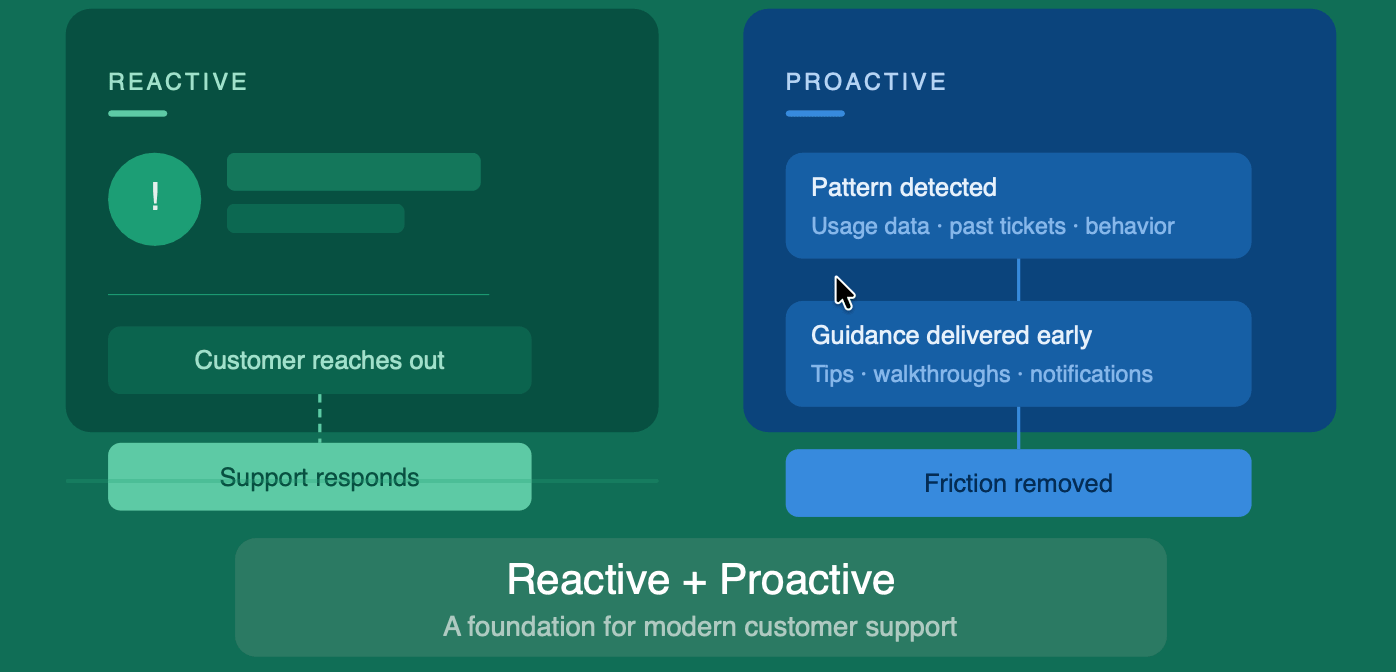
When these two approaches work together, customers encounter fewer disruptions because many issues are prevented before they occur. At the same time, they know help is always available when something unexpected happens. Support teams benefit as well, because proactive strategies reduce repetitive workloads and allow agents to focus on meaningful problem solving.
Organizations that embrace both perspectives can create a support system that does more than simply fix issues: It anticipates customer needs, removes friction from the experience, and ensures that help is always available when it truly matters.