

- HOME
- Expense Management
- Best Enterprise Expense Management Software: 6 Platforms Compared
Best Enterprise Expense Management Software: 6 Platforms Compared
Choosing the best enterprise expense management software requires more than automating expense reports. Large organisations need a platform that can manage spending across legal entities, enforce expense policies across countries, integrate with existing finance systems, and provide visibility into business travel and employee expenses.The right solution can help finance teams reduce manual work, strengthen compliance, improve spend visibility, and simplify expense reporting as the organisation grows. However, not every platform offers the same capabilities. Some focus on enterprise resource planning (ERP) integration, others prioritise travel booking or receipt capture, while some specialise in regional tax compliance.
This guide compares six enterprise expense management platforms: SAP Concur, Zoho Expense, Navan, Expensify, Emburse, and Rydoo. It examines their key capabilities, ideal use cases, and important considerations to help finance leaders make an informed decision.
What is enterprise expense management software?
Enterprise expense management software helps organisations capture, process, approve, audit, and report employee business expenses through a centralised system. It replaces manual spreadsheets and fragmented workflows with automated expense reporting, policy enforcement, approval routing, and accounting integrations.
For large organisations, enterprise expense management software typically needs to support:
Multi-entity expense management:
Separate policies, approval workflows, and reporting across subsidiaries and legal entities.
Global expense compliance:
Local tax rules, VAT requirements, per diem rates, and mileage policies.
Multi-currency transactions:
Expense reporting and reconciliation across currencies.
ERP and HR integrations:
Connected employee, financial, and accounting data.
Travel and expense management:
Business travel bookings linked to expense reports.
Audit and policy controls:
Automated checks, exception identification, and approval workflows.
Scalable administration:
Centralised oversight with flexibility for regional teams.
These requirements help distinguish enterprise-ready solutions from tools designed primarily for smaller teams.
6 best enterprise expense management software platforms compared
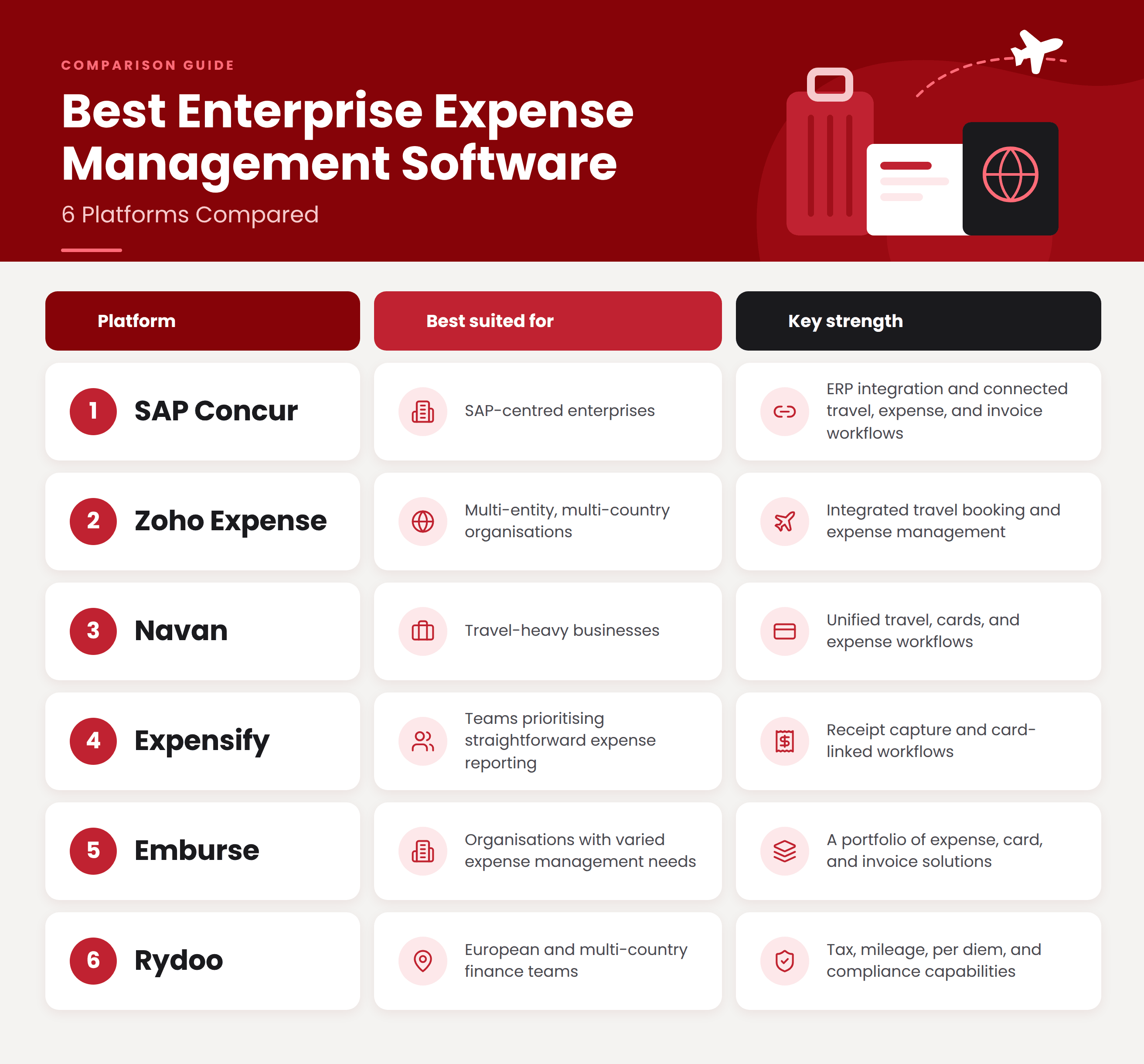
The following platforms serve different business needs. This is a comparison of their positioning and capabilities, not a universal ranking.
1. SAP Concur:
SAP Concur is a well-established option for large enterprises looking to connect travel booking, expense reporting, and invoice automation. Its integration with SAP ERP and broader partner ecosystem can make it a natural candidate for organisations already invested in SAP.The platform supports multi-currency expense processes and provides capabilities for country-specific tax requirements and VAT reclaim. Its App Center also offers connections to a broad range of third-party applications.
For global finance teams, these capabilities can help consolidate expense data and establish consistent processes across business units. However, implementation complexity, configuration requirements, and everyday usability should be evaluated against the needs of employees and finance administrators.
Key capabilities
1.Travel booking, expense reporting, and invoice automation.
2.Integration with SAP ERP and third-party applications.
3.Multi-currency expense processing.
4.Support for international tax and VAT requirements.
Best for:
Large multinational organisations that prioritise SAP integration and consolidated finance workflows.
What to evaluate: Implementation timelines, configuration effort, user experience, and the cost of maintaining complex workflows.
What to evaluate:
Implementation timelines, configuration effort, user experience, and the cost of maintaining complex workflows.
2. Zoho Expense:
Zoho Expense combines expense reporting with business travel booking, helping organisations manage two closely connected activities through one platform. Employees can book flights, hotels, and ground transportation, with bookings flowing into expense reports to reduce manual data entry.Its travel capabilities include policy checks during booking, unused airline credit tracking, fare-drop alerts for rebooking, and access to 24/7 travel agent support. These features can help finance teams improve travel policy compliance while giving employees greater visibility into their bookings.
Beyond travel, Zoho Expense supports multi-entity structures, regional data residency options, and integrations with ERP, HRMS, and accounting systems. It can be used independently of other Zoho applications, making it an option for organisations with mixed technology environments.Additional enterprise capabilities include APIs, more than 200 marketplace extensions, a named account manager, and 24/5 priority support with a one-hour SLA for enterprise customers, as described in the product information supplied for this comparison.IDC MarketScape named Zoho a Leader in AI-enabled travel and expense applications for 2025, according to the information provided for this article.
Key capabilities
1.Integrated business travel booking and AI native expense reporting.
2.Multi-entity expense management.
3.Policy checks during travel booking.
4.Inbuilt automatic mileage tracking at no extra cost.
5.ERP, HRMS, and accounting integrations.
6.Regional perdiem, data residency options and enterprise support.
Best for:
Multi-country organisations looking to connect travel bookings, employee expenses, and finance controls in one platform.
What to evaluate:
Country-specific tax localisation, data residency requirements, ERP integration depth, and the suitability of travel inventory in your operating regions.
3. Navan:
Navan combines business travel booking, corporate cards, and expense management in a unified platform. Its travel booking experience is designed to be familiar to employees, with corporate rates presented alongside public fares.
The platform also offers 24/7 travel agent support. Businesses can evaluate its card offering or determine whether their existing card arrangements can be accommodated.For organisations where business travel represents a significant share of employee spending, connecting bookings with expense workflows can simplify administration and improve visibility into travel costs.However, businesses should confirm card availability and functionality in each operating country. Organisations looking primarily for standalone expense reporting may also find that Navan's travel-focused approach is broader than their immediate requirements.
Key capabilities
1.Business travel booking and expense management.
2.Corporate card options.
3.Integrated travel and expense workflows.
4.Access to travel support.
Best for:
Travel-intensive businesses seeking a connected booking, card, and expense experience.
What to evaluate:
Geographic card availability, support for existing corporate cards, integration requirements, and the value of its travel capabilities for your organisation.
4. Expensify:
Expensify is known for SmartScan receipt capture, which helps employees record expense information without entering every detail manually. Its platform also supports the Expensify Card, multi-level approvals, and integrations with finance systems, with some capabilities dependent on the plan selected.Enterprise plans offer features such as dedicated account management and custom reporting. These capabilities can make Expensify a practical option for organisations seeking to simplify employee expense submission and reimbursement workflows.For enterprises with complex legal-entity structures, advanced jurisdiction-specific tax needs, or extensive consolidation requirements, it is important to validate whether the available functionality meets those requirements.
Key capabilities
1.SmartScan receipt capture.
2.Expense reporting and reimbursement workflows.
3.Card-linked expense processes.
4.Approval workflows and accounting integrations.
5.Custom reporting on eligible plans.
Best for:
Organisations that prioritise receipt capture and straightforward employee expense workflows.
What to evaluate:
Multi-entity reporting, tax localisation, approval flexibility, and integration depth.
5. Emburse:
Emburse brings together multiple expense management products that serve different organisational needs. Its portfolio has included solutions such as Emburse Professional, Emburse Enterprise, and Emburse Spend, alongside capabilities spanning corporate cards, virtual cards, and invoice automation.This portfolio approach gives organisations options when evaluating expense management requirements across different business sizes and workflows. Depending on the product selected, capabilities can include expense capture, approvals, spend controls, and accounts payable processes.However, buyers should assess the specific Emburse product rather than treating the entire portfolio as one uniform application. Interfaces, integrations, and functionality may differ across products.
Key capabilities
1.Expense capture and approval workflows.
2.Corporate and virtual card capabilities.
3.Spend controls.
4.Invoice automation across relevant offerings.
5.Solutions tailored to different organisational requirements.
Best for:
Organisations seeking an expense management solution aligned with their specific workflow and control requirements.
What to evaluate:
Product fit, integration compatibility, migration requirements, and consistency across the workflows you intend to deploy.
6. Rydoo:
Rydoo focuses on travel and expense management, with particular relevance for organisations managing tax and expense requirements across multiple countries.Its capabilities include tax, per diem, and mileage data for major European and North American markets. The platform also integrates with VAT recovery providers to help automate reclaim processes.
For finance teams managing expenses across multiple jurisdictions, these capabilities can help standardise policy enforcement and reduce the administrative effort associated with local compliance. Enterprise features include Smart Audit, advanced approval workflows, and SAML single sign-on. Policies and currencies can also be configured by legal entity or country.Rydoo's focused approach may suit organisations whose primary requirement is expense management and compliance. Businesses seeking a broader travel booking and corporate card offering should confirm the extent of the capabilities available to them.
Key capabilities
1.Tax, per diem, and mileage support.
2.VAT recovery integrations.
3.Smart Audit.
4.Advanced approval workflows.
5.SAML single sign-on.
6.Country- and entity-specific policy configuration.
Best for:
European and international finance teams that prioritise local expense compliance and VAT recovery.
What to evaluate:
Coverage in all operating countries, travel booking requirements, corporate card capabilities, and integration with existing finance systems.
How to choose the best enterprise expense management software
Selecting enterprise expense management software involves more than comparing feature lists. Finance leaders should assess how well a platform fits their organisational structure, compliance obligations, technology environment, and employee workflows.
Use these seven criteria to evaluate shortlisted vendors.
1. Multi-entity and multi-country support
Can the platform manage different legal entities, regional policies, currencies, and approval structures? Confirm whether finance teams can maintain central oversight while allowing local administrators to manage country-specific requirements.
2. Tax compliance and audit controls
Check how the software handles local tax rules, VAT, mileage, per diem, duplicate expenses, and out-of-policy transactions. Confirm which controls are automated and which require manual review.
3. ERP, HRMS, and accounting integrations
Review the integrations required to synchronise employee data, expense transactions, cost centres, and accounting entries. Validate whether integrations are native, partner-supported, or dependent on APIs and custom development.
4. Travel and corporate card capabilities
If employees travel frequently, assess whether bookings can flow directly into expense reports. Check card transaction feeds, reconciliation, unused travel credits, policy enforcement, and the availability of travel support in relevant regions.
5. Reporting and spend visibility
Evaluate whether the platform provides consolidated reporting across entities, departments, currencies, and expense categories. Finance leaders should be able to identify spending patterns, policy exceptions, and opportunities to improve cost control.
6. Data residency, security, and administration
For global organisations, data location and security requirements can influence vendor selection. Review available data residency options, access controls, single sign-on, audit trails, and administrative permissions against your organisation's policies.
7. Implementation, support, and total cost
Compare implementation effort, training, migration, ongoing administration, and support commitments alongside subscription costs. A platform that looks less expensive initially may require additional investment in integrations, customisation, or ongoing maintenance.
Practical tip:
Run a pilot using real-world scenarios, including a cross-border trip, a multi-currency expense, a policy exception, a reimbursement, and an expense submitted under a different legal entity. This will reveal workflow gaps that a standard product demonstration may not uncover.
Which enterprise expense management platform is right for you?
The right choice depends on the problem your finance team needs to solve.
Choose SAP Concur for evaluation if your organisation is built around SAP and needs connected travel, expense, and invoice processes.
Consider Zoho Expense if you want integrated travel booking and expense management, with support for multi-entity operations and global finance workflows.
Consider Navan if business travel is central to your expense management strategy.
Consider Expensify if simplifying receipt capture and employee expense reporting is the priority.
Evaluate Emburse if you need to match specific expense, card, and invoice workflows to an appropriate product in its portfolio.
Consider Rydoo if regional tax compliance, mileage, per diem, and VAT recovery are key requirements.
Before making a decision, shortlist two or three platforms and compare them using the same policies, integrations, entity structures, and reporting requirements.The most suitable enterprise expense management software is the one that fits your operating model, supports your compliance obligations, integrates with your finance systems, and gives employees and finance teams a manageable day-to-day experience.

Final thoughts
Enterprise expense management is no longer just about processing receipts and reimbursing employees. It involves connecting spending data, enforcing policies, supporting global operations, and giving finance teams better visibility into business expenses.The six platforms in this comparison address different priorities, from ERP integration and travel booking to receipt capture and regional compliance. By assessing each solution against your organisation's actual workflows, technology environment, and growth plans, you can build a shortlist that balances financial control, operational efficiency, and employee experience.
Disclaimer:
This article was prepared by Zoho using publicly available information and third-party sources, current as of October 2026. It is intended for general informational purposes and should not be interpreted as authorised or verified information from any vendor mentioned. All product and company names and marks remain the property of their respective owners. Features, pricing, and availability may change. Verify details directly with each vendor before making a purchasing decision. Zoho disclaims liability for errors, omissions, or consequential losses arising from the use of this information.
Frequently asked questions about enterprise expense management software
What is the best enterprise expense management software?
There is no single best platform for every enterprise. SAP Concur may suit SAP-centred organisations, Zoho Expense may suit businesses seeking integrated travel and expense management, Navan may fit travel-heavy companies, Expensify may suit receipt-focused workflows, Emburse offers a portfolio of expense solutions, and Rydoo focuses on travel and expense compliance. The best choice depends on your requirements and operating footprint.
What features should enterprise expense management software have?
Look for multi-entity support, multi-currency processing, configurable approval workflows, tax and policy controls, audit capabilities, ERP and HRMS integrations, consolidated reporting, and strong security controls. If employees travel frequently, integrated travel booking and corporate card management may also be important.
Why do large organisations need multi-entity expense management?
Large organisations often operate through subsidiaries or legal entities with different budgets, tax requirements, currencies, approval structures, and reporting needs. Multi-entity expense management helps centralise oversight while supporting the policies and processes applicable to each entity.
Can enterprise expense management software support multiple countries and currencies?
Many enterprise platforms support international operations and multi-currency expenses. However, support for currencies does not automatically mean comprehensive local tax compliance. Organisations should verify country-specific tax rules, VAT handling, mileage rates, per diem requirements, data residency, and reporting capabilities for every market in which they operate.
What is the difference between expense management software and travel and expense management software?
Expense management software focuses on recording, submitting, approving, auditing, and reimbursing business expenses. Travel and expense management software also connects business travel processes, such as booking flights and hotels, with expense reporting and travel policy controls. The exact capabilities vary by vendor and product plan.
How should enterprises compare expense management software vendors?
Enterprises should evaluate platforms against a consistent set of requirements: legal-entity structures, international compliance, integrations, travel and card capabilities, reporting, security, implementation effort, support, and total cost of ownership. A pilot using real workflows is more informative than comparing feature lists alone.
Is enterprise expense management software suitable for companies without a large finance team?
Yes. Organisations can benefit from automated receipt capture, approval routing, policy checks, and accounting integrations even if their finance teams are relatively small. The important considerations are implementation effort, administrative overhead, scalability, and whether the platform provides the controls the business needs.
 Satheesh KP
Satheesh heads global product marketing at Zoho Expense & Spend , a part of Zoho's Finance Suite. He has 17+ years of industry experience across multiple industries and regions. His areas of interest include technological advancements in finance, travel and expense management, spend management, and more.