

- HOME
- Inventory Management
- What is supply chain management (SCM)? Process, types, and examples
What is supply chain management (SCM)? Process, types, and examples
Supply chain management (SCM) is the planning and coordination of everything that moves a product from raw materials to the customer. When it works, customers get what they ordered on time, and the business is not stuck with too much or too little stock.
This guide covers how a supply chain works, the steps and the Supply Chain Operations Reference (SCOR) framework, the main supply chain models, how to measure performance, and where a small or mid-sized business should start.
Key takeaways
SCM runs in six stages: plan, source, make, deliver, return, and review and improve.
A supply chain runs on four flows: products, information, money, and returns.
Logistics is one part of SCM, not another name for it.
Perfect order rate, fill rate, inventory turnover, and cash-to-cash cycle time show whether it is working.
What is supply chain management?
Supply chain management covers the whole path a product takes from raw materials to the customer, in six stages: plan, source, make, deliver, return, and review and improve. The supply chain is the network of businesses involved. SCM is the work of running that network well, so each stage hands over to the next without delay or waste.
Supply chain vs. supply chain management
The supply chain is the set of businesses and steps a product passes through: suppliers, manufacturers, warehouses, distributors, retailers, and the customer.
Supply chain management decides how that chain should run and keeps it running to plan. No single company owns the whole chain, so much of the work is coordination between businesses: sharing forecasts with suppliers, agreeing lead times, and keeping stock in line with customer orders.
The term was first used publicly by consultant Keith Oliver in a 1982 Financial Times interview (NC State SCM Initiative).
How does a supply chain work? The four flows
A supply chain runs on four flows. Products move from suppliers toward customers. Information, such as orders and forecasts, moves in both directions. Money moves back from customers to suppliers. Returns, repairs, and recycling move products backwards. SCM keeps all four in step because a delay in one soon shows up in the others.
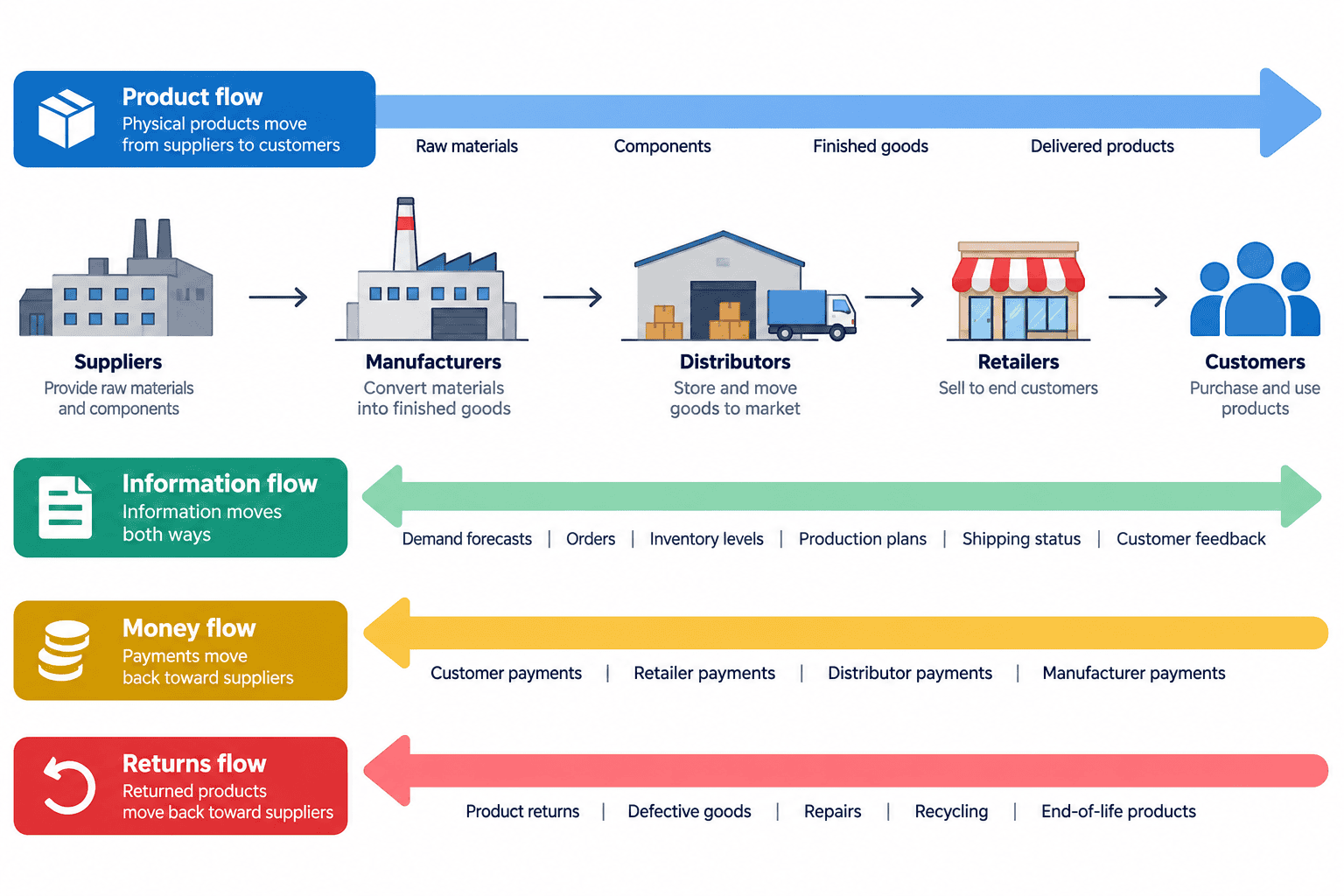
Products: raw materials, components, and finished goods move through suppliers, factories, warehouses, and stores. This is the flow most people picture.
Information: forecasts and purchase orders travel upstream to suppliers. Shipping notices, invoices, and delivery updates travel downstream. Without this flow, each business has to guess.
Money: customers pay retailers, retailers pay distributors, and payment works its way back to the raw material suppliers. Payment terms decide how long each business waits for its cash.
Returns: faulty, unwanted, or end-of-life products travel back for refund, repair, resale, or recycling.
The flows depend on each other. If a forecast reaches a supplier late, materials arrive late, the product ships late, and the customer pays late. Many supply chain problems start as a gap in information rather than a shortage of goods.
What are the steps in supply chain management?
Most businesses run supply chain management in six steps: plan, source, make, deliver, return, and review and improve. Planning sets demand and capacity, sourcing secures materials, making turns them into products, delivery gets them to customers, and returns bring some back. The steps repeat as a loop, so the last step feeds the next round of planning.
1. Plan
Forecast demand from sales history, seasonality, and known events, then work back through the operation. How much material is needed, and when must it be ordered? Is there enough production capacity, warehouse space, and staff to meet the forecast? Errors here carry into every later step.
2. Source
Choose suppliers on quality, reliability, lead time, and risk, as well as price, then buy and receive materials. Long-term relationships with key suppliers pay off during shortages, when suppliers decide whose orders to fill first.
3. Make
Schedule production, manage the flow of materials onto the line, check quality, and pack finished goods. The aim is steady output without bottlenecks. Businesses that resell rather than manufacture handle this step as kitting, assembly, or repackaging, or skip it.
4. Deliver
Store stock, take orders, then pick, pack, and ship them. This step covers warehousing, transport, and the position of stock across locations, so delivery promises can be kept.
5. Return
Accept customer returns, inspect them, and then restock, refurbish, repair, or recycle. Good returns handling recovers value and records why products came back, which points to quality or listing problems.
6. Review and improve
Measure performance against targets, find the causes of misses, and adjust plans, suppliers, or processes. This is a habit, not a one-off project.
How the SCOR model organizes the work
The Association for Supply Chain Management (ASCM) maintains the SCOR model, a widely used industry framework for describing supply chain work. Its current version names seven processes: orchestrate, plan, order, source, transform, fulfill, and return. Here is how the six steps above line up with them.
Step on this page | SCOR process | What it covers |
Plan | Plan | Forecasting demand and matching it with materials, capacity, and people |
Source | Source | Choosing suppliers, buying, receiving |
Make | Transform | Production, assembly, testing, packing |
Deliver | Order and Fulfill | Taking and pricing orders; picking, packing, shipping, and invoicing |
Return | Return | Customer returns, repairs, recycling, recalls |
Review and improve | Orchestrate | Business rules, network design, performance, risk, and technology across the chain |
Logistics and supply chain management: what is the difference?
Logistics is one part of supply chain management. Logistics moves and stores goods: transport, warehousing, and delivery. Supply chain management covers logistics plus forecasting, supplier selection, production planning, and returns, and it coordinates them across every business in the chain, not just one company.
| Logistics | Supply chain management |
Scope | Moving and storing goods | Planning and coordinating the whole chain, including logistics |
Main activities | Inbound and outbound transport, warehousing, delivery | Demand planning, sourcing, production planning, logistics, returns, supplier relationships |
Who is involved? | One business and its carriers and warehouses | Every business in the chain, from suppliers to customers |
Typical measures | On-time delivery, freight cost per unit | Perfect order rate, cash-to-cash cycle time |
The two terms are often paired, as in logistics and supply chain management courses and job titles, because the work overlaps every day. The difference is scope. A logistics team can run a warehouse well while the wider chain still fails, for instance, when a supplier misses a delivery.
What are the types of supply chain models?
Businesses usually follow one of six supply chain models: continuous flow, fast, efficient, agile, custom-configured, or flexible. The right one depends on how predictable demand is, how quickly products change, and whether customers care most about low cost or customization. Many businesses run different models for different product lines.
Model | How it works | Best for | Examples | Key advantage |
Continuous flow | Standardized products move through the same process with little variation. | High-volume, standardized products with stable demand | Car manufacturing, soft drinks, basic pharmaceuticals | Low unit costs through economies of scale |
Fast | Speed of response matters more than unit cost, because products have short lifecycles. | Fashion, electronics, seasonal products | Fast fashion retailers, smartphone makers, holiday decorations | First to market with trending products |
Efficient | Lean operations, with every step checked for cost and waste | Commodity products with price-sensitive customers | Generic medicines, basic food staples, office supplies | Lowest operating cost |
Agile | Adapts quickly to changes in demand, supply, or market conditions | Unpredictable markets, custom products, emerging industries | Specialized equipment, niche products | Rapid adaptation when conditions change |
Custom-configured | Each order may need different components, processes, or delivery methods. | Made-to-order, configurable, and personalized products | Industrial machinery, custom furniture, personalized jewelry | Meets specific customer requirements |
Flexible | Combines elements of other models, switching by product line or season | Businesses with varied product ranges or seasonal peaks | Large retailers, multi-brand manufacturers, seasonal businesses | A suitable approach for each product category |
The models describe priorities, not fixed categories. A business picks the one that matches what its customers value.
Push vs. pull supply chains
In a push supply chain, the business makes or buys stock to a forecast and pushes it toward customers. In a pull supply chain, work starts only when a customer order arrives. Push suits steady, predictable demand. Pull suits custom or fast-changing products.
Most businesses mix the two: they keep common components in stock and assemble or ship to order. Where the switch from push to pull happens is a design choice. The closer it sits to the customer, the faster the delivery and the more stock the business carries.
Why is supply chain management important?
Supply chain management decides whether customers get what they ordered, when promised, at a cost the business can sustain. Done well, it lowers costs, frees cash tied up in stock, softens the blow of disruptions, and keeps customers coming back. Done badly, it shows up as stockouts, late orders, and excess inventory.
Lower costs: When planning, sourcing, and production are coordinated, less money goes on rush freight, idle stock, and storage for products that are not moving.
More cash to run the business: Stock is cash sitting on a shelf. Holding less of it, collecting from customers sooner and agreeing longer supplier terms all shorten the time cash is tied up. Some businesses collect from customers before they pay suppliers, so day-to-day operations fund growth instead of draining cash.
Faster, more reliable delivery: A business that can see stock and shipments across the chain can promise realistic dates and keep them.
Customers who come back: Accurate stock and shipment tracking remove two common complaints: orders that go missing and items that are out of stock. Customers who can rely on a business tend to order again and recommend it.
Fewer surprises: Tracking risks such as single-source suppliers lets a business act before a problem reaches customers.
What it means for each team
Finance: less working capital tied up in slow-moving stock, lower storage and carrying costs, and more cash available for growth.
Operations: fewer late deliveries and stockouts, and less time spent firefighting, so the team can work on longer-term improvements. Clear data also shows which supplier, product or location is causing the delays.
Leadership: a supply chain that keeps service high and costs stable becomes a reason customers choose the business. It also turns supplier relationships from one-off transactions into partnerships.
Supply chain management examples
The three businesses below run very different supply chains. Each one focuses on the stage where it is most likely to fail.
Illustrative example: an online skincare brand
An online skincare brand sells on its own website and two marketplaces from one warehouse. Its biggest supply chain risk is selling the same units twice. So it keeps one stock count across all three channels. It sets reorder points that allow for its slowest suppliers, so late deliveries do not cause stockouts. The measure it watches most is fill rate.
Illustrative example: an industrial parts distributor
An industrial parts distributor stocks 2,000 items from 40 suppliers. It uses ABC analysis, which ranks items by their share of revenue, to hold more safety stock for the few items that drive most of its sales. It reviews supplier lead times every quarter and moves orders away from suppliers that keep slipping. The measure it watches most is on-time in-full (OTIF) delivery, because its customers' own work depends on it.
Illustrative example: a sweets manufacturer
A sweets manufacturer sells most of its output in the festive season, so it follows a flexible model. Ahead of the peak, it builds stock of raw materials and packaging and runs extra shifts for six weeks. Because the products have a short shelf life, it ships the oldest batches first. The measure it watches most is inventory turnover, since stock that sits too long cannot be sold.
In each case, the business picked the measure that matches its biggest risk and built its routines around it.
How do you measure supply chain performance?
Supply chain performance is tracked with a handful of key performance indicators (KPIs): perfect order rate, on-time in-full delivery, fill rate, inventory turnover, cash-to-cash cycle time and supply chain cost as a share of revenue. Together they show whether orders arrive right, whether stock moves, and how long cash stays tied up.
Measure | How to calculate it | What it tells you |
Perfect order rate | Orders delivered complete, on time, undamaged and with correct documents ÷ total orders × 100 | How often everything goes right |
On-time in-full (OTIF) | Orders delivered on time and in full ÷ total orders × 100 | Delivery reliability |
Fill rate | Units shipped from stock on the first shipment ÷ units ordered × 100 | Whether stock covers demand |
Inventory turnover | Cost of goods sold ÷ average inventory | How fast stock moves |
Cash-to-cash cycle time | Days inventory outstanding + days sales outstanding − days payable outstanding | How long cash is tied up |
Supply chain cost | Total supply chain cost ÷ revenue × 100 | Whether the chain is affordable |
Illustrative example: a business holds stock for 45 days, collects from customers in 30 days and pays suppliers in 40 days. Its cash-to-cash cycle time is 45 + 30 − 40 = 35 days. Every day taken off that cycle is a day less of cash tied up in stock and unpaid invoices.
Start with two or three measures that match your biggest risk. Calculate them the same way every month, so the trend means something. Perfect order rate is the strictest of the set, so for the same orders it can never be higher than OTIF.
What are the biggest supply chain challenges and risks?
The most common challenges are poor visibility beyond direct suppliers, manual processes, slow supplier communication and stock spread across too many locations. On top of these sit disruption risks: supplier failures, transport delays, sudden swings in demand, extreme weather, tariffs and geopolitical events.
Limited visibility beyond direct suppliers
Many businesses see only their immediate suppliers. When a problem hits a supplier's supplier, it arrives without warning. Partial visibility can be worse than none, because it creates false confidence. For critical items, mapping your key suppliers' own suppliers is a practical first step.
Manual processes
Spreadsheet stock counts, paper purchase orders and supplier updates by email add errors and delays at every step. They also keep staff on admin instead of planning.
Slow supplier communication
If forecasts, specifications and changes cannot be shared quickly, small problems grow before anyone acts. Data security concerns make some businesses reluctant to share, but working in isolation usually carries the bigger risk.
Stock spread across too many locations
The hard part is not counting stock but predicting what will be needed, when and where. Without one view of every location, one warehouse runs short while another holds surplus.
Disruption risk
Disruptions are now a planning input, not an exception. The usual defenses are a second supplier for critical items, safety stock sized to supplier reliability, and visibility of stock and shipments across locations. Each costs money, so businesses apply them to the items whose shortage would stop sales or production.
What technology supports supply chain management?
Supply chain management runs on software that records each step: inventory management, order management, purchasing, warehouse management, transportation management and enterprise resource planning (ERP). Small and mid-sized businesses usually start with inventory and order management and add the rest as volume and complexity grow.
Inventory management: stock levels, locations, reorder points, and batch or serial number tracking.
Order management:orders from every sales channel, through to shipment and invoice.
Purchasing: purchase orders, supplier records and goods received.
Warehouse management system (WMS): bin locations, picking, packing and warehouse labor.
Transportation management system (TMS): carrier selection, freight rates and shipment tracking.
ERP: finance, purchasing, production and inventory in one system.
When comparing tools, check three things: whether every module works from one stock record, whether it connects to your sales channels and accounting software, and whether it can handle more warehouses as you grow.
Inventory software such as Zoho Inventory covers the inventory and order layer: one stock record across warehouses and sales channels, with purchase orders, sales orders and shipments linked to it.
Where should a small or mid-sized business start?
Start where the pain is. For most small and mid-sized businesses that means stock accuracy and order fulfillment. Build one reliable record of stock across every location and sales channel, set reorder points for your key items, then track fill rate and on-time delivery before adding anything more complex.
Count, then connect: Do a full stock count, then make sure every warehouse, store and sales channel updates the same record. Most stock errors come from records kept in more than one place.
Set reorder points from real numbers: A simple reorder point is average daily sales × supplier lead time in days, plus safety stock. Start with the items that bring in the most revenue.
Review two measures monthly: Fill rate shows whether stock covers demand. On-time delivery shows whether customers get what you promised.
Widen the scope later: Once stock and orders are under control, move on to supplier performance, demand forecasting and returns.
Frequently Asked Questions
The classic five are plan, source, make, deliver, and return, the processes named in earlier versions of the SCOR model. They match the first five stages in this guide. ASCM's current SCOR model adds "orchestrate," renames "make" as "transform," and splits "deliver" into "order" and "fulfill."
A value chain is the set of activities inside one business that add value to its product, a concept introduced by Michael Porter in 1985. A supply chain spans every business that helps make and deliver the product.
Procurement is buying goods and services and managing suppliers. It is one part of supply chain management, which also covers planning, production, logistics, and returns.
Consultant Keith Oliver, in a 1982 Financial Times interview.
It is the ongoing work of finding what could interrupt supply, judging how likely and how damaging each risk is, and deciding which risks to reduce, transfer, or accept. Typical risks include a single supplier for a critical part, a congested port, or a sudden spike in demand. The aim is resilience, so customers stay supplied when something goes wrong.
No. Retailers, distributors, online sellers, and service businesses that hold supplies all run a supply chain, even if they do not make anything.
To meet customer demand at the agreed service level, at the lowest total cost, with as little cash tied up in stock as possible, while managing the risk of disruption.
A supply chain manager plans demand and supply, chooses and manages suppliers, coordinates production and logistics, and balances cost against service. Common certifications include ASCM's Certified Supply Chain Professional (CSCP), Certified in Planning and Inventory Management (CPIM), and Certified in Logistics, Transportation, and Distribution (CLTD).
Pay depends on the role, industry, and country. For the US, the Bureau of Labor Statistics (BLS) publishes current pay and job outlook for related roles in its Occupational Outlook Handbook, including the profile for logisticians and for purchasing managers.
Forecasting and basic data analysis, negotiation, a working knowledge of inventory and logistics, comfort with inventory or ERP software, and the ability to coordinate suppliers and internal teams when plans change.