

- HOME
- Multichannel Selling
- What is multi-channel ecommerce? Definition and benefits
What is multi-channel ecommerce? Definition and benefits
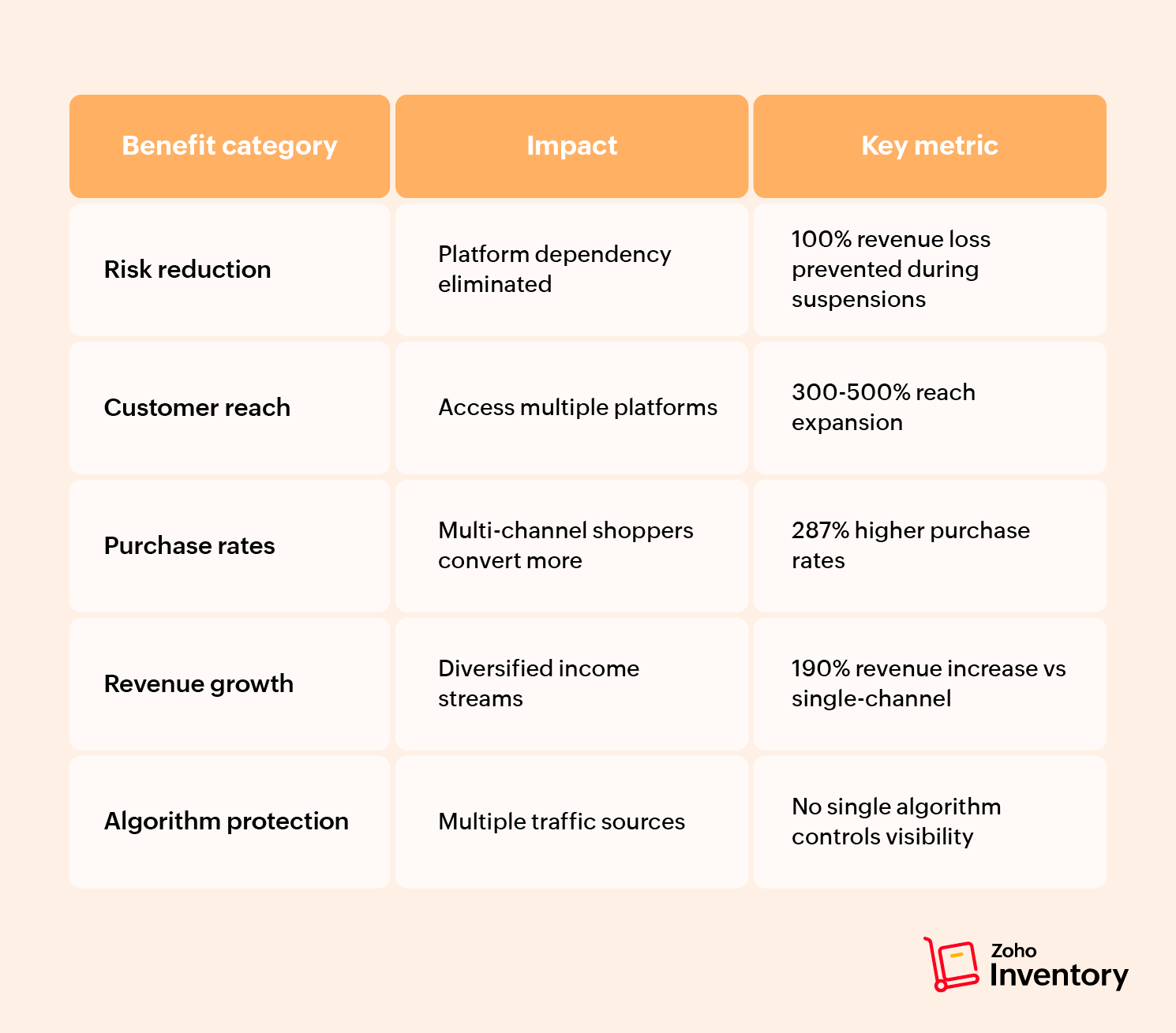
Multi-channel ecommerce means selling products through multiple sales platforms like Amazon, eBay, Etsy, and your own website, simultaneously with centralized operations managing inventory, orders, and customer data. Unlike single-channel selling that depends on one platform, multi-channel operations diversify revenue streams and protect against algorithm changes, policy updates, or platform outages.
Businesses using three or more channels see 287% higher purchase rates than single-channel sellers because customers can buy from their preferred platform.
Today, retailers sell across multiple platforms like Shopify, Etsy, Wayfair, and Amazon, because that's where customers expect to find them.
Harvard Business Review studied 46,000 shoppers and found 73% of customers use multiple channels before purchasing. Multi-channel presence meets customers where they already shop.
What is multi-channel ecommerce?
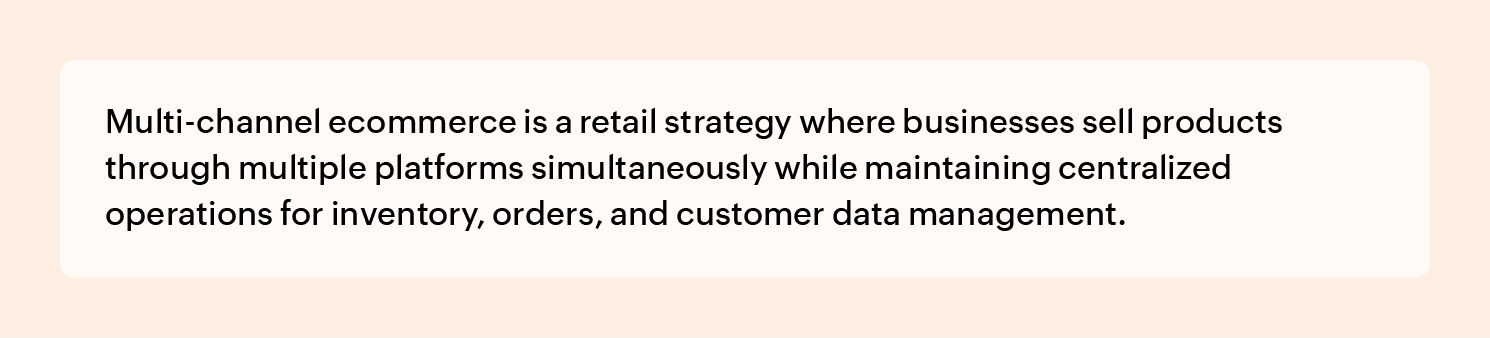
Think of multi-channel ecommerce as listing products on several platforms rather than relying on a single storefront.
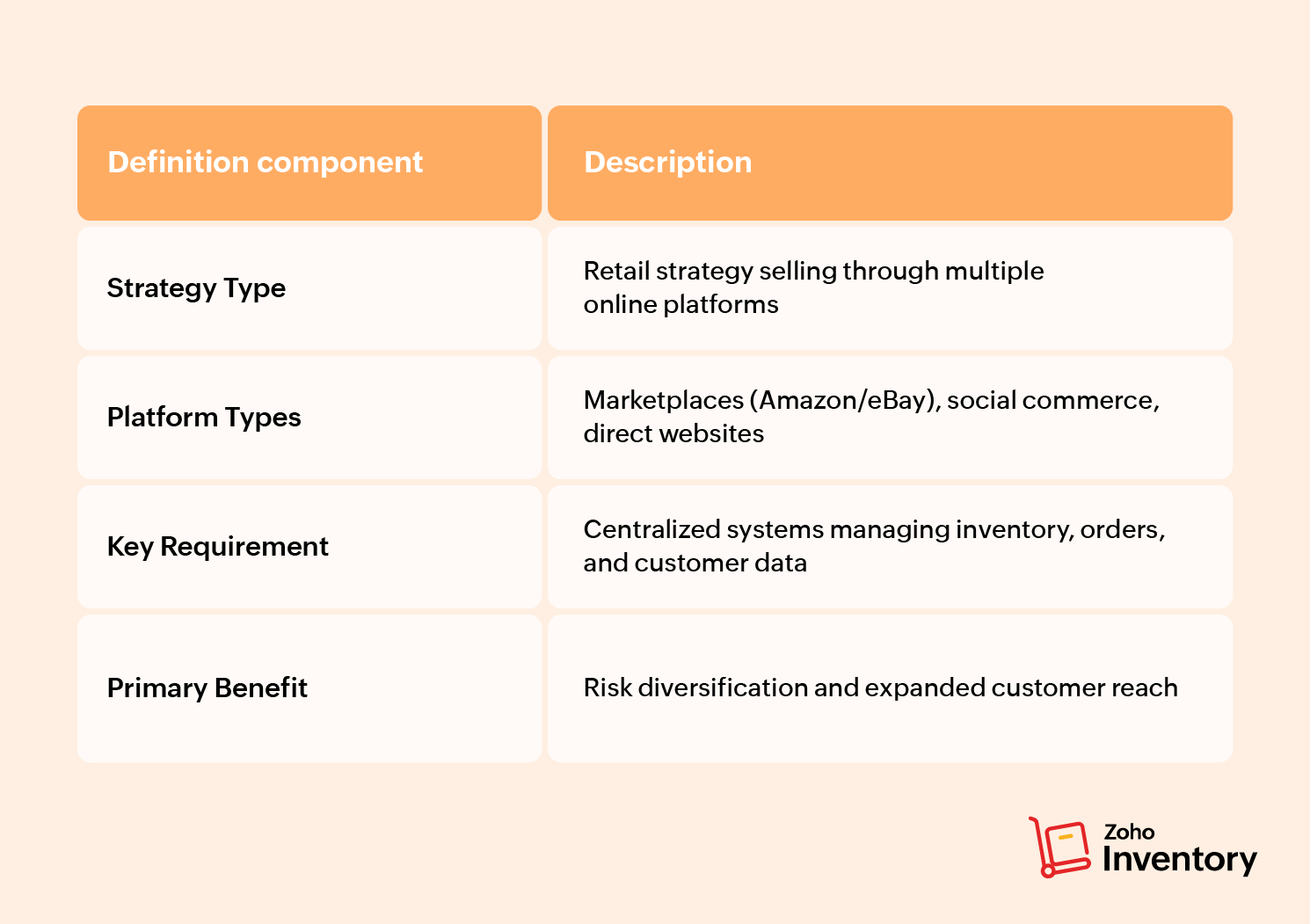
Core components of multi-channel ecommerce
What are the challenges in multi-channel selling?
Inventory tracking creates challenges
Here's where it gets tricky. When someone buys your product on Amazon, you need to decrement stock counts on eBay, Etsy, your website, and all other channels immediately.
Manual inventory management fails at three channels. Why? Humans make 12–18% data entry errors.
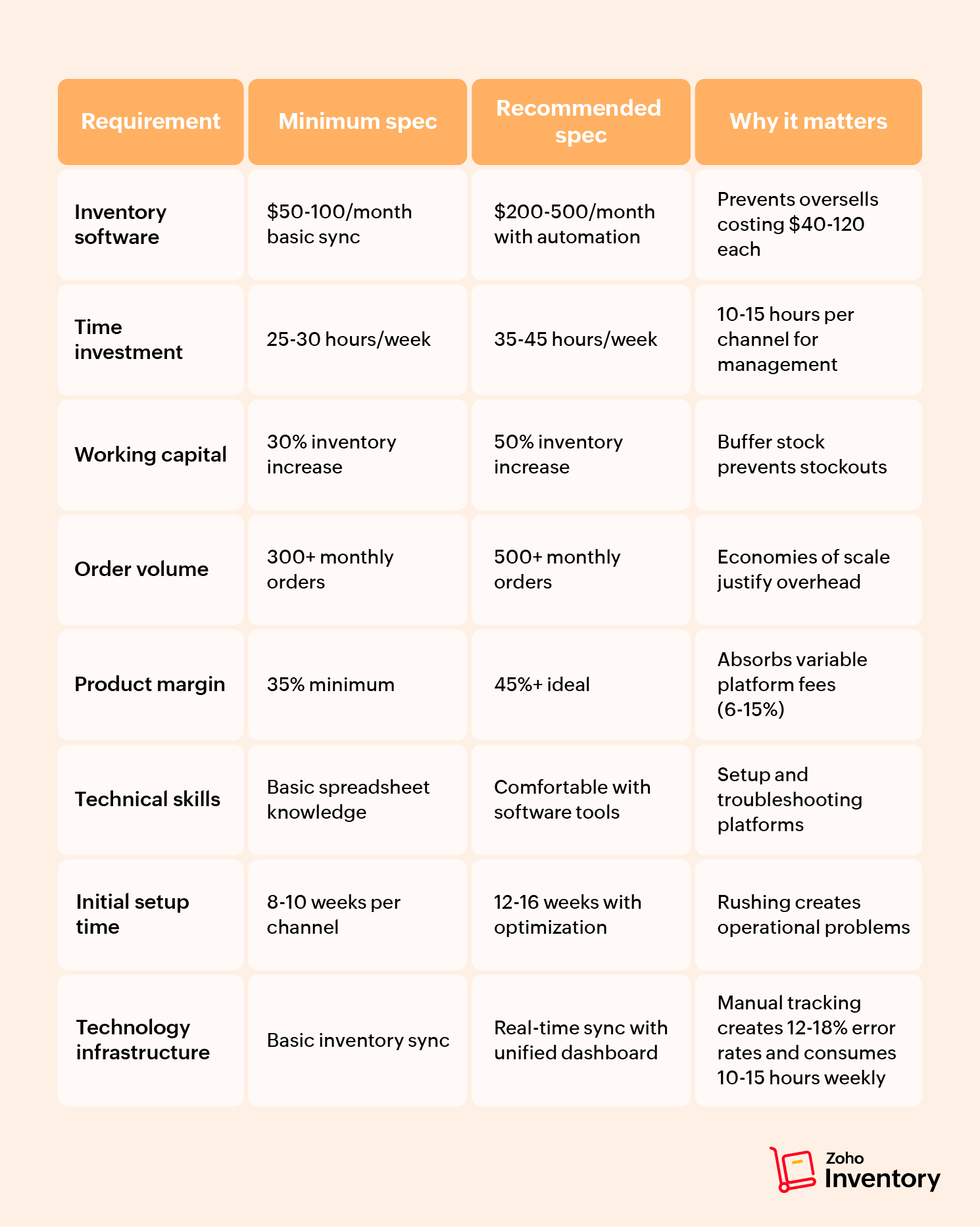
The math compounds quickly. Selling 5 units daily across 3 channels means 15 inventory updates are required. With manual processes, updates lag behind actual sales. This generates oversells that cost $40–120 per incident to resolve through expedited shipping or order cancellations.
Order fulfillment varies by platform
Each platform has different rules. Amazon FBA handles storage, packing, shipping, and returns. eBay requires self-fulfillment or third-party logistics. Etsy sellers typically ship from home. Your website might use dropshipping.
Managing four different fulfillment workflows simultaneously? That demands systematic operational processes.
Customer data fragments across platforms
Your Amazon customer isn't the same database record as your website customer. Even if they're literally the same person.
Amazon restricts seller access to customer email addresses and purchase history. This fragmentation prevents unified customer lifetime value tracking without middleware connecting systems.
Software solves synchronization
This is where automation matters. Solutions like Zoho Inventory provide real-time inventory sync across Amazon, eBay, Etsy, Shopify, and WooCommerce.
When one sale occurs anywhere, inventory decrements everywhere automatically. This prevents the 12–18% error rate from manual updates.
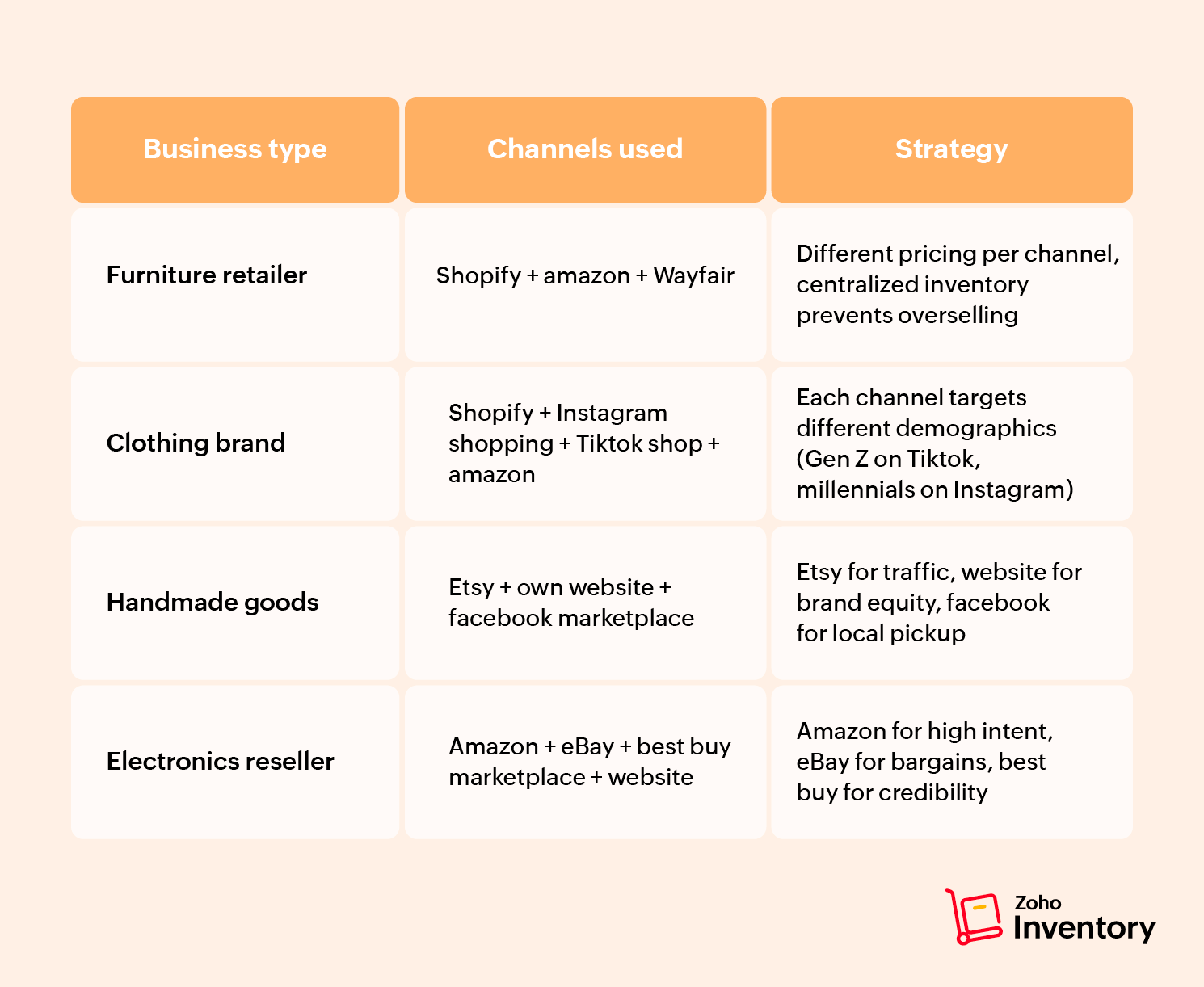
What are examples of multi-channel ecommerce?
Why use multi-channel ecommerce instead of single-channel?
Multi-channel ecommerce increases revenue by 190%, provides algorithm protection, eliminates platform dependency risk, and reaches 300–500% more customers than single-channel operations.
Why do multi-channel customers buy more?
Customers shopping across multiple channels demonstrate higher purchase intent. They're actively comparing options, researching products, and ready to buy. Meeting them on their preferred platform removes the final barrier to purchase.
Platform preference affects trust. A customer who has used eBay for 15 years trusts eBay's buyer protection. They're more likely to purchase from an eBay listing than from an unknown website, even if it's the same seller and product.
Is multi-channel ecommerce right for your business?
Multi-channel ecommerce works best for established businesses with stable single-channel operations generating $500K+ annually. The strategy requires 30–40% additional inventory investment, 15–20 hours weekly for 2–3 channels, and centralized inventory management systems.
Businesses under $100K annual revenue should master one channel before expanding. Multi-channel operations demand systematic processes, technical infrastructure, and operational capacity that new businesses typically lack. Build profitability on one platform first. Then expand strategically.
The decision framework depends on your current revenue, order volume, operational maturity, and whether you need omnichannel or unified commerce capabilities. If you're unsure whether multi-channel, omnichannel, or unified commerce fits your business size and revenue level, see our detailed comparison guide: Multi-channel vs omnichannel vs. unified commerce: which is right for your business?
Quick assessment
✅ Use multi-channel if you have a profitable single channel, $500K–2M revenue, 300+ monthly orders, and 3–10 SKUs, and are testing new platforms.
❌ Wait on multi-channel if you are a new business (<$100K) with negative margins, 100+ SKUs without systems, and no inventory automation.
What do you need for multi-channel ecommerce?
Requirements table: Multi-channel infrastructure needs
Conclusion: Building multi-channel success
Multi-channel ecommerce provides measurable risk protection and revenue growth for established online businesses. But those 287% purchase rate increases and 190% revenue growth numbers are not automatic.
You need centralized inventory systems, platform-specific pricing strategies, and systematic channel expansion.
Start with profitability on one channel. When you're consistently generating $500K+ annually with 300+ monthly orders, multi-channel expansion becomes viable. Add one channel at a time. Stabilize operations for 60–90 days. Then consider the next platform.
The investment in inventory automation (200–500/month) pays for itself by preventing oversells that cost $40–120 each. The 30–50% additional inventory investment protects against stockouts that fragment sales velocity. The 25–40 hours weekly operational commitment ensures each channel receives proper attention.
But for established sellers ready to diversify platform risk and expand customer reach? Multi-channel operations deliver measurable competitive advantages that single-channel businesses simply can't match.
Frequently Asked Questions
Multi-channel operations need coordination across separate platforms. You're not creating one Amazon listing that magically appears on eBay.
Each platform needs its own setup, individual product listings, separate accounts, distinct pricing strategies accounting for fee structures, and platform-specific marketing approaches.
Multi-channel ecommerce is profitable when properly implemented. Businesses see 190% revenue increases compared to single-channel operations, according to retail industry benchmarking.
The profitability breakpoint typically occurs at 500–1,000 monthly orders, where economies of scale offset additional operational complexity. Below 300 monthly orders, single-channel focus often delivers better margins because the overhead of multi-channel infrastructure exceeds revenue benefits.
Splitting existing inventory across channels is the most expensive mistake.
Here's what this looks like. You allocate 50 units to Amazon and 50 to eBay instead of showing 100 units on both platforms. You've artificially created scarcity everywhere, increasing stockout frequency by 300–400%.
The correct approach? Centralized inventory where all 100 units show available on all channels simultaneously. The system automatically decrements across all platforms when any sale occurs. This prevents the inventory fragmentation that causes one channel to show an item is out of stock while another channel has available inventory of the same product.
Proper multi-channel setup requires 8–12 weeks for one new channel. Here's the breakdown.
Two weeks for platform research and technology setup.
Four to six weeks to create optimized product listings.
Two weeks of initial inventory planning and allocation.
Then 60–90 days to monitor and optimize operations before considering additional channel expansion.
Businesses attempting to launch three or more channels simultaneously typically experience 40% failure rates due to overwhelming operational complexities.
The sequential approach works better. Adding one channel, stabilizing operations, and then adding another reduces failure rates from 40% to 10–15% while building systematic processes that scale.
Yes. Strategic multi-channel pricing accounts for platform-specific fees. Amazon charges 15% average referral fees plus FBA costs. eBay charges 12.5%. Etsy charges 6.5% plus payment processing.
A product that costs $20 with a 40% target margin requires different pricing. Given the aforementioned feeds, the Amazon price would have to be $40, the eBay price $38, the Etsy price $35, and your website price $34. Identical pricing across channels means variable profitability, sometimes negative margins on high-fee platforms.
Customers understand marketplace pricing varies. They're comparing within each platform, not across platforms. Platform-specific pricing protects margins while remaining competitive within each channel's pricing environment.
Manual spreadsheet inventory management fails at three or more channels. The reason is 12–18% error rates come from human data entry mistakes.
Multi-channel ecommerce operates separate, independent sales channels like an Amazon account, eBay account, website—all with siloed inventory and customer data.
Omnichannel ecommerce integrates the customer experience so shoppers can start on one channel and complete their order on another. For example, they can browse on mobile, buy on desktop, and return an item in-store—all with connected customer profiles.
For a complete comparison including unified commerce, cost analysis ($50–10,000/month range), and revenue-based recommendations, see our detailed guide: Multi-Channel vs. Omnichannel vs. Unified Commerce: Which is right for your business?
Channel selection depends on product category fit, not popularity.
Handmade goods perform on Etsy with 91.5 million buyers seeking unique items.
Electronics dominate Amazon with 310 million customers and high purchase intent.
Vintage and collectibles thrive on eBay with 32 million buyers and its auction format.
Fashion succeeds on Instagram Shopping thanks to visual discovery and impulse purchases.
Wholesale B2B belongs on Amazon Business.
The framework: Research where your product category performs best by checking bestseller ranks. Evaluate competitive density; avoid oversaturated categories. Calculate true profit after platform fees (15% on Amazon, 12.5% on eBay, 6.5% on Etsy). Start with the single best-fit channel before expanding. Add a second channel only after achieving profitability on the first channel.
Multi-channel requires 30–50% more inventory investment than single-channel operations. This isn't for splitting stock—it's for buffer stock preventing oversells.
Here's an example: A single-channel seller stocks 100 units. Adding Amazon plus eBay requires 130–150 units total. Why? Each channel has independent demand patterns. Website sales peak Mondays. Amazon peaks on Wednesdays. eBay peaks on weekends.
Without buffer stock across all channels, you're constantly shown as out-of-stock on one platform while the same product sits available elsewhere. This fragments sales velocity and triggers algorithm penalties for poor availability.
The additional 30–50 units serve as safety stock, absorbing demand variability across platforms. This prevents stockouts that cost two to three times more in lost sales than carrying costs.