

- HOME
- Multichannel Selling
- Multi-channel ecommerce best practices: 9 proven strategies for 2025
Multi-channel ecommerce best practices: 9 proven strategies for 2025
When most businesses try to launch on multiple platforms at once, the story usually starts the same way: a burst of energy, a feeling of “we can do this,” and then a slow drift into operational clutter.
The brands that manage to grow do not succeed by being everywhere. They grow by knowing when not to be everywhere. They build one channel until it feels predictable, and only then do they move to the next.
Ironically, revenue rarely causes the collapse. It is the fog around operations, the small mismatches, duplicated work, and unclear costs, that slowly drain margin until nobody can remember where the money went.
This guide breaks down nine practices that consistently help teams regain visibility and grow without burning out. Each explains why it works, how to implement it, and which metrics actually matter.
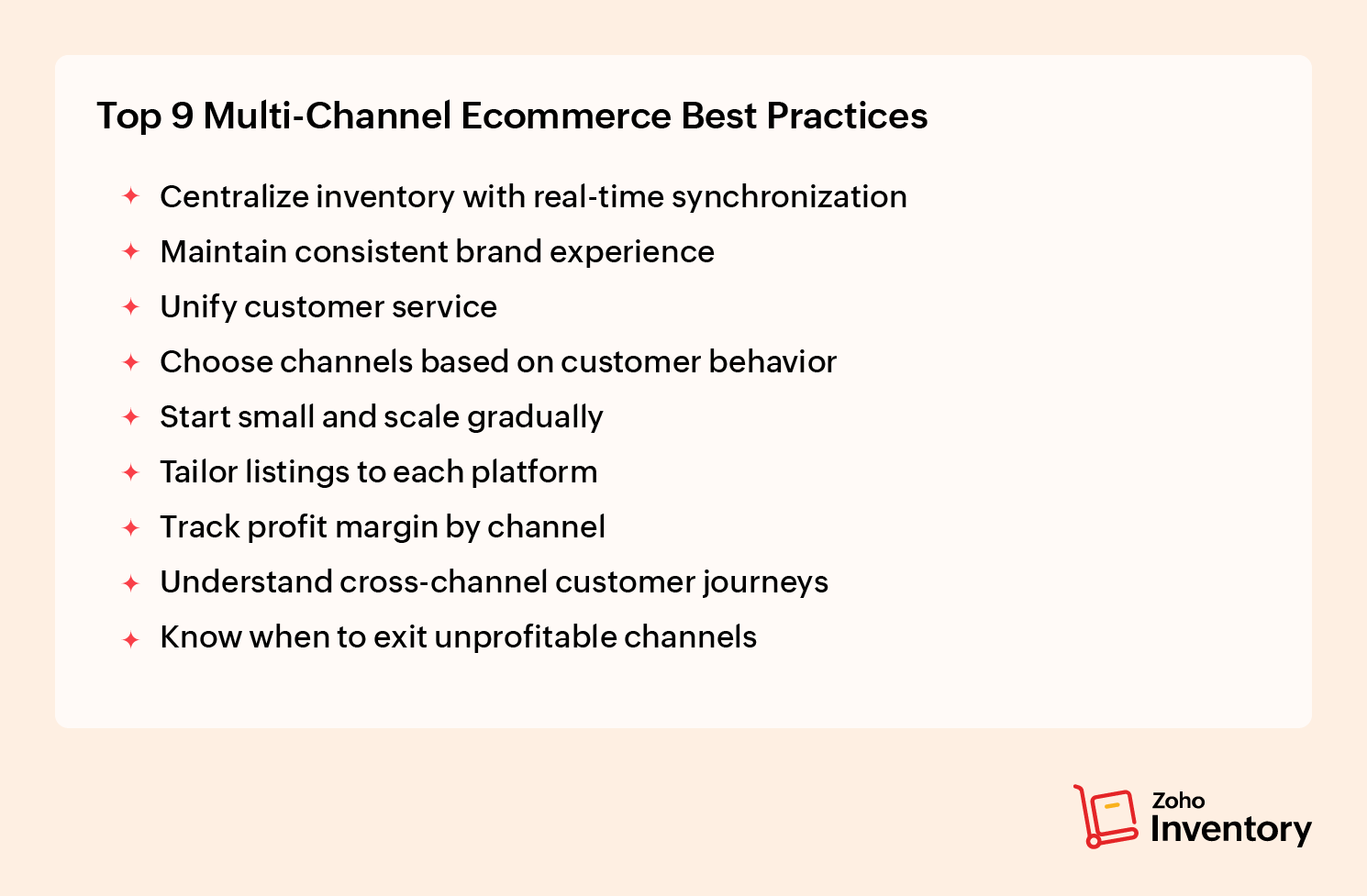
Begin with practices 1–4. They form the operational foundation. Expanding before these are in place usually leads to months of reactive firefighting.
1. Centralize inventory with real-time synchronization
Most businesses do not realize how fragmented their inventory really is until something breaks. Each sales channel operates on its own data, whether that is Amazon, Shopify, eBay, or your own website.When those numbers drift, even by a few hours, the impact spreads across your entire operation.
Imagine this: You sell a product on Amazon at 3:00 PM. However, your website still shows it as "In Stock" because the systems have not synced yet. A second customer buys the same item at 3:15 PM. Now you are forced to cancel an order, issue a refund, and potentially lose a customer you worked hard to earn. Some studies suggest that once customers experience a stockout, nearly 9 out of 10 will not return.
This is not a one-off problem. It creates three recurring challenges for every multi-channel seller.
1. Overselling across platforms
When inventory updates happen manually or on long sync cycles, your channels fall out of alignment. A single unit can appear twice, which leads to double-orders, cancellations, and poor ratings. For growing brands, this becomes an almost weekly occurrence.
2. Inefficient stock allocation.
To avoid oversells, many teams divide inventory. They assign 50 units to Amazon, 30 to their website, and 20 to eBay. It feels safe, but it is costly. One channel might sell out in days while another sits on unsold stock. you end up losing revenue on your highest-volume platform while inventory sits idle elsewhere.
3. Manual reconciliation that drains time
BEhind the scenes, someone inevitable spends 8 to 15 hours each week checking stock levels, updating spreadsheets, and shifting allocations. Over a year, that is more than 400 hours spent on maintenance instead of marketing, customer experience, or expansion.
Why centralization matters
When you centralize inventory, you stop dividing your stock into isolated buckets. Instead, you publish a single shared pool, for example 200 units, across every channel with a small buffer for safety. Every sale, no matter where it happens, updates the count everywhere else.
The results are both operational and financial.
Real-time synchronization updates all connected channels within minutes. A sale on Amazon automatically adjusts inventory on your website, on eBay, on Etsy, and on any other channel you sell through. Brands that move from manual tracking to real-time synchronization typically reduce oversell incidents by 90 to 95 percent.
Faster turnover reduces the cost of holding unused inventory. If you are holding 50,000 dollars worth of stock and carrying costs are roughly 25 percent annually, removing even two weeks of excess inventory frees up close to 480 dollars. Multiply that improvement across a full year and the savings scale quickly.
Automation replaces the repetitive reconciliation work that once consumed entire afternoons. The hours you save can shift toward optimizing listings, improving customer service, launching campaigns, or expanding into new markets. For many businesses, the time savings alone pay for an inventory platform within the first month.
Tools such as Zoho Inventory are designed to deliver this level of operational clarity. They eliminate manual updates, synchronize multi-channel sales, and give teams the freedom to focus on growth instead of data entry.
2. Maintain a consistent brand experience
Customers do not think in terms of sales channels. They think in terms of trust. If your product details or messaging look different from one platform to another, that trust starts to slip.
Consistency does not mean copying content word for word. It simply means keeping the facts stable. Measurements, materials, warranty terms, policies, and care instructions should match everywhere your product appears.
A typical shopper might discover you on Instagram, read specs on your website, and buy on Amazon. Along the way, they compare the information you provide. If the dimensions change, or the return policy looks different, or the material description does not match, they lose confidence. Customers are three times more likely to abandon the purchase and choose a competitor with clearer, more reliable product data.
Consistency makes life easier inside your business too. Customer service should not need to check where someone bought an item before answering a question. Fulfillment should not need different instructions for each channel. When product data and policies stay consistent, everything runs smoother. Training is simpler, responses are quicker, and errors drop.
People do not see an “Amazon version” of your brand and a “website version.” They see one company. When your voice and product quality feel the same everywhere, customers trust that their experience will be reliable no matter where they shop.That trust increases repeat purchases.
Your core message should stay the same, but the format can flex. Amazon benefits from clear, keyword-rich descriptions. Etsy rewards storytelling. Your website can go deeper with longer explanations. The facts stay consistent while the presentation fits the platform.
3. Unify customer service across every sales channel
Buyers expect the person responding to their message to know their order history already, regardless of where they purchased. When teams respond from separate inboxes, mistakes appear quickly.
You might send the website return policy to an Amazon buyer. Or a customer may ask for tracking updates that your support team cannot see because the order came through Instagram. It only takes one annoyed review to undo an entire week of good service.
A unified helpdesk fixes these blind spots. Bringing Amazon messages, DMs, website chats, and emails into one dashboard gives your team full context before replying.
Support staff can access the customer's complete purchase history, previous conversations across all channels, current order status, and past support tickets. This means they can provide faster resolutions without asking customers to repeat information. It eliminates conflicting answers because every team member sees the same data.
This increases customer satisfaction, builds brand trust because customers feel recognized rather than treated as ticket numbers, and increases overall efficiency because support teams resolve issues in one interaction instead of three.
4. Choose channels based on customer behavior
Expanding across platforms without strategy almost always leads to wasted effort. Strong brands usually operate on only a few channels, but they are the right channels.
Before entering a new platform, test it with four questions:
1. Do the audience demographics match your buyers?
Each platform attracts a different crowd.
2. Does your category perform well there?
Some categories thrive on marketplaces where others struggle.
3. Do the fees allow healthy profit?
A product that earns good margins on Shopify may struggle on Amazon because of fee structures.
4. Can your team reliably meet the platform’s operational standards?
Some require weekend replies or strict fulfillment windows.
If a platform fits all four, it is worth exploring. If it fails two or more, it often becomes a distraction.
5. Start small and scale only when you are ready
Most multi-channel failures happen because expansion occurs too early. A healthy channel operates predictably with tight inventory accuracy, fast shipping, responsive support, and proven product-market fit.
A sustainable path looks like:
Months 1 to 6: Perfect the first channel.
Months 7 to 12: Add a second channel slowly.
Months 13 to 18: Stabilize operations for both.
Month 19 onward: Add a third channel only if the first two run smoothly and profitably.
Christy Ng followed this pattern. She started with flea markets, then a website, then physical stores, and only later added more channels. Every new step came after the previous one felt stable.
6. Tailor listings to each platform’s personality
Copying the same listing everywhere is tempting. It also reduces visibility and conversion on almost every platform.
Every platform has its own style and its own search logic:
Amazon:
Shoppers come with intent. They want specs, bullets, and fast clarity.
Etsy:
Shoppers want story and craft. They want to know the human behind the product.
Instagram:
Imagery leads. Text only matters after the scroll stops.
Small changes to titles, photos, and tone can significantly improve ranking and sales.
7. Track profit margin by channel after all costs
Revenue alone does not reveal channel health. Even gross profit can be misleading. A channel might look successful while quietly draining cash.
Most teams track product cost and platform fees. Fewer track:
packaging
storage
advertising
customer service hours
returns
shipping surcharges
warehouse labor
When you include every cost, the real margin becomes clear.
A platform that consistently sits below 10 percent in true profit is not supporting your business. It is consuming your time and energy.
8. Understand how customers move across channels
Most customers do not see a product and buy it on the spot. They move across multiple devices and platforms before making a decision. A shopper might discover your product on Instagram, read the full details on your website later in the day, and eventually complete the purchase on Amazon because the checkout feels familiar and secure.
If you view these touchpoints in isolation, the data becomes misleading. Instagram appears weak, the website looks like it has abandonment issues, and Amazon looks like the clear winner. In reality, all three played a role in the conversion.
Many marketing and operational decisions depend on attribution data. If analytics tell you that Amazon generates 60 percent of revenue while Instagram drives only 5 percent, you will naturally invest more in Amazon. You might even cut Instagram advertising and shift the budget into Amazon sponsored products. The problem is simple. If Instagram actually introduces 40 percent of the customers who later convert on Amazon, reducing that spend cuts off the top of your pipeline. You end up optimizing the wrong channel.
Understanding the full customer journey shows where each channel truly contributes. It reveals which platforms build awareness, which ones drive consideration, and which ones close the sale. These are often three different places.
After mapping customer journeys, businesses usually discover insights such as:
Some channels deserve more investment even if they look weak in last-click attribution.
A channel that shows only 10,000 dollars in direct sales might influence 80,000 dollars in purchases on other platforms. If you cut that channel, you lose far more than the 10,000 dollars you expected.
Operational friction often explains abandonment more than interest levels.
Customers might browse on mobile and convert on desktop because the mobile checkout requires seven steps while the desktop version takes only three. Improving mobile conversion becomes a higher priority than increasing traffic.
Customers follow predictable patterns that you can design around.
If shoppers regularly discover products on Instagram, compare prices on Google Shopping, and buy on your website, you can tailor Instagram content to highlight value and differentiation rather than price. You already know price comparison happens later and somewhere else.
Once you begin mapping these journeys, many confusing metrics become clearer. You stop fixing surface-level problems and start shaping your strategy around how customers actually behave.
9. Know when to exit a channel
Not every platform is a match for your business. Sometimes a channel drains time, cash, or energy while delivering very little in return.
A channel should not be reconsidered if:
margin stays below 10 percent after improvements
the support workload is disproportionate
return rates stay high
the time invested produces very low financial return
Exiting frees up bandwidth. That time and money often deliver faster results when redirected to stronger channels.
Conclusion
Growing across multiple channels is not about showing up everywhere. The brands that last focus on operations first, choose channels intentionally, and expand only when the core is strong.
If you want a simple starting point:
Week 1:
Review where things break. Look at inventory sync issues, mismatched product information, and slow customer responses.
Weeks 2 to 4:
Fix those fundamentals before you try to expand.
After that:
Reevaluate each channel based on real profit. Remove what drains you. Double down on what works.
Then:
Optimize listings for each platform, and map the different journeys customers take before they buy.
If you are unsure where to begin, start with inventory. When stock updates cleanly across platforms, everything else becomes easier. Multi-channel growth has never required being everywhere. It has always required being excellent wherever you decide to show up.
Frequently Asked Questions
Centralizing your inventory with real-time sync.
It is the foundation every other best practice sits on. Businesses that rely on manual updates see mistakes, oversells, canceled orders, and support escalations. That easily drains revenue monthly in labor and penalties.
Automated systems cost a fraction of that and free 15–25 hours per week. Once inventory is stable, operations become predictable, and your team stops firefighting.
Keep the message consistent, and change the format. Your values, guarantees, quality standards, and product details stay identical everywhere. How you present them shifts by platform. Think of it like telling the same story to different audiences:
Amazon shoppers scroll fast; they need tight titles and bullets.
Etsy shoppers want craftsmanship, emotion, and backstory.
Instagram shoppers respond to visuals and a single strong opening line.
When core information is steady, optimization never creates inconsistency.
Only when your current channel is running smoothly with very little daily intervention.
A healthy channel hits these benchmarks:
On-time delivery
Faster customer service response
Greater inventory accuracy
Three consecutive months of profitability
Team bandwidth of at least 10–15 hours a week
Brands that expand before earning stability burn out fast. Brands that expand sequentially grow consistently.
Use a single helpdesk that pulls all conversations into one place. Whether a customer reaches out through Amazon messages, Instagram, email, or live chat, your team should see the same unified record: order history, past conversations, and current issues.
This creates faster answers, fewer handoffs, and the kind of personalized support customers remember. Businesses that adopt this approach routinely cut wait times by a third.
The ones that produce real profit, not just impressive revenue.
Calculate margin after every cost: fees, advertising, fulfillment, shipping, returns, packaging, and labor.
A channel doing $50K at a 36% margin often outperforms a $100K channel at 13%.
The goal isn’t to be everywhere. It’s to double down where profit per hour is highest.
A well-optimized channel should run 5–10 hours a week. Anything consistently taking 20+ hours is a sign of weak systems or poor automation.
Measure revenue per hour: Monthly Revenue ÷ (Weekly Hours × 4.33)
If that number drops below $1,000, you need to optimize—or consider exiting.
Exit when the numbers tell you the audience isn’t a fit. If the margin stays below 10% for three straight months after you’ve tried to optimize, it’s time to move on.
Common red flags include:
Return rates above 15%
Customer service load that outweighs revenue
Low revenue per hour invested
Persistent operational issues despite system improvements
Exiting isn’t failure. It’s resource reallocation. Many businesses grow faster after pruning the channels that drain them.
Create two layers of structure:
Brand Foundation Document: What must always stay the same:
product specifications
values
tone of voice
warranty, guarantees, returns
Platform Templates: How the same message is delivered:
Amazon: keyword-dense titles, white-background images, bullet points
Etsy: emotional titles, lifestyle images, backstory-driven descriptions
Instagram: strong opening line, lifestyle visuals, short captions
When you build from the same foundation, each listing can feel tailored while still clearly belonging to your brand.