

- HOME
- Multichannel Selling
- Multichannel vs. omnichannel: Which is right for your business?
Multichannel vs. omnichannel: Which is right for your business?
The choice between multichannel, omnichannel, and unified commerce comes down to three questions: How connected do your sales platforms need to be? Can your systems recognize the same customer across different channels? And how much delay can you tolerate in syncing inventory?
Most businesses evolve from multichannel to omnichannel and eventually to unified commerce as they grow. In fact, Harvard Business Review found that companies using omnichannel integration see customers spending 4% more in physical stores and 10% more online compared to those using multichannel systems.
The trade-off? While omnichannel solutions may cost $500–2,000 monthly versus $50–200 for multichannel tools, the return in engagement and sales often makes the investment worthwhile.
What is multichannel ecommerce?
Multichannel ecommerce means selling through multiple independent platforms like Amazon, eBay, Etsy, and your own website, where each channel maintains separate systems requiring coordination through synchronization software or manual processes. You manage distinct inventory allocations, separate customer databases, and channel-specific fulfillment workflows.
What is omnichannel ecommerce?
Omnichannel ecommerce integrates the customer experience so shoppers can move between platforms without friction. The system recognizes the same customer across touchpoints through connected profiles that identify your mobile browser, desktop purchaser, and in-store returner as the same person. Customer service sees the complete journey. Your email campaigns, abandoned cart messages, and personalized offers adjust based on what customers do across channels, not just isolated activity on one platform.
This integration creates flexible fulfillment options that multichannel can't support, such as:
Buy online, pick up in store
Buy online, return in store
Ship from store inventory
Reserve online for in-store pickup
Customers benefit from a unified order history regardless of where they shop.
Behind the scenes, achieving this work requires middleware technology that connects your platforms. Enterprise ecommerce platforms with marketplace integrations, plus customer data platforms (CDPs), form the backbone of this architecture.
For example, a sporting goods retailer allows customers to view real-time inventory across 12 store locations from the website. Shoppers can buy online and pick up their orders at a preferred store within a few hours or return items at any branch without a receipt thanks to unified records.
What is unified commerce?
Unified commerce achieves complete operational integration through a single platform managing all channels with real-time synchronization under five seconds. A single source of truth means one unified system where inventory, customer, and order data updates instantly across all channels. Every sale, return, or interaction syncs in real time, eliminating delays, oversells, and data silos.
Any order can be fulfilled from any location. Any channel accepts returns. The technology runs on a single platform with API-level integration: one database, one inventory count, one customer record, one order management system.
A specialty electronics retailer with warehouse locations in four regions processes orders based on customer proximity. The system automatically routes each order to the nearest fulfillment center with available inventory. When inventory runs low at one location, the platform redistributes stock during the next replenishment cycle based on regional demand patterns.
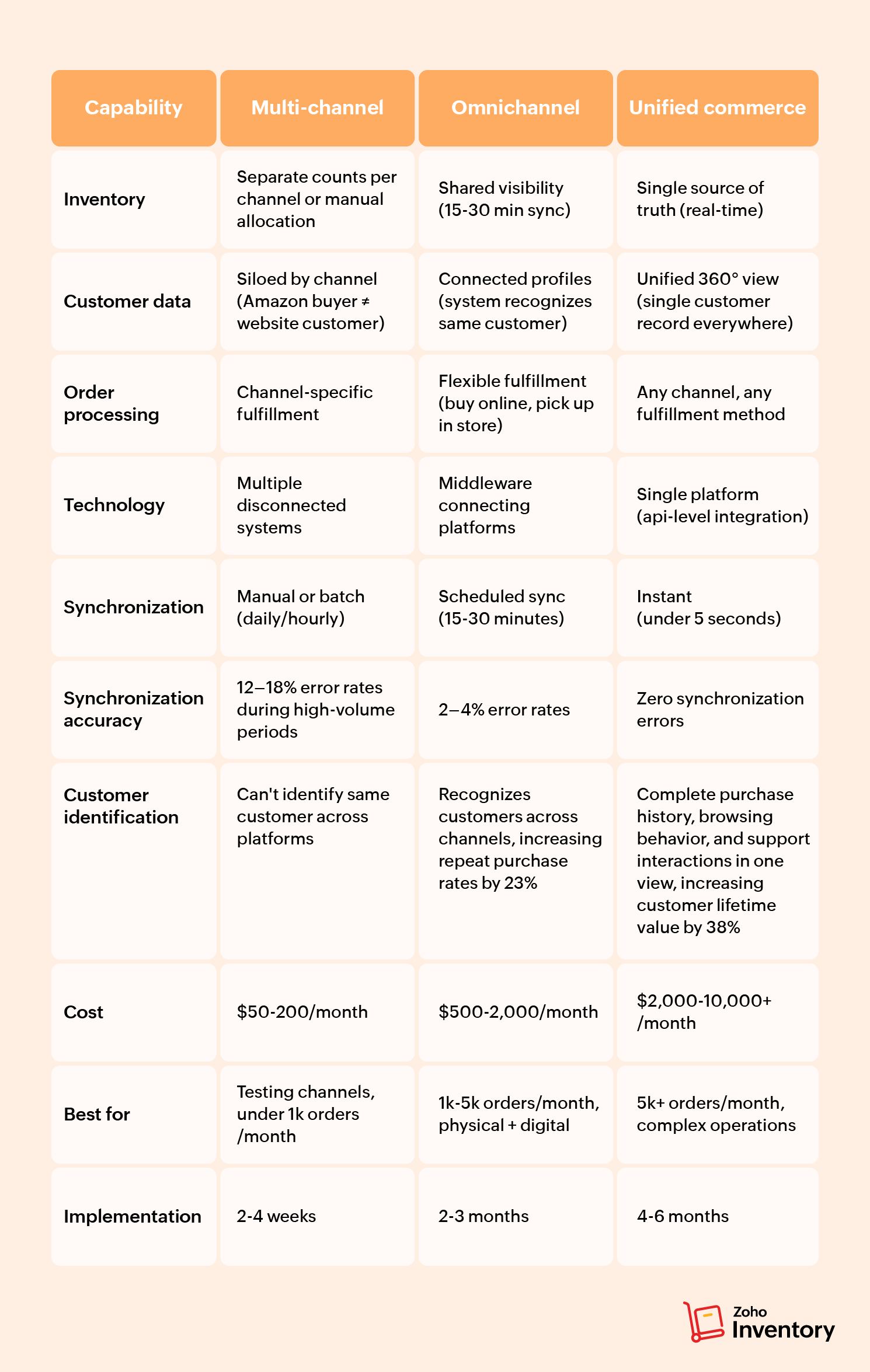
Comparison: Multichannel vs. omnichannel vs. unified commerce
Cost analysis: Multichannel vs. omnichannel vs. unified commerce
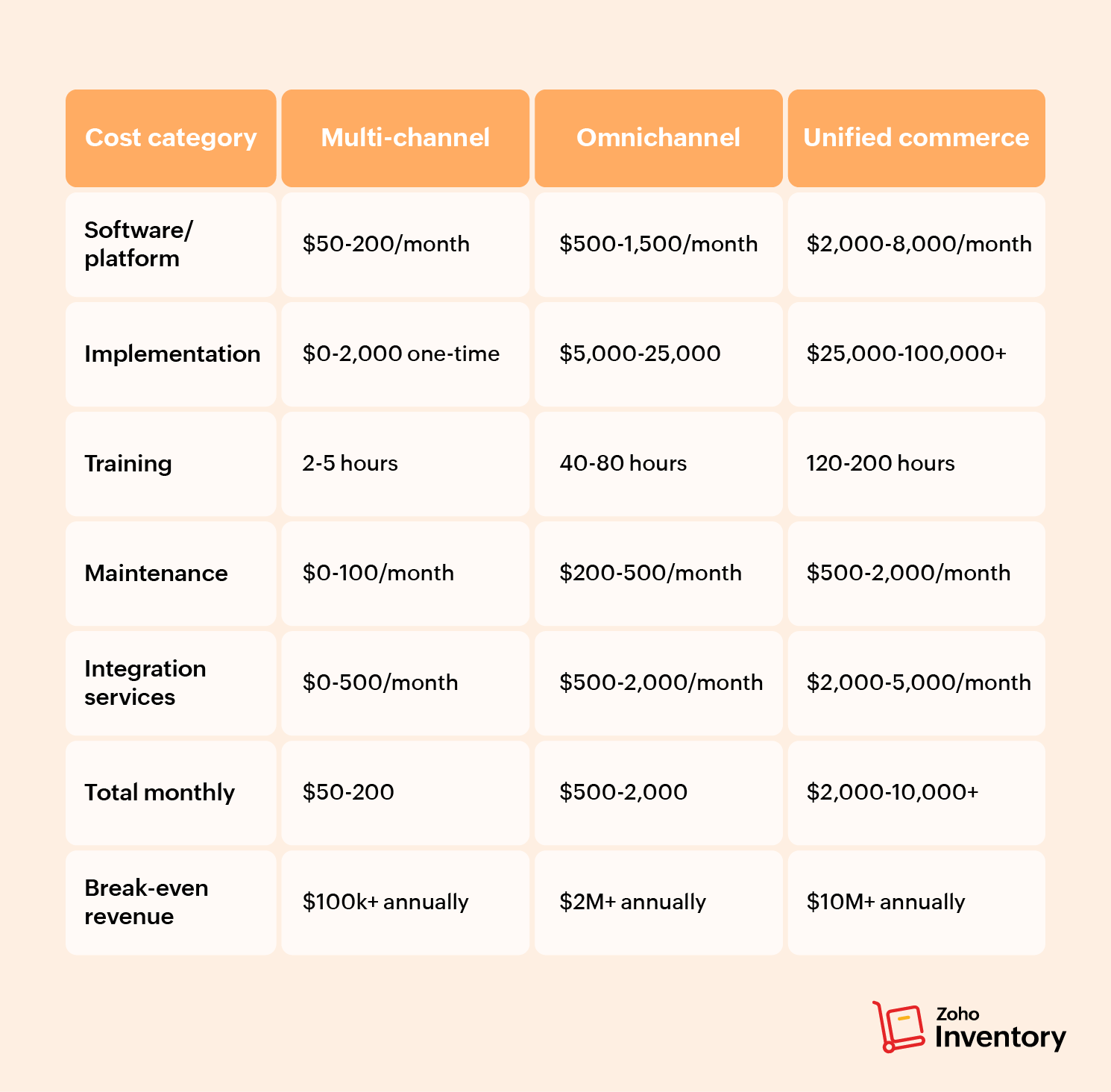
Hidden costs by model
Multichannel hidden costs: Manual labor consumes 10–15 hours weekly for updating inventory and reconciling orders. Overselling affects 2–4% of orders at $40–120 each in resolution costs. Stock fragmentation causes 5–8% revenue loss from items showing unavailable on one channel while sitting in another channel's allocation. Customer service complexity increases inquiry time by 15–20% because representatives need to check multiple systems.
Omnichannel hidden costs: Change management requires three to six months of staff training. Process redesign affects fulfillment workflows, return policies, and inventory allocation. Customer service retraining covers unified systems and flexible fulfillment options. Technology dependencies mean more complex integrations create more potential failure points requiring technical support.
Unified commerce hidden costs: Platform lock-in creates major migration efforts if switching providers. Customization needs emerge because enterprise requirements often need development work beyond standard features. Ongoing optimization requires dedicated staff for system management. Scale requirements mean the system may be overkill for smaller operations, paying for capabilities they don't use.
Choosing your commerce model
Your commerce model should reflect how your business actually operates, not how much revenue you hope to generate. The choice usually comes down to three questions: How complex is your order volume? What do your customers expect? And do you have the infrastructure to support deeper integrations?
Start with multichannel when you are testing and diversifying
Multichannel is the easiest place to begin when you are still figuring out which platforms fit your products. Handmade sellers often find that Etsy’s 91.5 million buyers convert better for unique pieces. Electronics sellers tend to perform well on Amazon because shoppers arrive with clear purchase intent. Vintage and collectible items continue to thrive on eBay thanks to its auction-driven culture.
The beauty of this stage is the low risk. You can test two or three platforms, see what gains traction, and quietly drop the channels that do not pull their weight. Seasonal brands often lean on this approach. Holiday ornaments may explode on Etsy during Q4 but sell at a steady pace through Amazon. Valentine’s jewelry peaks on Etsy early in the year while maintaining predictable website sales. Each platform follows its own seasonal rhythm, and together they stabilize your revenue across the year.
Multichannel also works well when you already have one strong channel and want to reduce platform dependence before anything goes wrong. A single algorithm change or fee update can disrupt your entire revenue stream. Adding a few channels spreads the risk.
At the same time, multichannel is not for everyone. New businesses often need every spare hour for sourcing, product development, and customer feedback. Spreading themselves thin across too many platforms slows down early momentum. Businesses with poor margins should fix their unit economics before expanding. Losing money on three channels is still losing money. And brands with very large catalogs should stabilize listing workflows on one platform before tripling the operational load.
Move to omnichannel when customers begin asking for cross-channel experiences
The timing for omnichannel has nothing to do with hitting a revenue target. It starts when customers begin asking for things your current setup cannot support. When someone wants to buy online and pick up in-store, or return a website order at a physical location, or check in-store availability before driving over, you have crossed the threshold. These moments are your indicators that customers expect a unified experience.
The revenue uplift from omnichannel usually comes from the convenience you unlock. Buy-online-pick-up-in-store, better return flexibility, and real-time stock visibility all tend to increase average order value and repeat purchases. For most retailers, this increase covers the platform investment within a few months.
However, omnichannel only makes sense when you have both a physical and a digital presence at meaningful scale. A purely online business cannot take advantage of the fulfillment flexibility that drives the uplift. For online-only brands selling across marketplaces, a well-automated multichannel setup still delivers stronger ROI than full omnichannel integration.
Adopt unified commerce when your scale requires real-time accuracy
Unified commerce becomes necessary once your volume reaches a point where delays cause real damage. A business processing thousands of orders per day across multiple channels cannot afford even a few minutes of inventory lag. The small delays that are acceptable in an omnichannel workflow turn into oversells, customer frustration, and support overload at high volume. At that point, you need a single system that updates inventory, orders, and fulfillment decisions instantly.
The investment only makes sense at significant scale. Real-time systems prevent massive stockout losses for high-volume operations, which justifies the higher monthly cost. For smaller businesses, omnichannel integration is usually sufficient because the risks are lower.
Unified commerce also makes sense for businesses with operational complexity even if their revenue is not massive. Manufacturers juggling multiple warehouses need real-time allocation. Brands selling to both B2B and B2C customers need precise pricing and terms. High-value electronics sellers with limited inventory cannot risk any synchronization errors.
Most companies move through these stages naturally as their systems start to crack under growth. Businesses that struggle tend to move too early and overpay for capabilities they are not ready to use, or they wait too long and force customers to work around outdated processes. The safest path is simple: choose the model that solves the problems you are facing right now, not the one that simply sounds the most advanced.
Frequently Asked Questions
The technical difference separates the two at the system integration level. Multichannel uses disconnected systems requiring synchronization software. Each platform maintains separate inventory counts and customer databases. Omnichannel uses middleware connecting platforms for unified experiences. The system recognizes customers across channels and provides flexible fulfillment options like buy online, pick up in store.
Upgrade when you reach $2M+ annual revenue with 1,000+ monthly orders and have both a physical and digital presence. The trigger happens when customers start asking for cross-channel capabilities or when stock fragmentation causes 5%+ lost sales from items showing out-of-stock on one channel while available on another. See the decision framework section for complete analysis.
Unified commerce provides more advanced technology with real-time synchronization under 5 seconds versus omnichannel's 15–30 minute sync. But "better" depends on business needs and scale. Unified commerce only makes financial sense at $10M+ annual revenue with 5,000+ monthly orders. For businesses under $10M, omnichannel provides sufficient integration with a better ROI.
You can technically skip multichannel and implement omnichannel directly, but it's rarely advisable. New businesses should build profitability on one channel before expanding. The omnichannel investment of $5,000–25,000 setup plus $500–2,000 monthly doesn't make sense until generating $2M+ annually. Multichannel lets you test platforms, develop operational processes, and prove channel ROI with a lower investment of $0–2,000 setup plus $50–200 monthly.
Multichannel requires basic inventory synchronization software like Zoho Inventory, connecting two to five sales channels with hourly or daily sync. The technology stack includes your eCommerce platform (Shopify, WooCommerce), plus marketplace accounts (Amazon, eBay), plus sync middleware.
Omnichannel requires middleware platforms like Shopify Plus, BigCommerce Enterprise, or Adobe Commerce, connecting all touchpoints with 15–30 minute sync. Add customer data platforms, unifying customer profiles. The technology stack includes an integrated commerce platform, plus CDP, plus marketing automation, plus unified analytics.
Physical plus online retailers should use omnichannel at a minimum once reaching $2M+ annual revenue. Customers expect cross-channel capabilities at this scale: buy online, pick up in store; buy online, return in store; check in-store inventory online; and unified loyalty programs. Multichannel treats online and physical as separate operations where customers can't return online purchases in stores and inventory doesn't sync. The 14% spending increase from omnichannel integration comes primarily from physical plus online convenience.
Switching from multichannel to omnichannel requires customer data migration and unification. You deduplicate customers by identifying that Customer A on Amazon equals Customer B on your website. Then, migrate the order history and establish an ongoing sync. The process takes two to four weeks for data cleanup and migration.
Switching from omnichannel to unified commerce involves platform migration from connected-but-separate systems to a single source of truth. You consolidate databases, rebuild integrations, and retrain staff. The process takes three to six months depending on data volume.
Downgrading proves harder. Going from omnichannel back to multichannel means losing customer unification and flexible fulfillment. Going from unified to omnichannel or multichannel risks operational disruption. Platform lock-ins increase with integration depth.