- HOME
- Work Culture
- From policy to everyday practice: Building a data governance framework
From policy to everyday practice: Building a data governance framework
- Last Updated : July 23, 2026
- 172 Views
- 6 Min Read

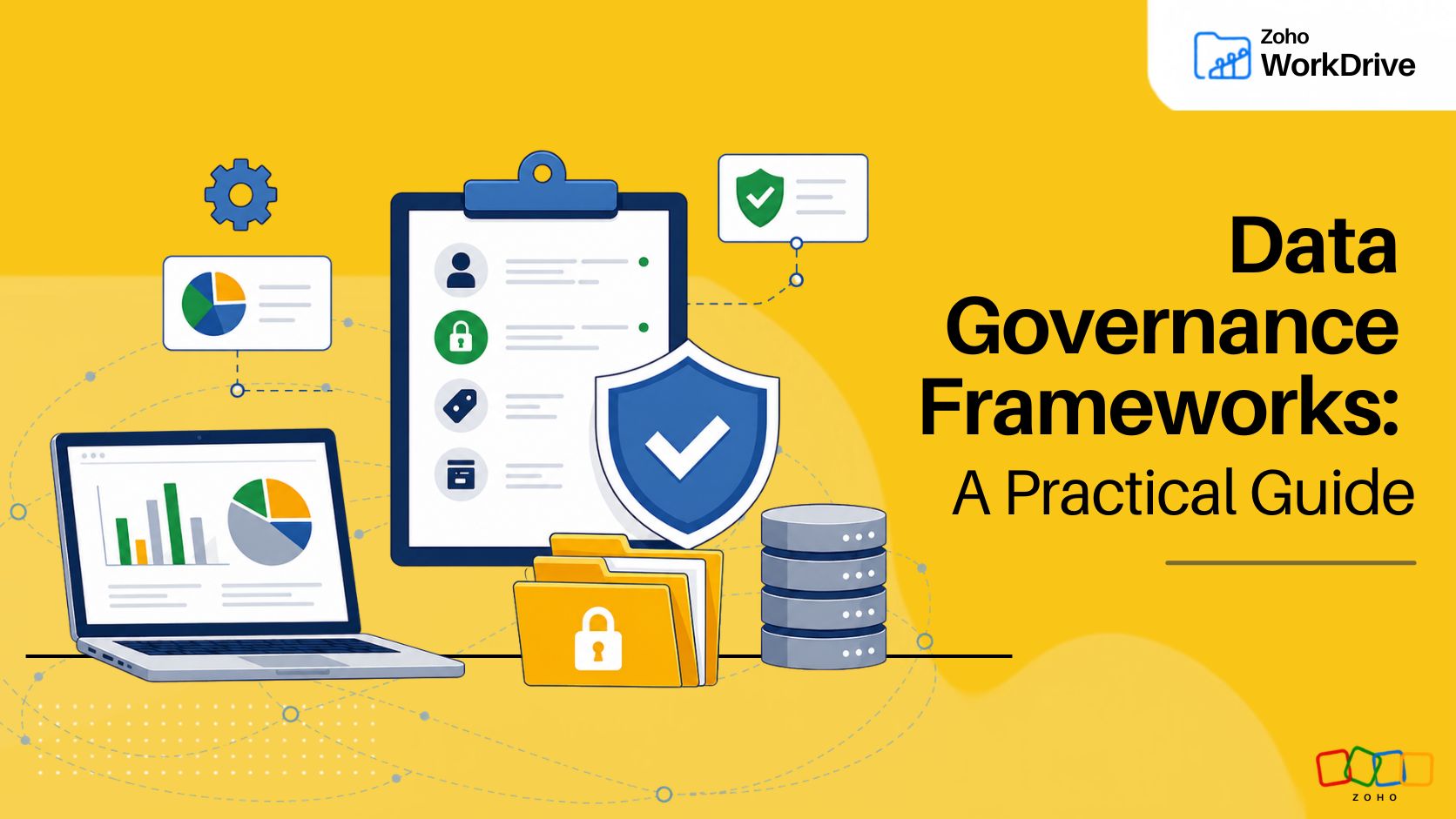
Data is the single most important resource that a business holds—and the compliance aspect is a major part of that. In any modern workplace, data security and compliance content can work together effectively only if the setup is practical and connected with a practical workflow.
Imagine a Friday deadline, where a teammate shares a client contract but with the wrong email address. Imagine if an old version of a policy gets approved by mistake. These are not hacking incidents. They are visible governance gaps. A strong data governance framework is built to deal with these issues at various levels.
Welcome to another blog post by Zoho WorkDrive, where we will dive deep into what a data governance framework is, its necessary components, and how to operate it effectively without stalling the team's productivity.
What is a data governance framework?
A data governance framework is a set of structured policies and processes that defines how an organization collects, classifies, stores, and deletes data. In other words, this framework turns the organization's security and compliance goals into repeatable, auditable actions. This helps the right people to reach the right data.
Why data governance frameworks matter now?
The volume of data that enterprises use today is compounding at a faster rate than ever seen in history. Managing all this data comes with its own dependencies and risks. Regulations like GDPR and HIPAA carry real penalties, and we can see that the customers are increasingly treating data handling as a buying criteria. But the real problem lies deep. As collaboration spreads across departments, and different tools, the actual ownership blurs. An example of this can be a question of which version of a contract was signed by a client or who approved the latest changes.
Data governance answers such questions before they become incidents. A framework prevents these incidents before they scale. For an enterprise, this is the difference between passing an audit seamlessly and scrambling through one.
Core components of a data governance framework
A strong data governance framework stands on five component pillars. Interconnected between these pillars are the individual aspects that can be applied to any team structure.
Ownership and roles
Every data domain needs an accountable owner, and clearly defined data contributors. The named owner will regulate the statutes and policies, and will be the individual directly responsible for enforcing them.
Data classification
Data varies in all levels, and not all data is equal. Tagging the data as public, internal, confidential, or restricted will allow admins to streamline the process of applying controls. This allows an admin to define access, sharing, and retention permissions with respect to individual team members, or specific files. If executed properly, this data classification can also help turn raw file data into actionable business intelligence that your teams can readily use.
Access and permissions
Classification specifies what your data is; the access and permissions determine who it is for. The guiding principle is to deliver access only as required for the role, so that a marketing coordinator is able to work on campaign assets, but never on a payroll spreadsheet.
Audit and accountability
Governance without a policy is just a suggestion. An audit trail is the unchangeable record of who accessed, modified, moved, or deleted a file, which turns a policy into a provable practical record. To put in simple terms, the rule of thumb is "if you can trace it, you can govern it".
Lifecycle and retention
While there are multiple policies that deal with protection of data, there is also a need to set up policies for the deletion of data. Because data isn't meant to live forever. Every file has an arc that starts from creation, moves through usage, and eventually reaches archival and then disposal. The governance is what gives the rules to that arc. For example, defined retention periods keep records exactly as long as the regulation or business need demands.
How to build a data governance framework
Building a data governance framework doesn't need a long program to start. You can utilize this framework even if you have years of business data. Here is a sequence of six steps that works for both a five-person team and a five hundred-person enterprise.
1. Map your data
Start by identifying the data you hold, where it lives, and how it moves between departments and tools. Governance policies can only protect your organization when it's applied to the right content. So this discovery phase becomes the foundation layer of the framework.
2. Classify the data
Segregate the data based on sensitivity. This helps in building a useful taxonomy of files, which assists in the creation of a well-performing system. The clear classification leads to understandable downstream control from access to retention.
3. Assign ownership
A framework with no owner is just a document, not a system. To build a system, accountable data owners and corresponding contributors need to be assigned and their responsibilities need to be articulated properly. This turns policies into commitments and gives actionable rules to every person who enforces them.
4. Set access and sharing rules
Define who can view, edit, and share the files, and how external sharing is handled. The rule here is to define the least required access for each role and provide additional permissions only if needed. This tightens how links are shared, and clarifies when and whether they expire.
5. Enable audit trails
Every meaningful action must be logged. Whenever a user accesses a file, makes edits to it, moves it to a different location, or deletes it, a document management system (DMS) with a strong audit logging capability strengthens the governance framework with a provable memory. Ensure the logs are immune to changes and easily exportable. This makes the software ready for an audit or a security review anytime.
6. Review and iterate
A governance framework is a living system. Roles change, data grows, and yesterday's rules slowly require changes to match how teams work today. Scheduling regular reviews of permissions, stale data, and policy exceptions will help in adjusting the policies.
How Zoho WorkDrive builds governance into your workflow
A framework is effective only if it is enforced at the point of collaboration, and that is the exact gap Zoho WorkDrive is built to close. The governance regulations in WorkDrive are embedded in your content—not layered on top. Here is a list of WorkDrive features that bolster the governance framework for your business.
Custom folder permissions
With custom folder permissions, admins can grant precise role-based access at every level of the folder hierarchy. This puts the least privilege rule into practice without slowing down teams' productivity. The data loss prevention (DLP) policies create another layer of protection with how sensitive files can be shared.
Classification
Data templates and labels lets you tag and structure content by type and sensitivity. With an option to mandate the use of data templates, the classification becomes a property of the file.
Audit trails
WorkDrive maintains detailed, exportable audit logs of file access, modifications, and deletions. This is an immutable record that is required for GDPR and SOC compliance reviews. Paired with workflow automation, approvals and file movements are automatically logged into the system as they happen.
Governance at scale
As part of a secure file-sharing platform, WorkDrive is GDPR and HIPAA compliant, and ISO certified, providing SMBs and enterprises a governed environment straight out of the box. This is the same foundation that underpins the intelligent content management layer, governing the data that makes the automation seamless and trustable.
The key point is not more controls, but having controls that reside where work happens.
Start where your data resides
Data governance frameworks don't have to begin with a huge panel approval or a detailed policy. It begins with visibility, ownership, and controls applied in the folders and files where teams work and collaborate together.
Explore how Zoho WorkDrive builds governance into everyday collaboration for businesses of all sizes.
Frequently asked questions
What is a data governance framework?
It is a structured policy that governs how data is classified, accessed, stored, and deleted. It turns security and compliance goals into auditable actions.
How is governance different from data security?
Data security protects your files from threats. Governance defines who should have access, how data is used, and how it is managed throughout its lifecycle.
Who owns data governance in an organization?
At the enterprise level, overall accountability often sits with a data governance council supported by team-specific data owners. In smaller organizations, this responsibility typically falls to an admin or operations lead instead.
How do data governance frameworks support compliance?
By enforcing classification, access control, and audit trails, frameworks pave the way for a well-documented compliance record with provable controls—as required by laws like GDPR and HIPAA.