- HOME
- Know Your Tech
- Intelligent automation examples: Top benefits and use cases
Intelligent automation examples: Top benefits and use cases
- Last Updated : March 24, 2026
- 781 Views
- 10 Min Read
A loan officer spends three hours verifying documents for a single mortgage application. Meanwhile, customer service receives 500 inquiries daily, with teams struggling to respond within 24 hours. Sound familiar?
These delays happen because manual processes can't scale with growing demands. Intelligent automation solves this by combining AI with workflow tools to handle complex tasks that traditional automation can't manage.
This guide shows you practical examples of intelligent automation across banking, healthcare, retail, and operations. Learn about the specific use cases and identify which processes are the most suitable for your needs.
Highlights
- Intelligent automation combines artificial intelligence (AI), robotic process automation (RPA), machine learning, and orchestration.
- It enhances accuracy, reduces errors, and improves decision-making across industries like finance, retail, IT, human resources, and healthcare.
- Unlike traditional automation, it can adapt, make decisions, and manage workflows autonomously.
- Businesses use intelligent automation to handle high-volume processes like customer onboarding, invoice processing, and supply chain optimization in real time.
- The market for intelligent automation is booming, with AI in retail expected to grow to USD 85.07 billion by 2032. Businesses must act now to stay competitive.
What is intelligent automation?
Intelligent automation is the next step in the evolution of automation. Traditional automation relies on predefined rules for repetitive tasks. Intelligent automation, on the other hand, combines AI, RPA, and orchestration to make decisions and manage complex workflows.
In the upcoming three years, 92% of companies are planning to adopt automation. In order to do that, you must be aware of the technologies used in intelligent automation.
How intelligent automation works in business processes
Intelligent automation operates through connected components that work together to handle complex workflows. Unlike traditional automation that follows fixed sequences, intelligent systems can adapt their behavior based on what they find in each case.
Here's how the components of intelligent automation work together.
- Data collection: Robotic process automation (RPA) extracts information from documents, emails, forms, and existing systems to gather the inputs needed for processing.
- Data analysis: AI validates data quality, checks information against business rules, and identifies patterns that indicate which path the workflow should follow.
- Decision-making: Machine learning models evaluate the data and determine the appropriate action based on historical patterns and defined criteria.
- Workflow execution: Automation tools execute the decided actions, update relevant systems, send notifications, and route tasks to human workers when manual review is needed.
- Continuous learning: The system captures outcomes from each processed case to improve accuracy and decision-making over time.
For instance, when processing insurance claims, robotic process automation extracts data from submitted forms and supporting documents. AI validates this information against policy rules and coverage limits.
Machine learning compares the claim against historical patterns to flag unusual submissions. Workflow automation routes approved claims for payment while sending questionable cases to adjusters for manual review. The system learns continuously, becoming more reliable with each processed claim.
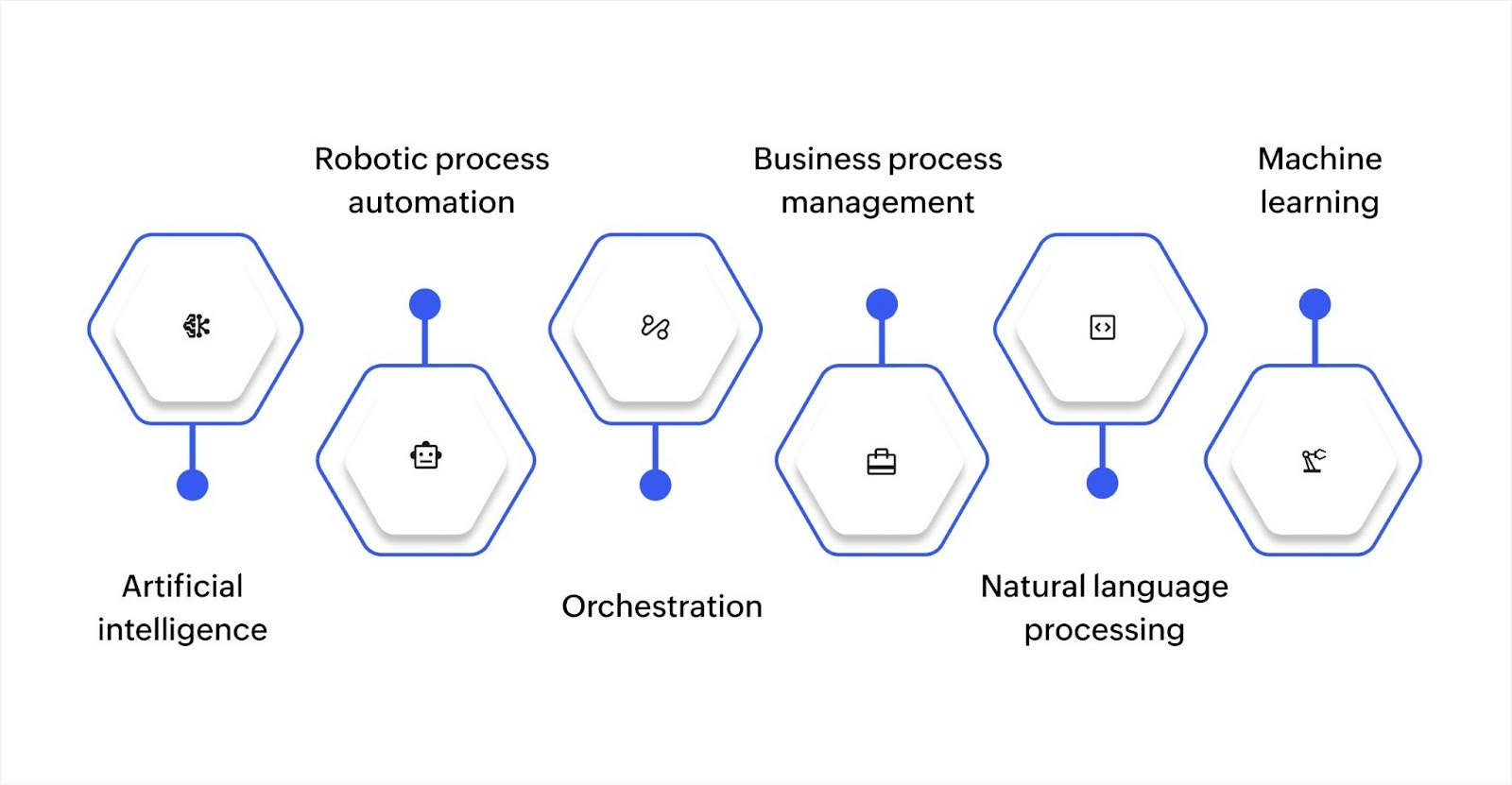
Intelligent automation relies on a blend of powerful technologies that help businesses work more efficiently and reduce manual effort. Understanding how these technologies come together will show you how they can enhance your business operations. Here's what you need to know:
- Artificial intelligence (AI)
This enhances automation by enabling machines to make decisions, process natural language (NLP), and recognize images. This enables systems to handle tasks such as customer service, data analysis, and pattern recognition. This creates a more adaptive and intelligent environment for your business. - Robotic process automation (RPA)
It focuses on automating rule-based tasks that involve structured data, such as data entry and transaction processing. While RPA improves efficiency, it relies on predefined workflows to complete tasks without the ability to adapt or learn from new situations. - Orchestration
This ties everything together by coordinating tasks across multiple systems and applications. Orchestration ensures end-to-end workflow management. So, intelligent automation can run across business functions without any bottlenecks. - Business process management (BPM)
BPM integrates and optimizes workflows across various departments. This enables businesses to align operations and ensure consistency, accuracy, and efficiency in day-to-day activities. - Natural language processing (NLP)
It allows systems to understand and interpret human language, enabling automation to process customer inquiries. NLP even engages in conversations with customers. This creates smarter, more responsive systems. - Machine learning (ML)
ML enables systems to learn from data, make predictions, and adapt over time. It uses historical data, so businesses can improve decision-making processes and continuously refine workflows for better outcomes.
Intelligent automation brings agility and adaptability to processes. However, a business needs more than that. Find out how this can help you grow in the marketplace.
Top 5 industry-specific use cases of intelligent automation
Intelligent automation solves different problems depending on the industry. Financial services prioritize compliance and fraud prevention, healthcare focuses on patient data accuracy, while retail needs inventory optimization across multiple channels.
Banking, financial services, and insurance (BFSI)
Financial institutions handle sensitive customer data and complex regulatory requirements while processing thousands of transactions daily. Intelligent automation maintains compliance standards while reducing approval times and detecting fraud in real time.
- Customer onboarding and Know Your Customer (KYC) verification: AI-driven systems can automate the collection, verification, and validation of customer information. It is making onboarding faster and more accurate.
- Loan application processing and document validation: Machine learning models assist in validating loan documents, ensuring compliance, and reducing the time spent on manual reviews.
- Mortgage cross-selling workflows: Using AI, financial institutions can identify opportunities for cross-selling mortgage products by analyzing customer profiles and behaviors.
- Fraud detection: AI models can detect unusual transaction patterns, flag potential fraud in real time, and enhance security and customer trust.
- Insurance claims extraction and approval: Natural language processing is used to extract data from insurance claims automatically. After routing them for processing, it approves claims without manual intervention.
Human resources
HR teams manage the entire employee lifecycle while handling sensitive personal data and ensuring policy compliance across the organization. Automation reduces the administrative burden in recruiting, onboarding, and ongoing employee management while maintaining accurate records.
- Employee onboarding: Machine learning algorithms simplify the onboarding process by handling document collection and training schedule creation, ensuring smooth transitions for new employees.
- Resume parsing: Natural language processing tools automate resume screening and shortlisting. At the same time, AI-driven platforms handle scheduling and background checks to reduce manual workload.
- Leave tracking: AI systems monitor attendance data, syncing it smoothly with payroll to eliminate errors and improve payroll accuracy.
- Document policy acknowledgement: Business process management solutions track employee interactions with policy documents, ensuring efficient record-keeping.
- Chatbot usage: Chatbots powered by AI handle routine employee inquiries about benefits, policies, and other HR-related questions. It reduces the burden on HR staff.
Information technology (IT) and infrastructure
IT departments respond to constant support requests while maintaining system security and performance across the organization. Intelligent automation handles routine incidents and monitors infrastructure health to prevent problems before they affect operations.
- Password resets: Robotic process automation tools handle password resets and provisioning new access credentials. So, reducing response times helps in employee satisfaction.
- Incident detection: Machine learning models automatically detect incidents, prioritize them based on severity, and initiate resolutions.
- Automated ticket routing: AI-driven systems route IT support tickets to the appropriate teams based on issue classification, ensuring faster resolution times.
- Software deployment: Business process management platforms automate the process of deploying software updates and patches. So, every system remains up to date and secure.
- Network monitoring: AI systems continuously monitor network performance, sending alerts when anomalies are detected, enabling proactive issue resolution.
Healthcare
Healthcare providers coordinate patient care across multiple systems while managing strict privacy regulations and documentation requirements. Automation improves both administrative efficiency and care quality by reducing delays in critical processes.
- Patient registration: Machine learning models automate patient registration processes and synchronize medical records across systems.
- Appointment confirmations: AI-powered systems handle appointment reminders, confirmations, and rescheduling, reducing no-shows.
- Medical billing: Natural language processing and AI assist in automating medical billing and claims processing and accelerating reimbursements.
- Compliance reporting: Business process management tools help healthcare providers generate accurate, compliant reports for audits.
- Inventory control: Machine learning algorithms predict inventory needs, ensuring that medical supplies are always available when needed.
- Lab report extraction and delivery: AI systems automate the extraction of lab results and their delivery to healthcare providers, speeding up diagnosis and treatment.
Retail and ecommerce
Retail businesses manage inventory across multiple locations while serving customers through various online and physical channels. Intelligent automation coordinates stock management, order fulfillment, and customer engagement to maintain consistent experiences.
- Order processing: AI systems automate the tracking of orders and manage returns, lowering processing times.
- Loyalty program management: Natural language processing helps businesses manage customer sign-ups. This also creates personalized loyalty programs based on purchasing behaviors.
- Customer relationship management: AI-driven platforms automatically update customer profiles with transaction history and support preferences. This can help you revise your customer service strategies.
- Marketing campaign approval: Business process management tools automate the review and approval process for marketing campaigns, ensuring faster time-to-market.
- Point of sale system integrations: AI systems integrate point-of-sale data with sales reporting tools. In this way, businesses make better-informed decisions.
These retail applications show how intelligent automation handles both customer-facing processes and backend operations. The combination of AI analysis with workflow automation lets retailers respond faster to customer needs while managing inventory more efficiently.
With the retail AI market expected to grow exponentially to USD 85.07 billion by 2032, businesses must act now to stay competitive. Zoho Creator offers an ideal solution to help retail operations in this regard. With features such as sales report generation, this platform allows businesses to automate workflows.
To better understand the impact, here are some common benefits and use cases of intelligent automation in action. These practical applications demonstrate how businesses are using intelligent automation in a versatile manner.
Key benefits and uses of intelligent automation
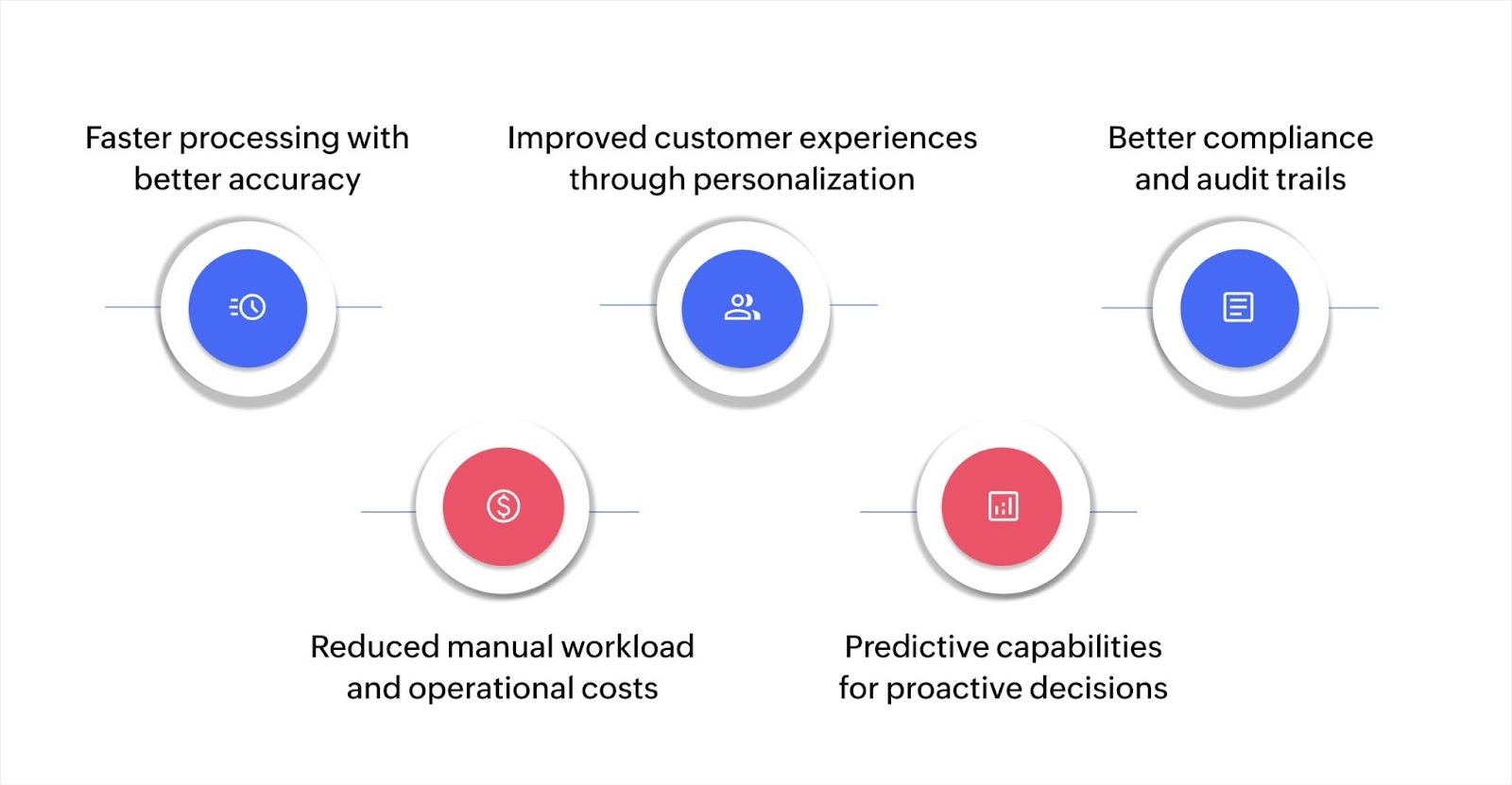
Intelligent automation creates measurable value by handling tasks that require both speed and decision-making accuracy. Businesses typically see the biggest impact in high-volume processes where manual work creates bottlenecks or where errors have costly consequences.
Here's how intelligent automation creates value across business operations.
Faster processing with better accuracy
Intelligent automation compresses workflows that previously required days of manual work into hours or minutes. The technology validates data at every step, catching errors that humans might miss during repetitive tasks.
For instance, procure-to-pay automation handles the entire workflow from purchase orders to invoice matching and payment processing. The system validates invoices against purchase orders, flags discrepancies for review, and processes approved payments within hours instead of days. This reduces payment delays while maintaining accurate financial records.
Reduced manual workload and operational costs
Robotic process automation handles repetitive, time-consuming tasks that don't require human judgment. This frees your team to focus on work that needs creativity, relationship-building, or complex problem-solving.
For example, customer invoice generation pulls data from sales systems, applies correct pricing and tax rules, and sends invoices automatically. The system tracks payment statuses and sends reminders for overdue accounts. This reduces delays in receivables while freeing finance teams from repetitive data entry and follow-up work.
Improved customer experiences through personalization
AI-powered systems analyze customer data to deliver personalized experiences at scale. This creates interactions that feel tailored to individual preferences without requiring manual customization for each customer.
For instance, product recommendation systems analyze browsing patterns, purchase history, and similar customer behaviors to suggest relevant items. When a customer views winter jackets, the system might recommend matching accessories or complementary products. This creates personalized shopping experiences that increase conversion rates while helping customers discover products they actually want.
Predictive capabilities for proactive decisions
Machine learning models identify patterns in historical data to predict future outcomes. This shifts operations from reactive problem-solving to proactive planning and prevention.
For example, predictive maintenance in manufacturing uses sensor data and machine learning to forecast equipment failures before they happen. When vibration patterns or temperature readings indicate potential problems, the system schedules maintenance during planned downtime. This reduces unplanned production stops and extends equipment lifespan by addressing issues before they cause major failures.
Better compliance and audit trails
Automated systems document every action, creating complete records of who did what and when. This transparency simplifies compliance reporting and makes audits less disruptive to daily operations.
For instance, supply chain optimization systems track every decision about inventory levels, supplier selection, and delivery routing. The system records which rules triggered each decision and maintains detailed logs for regulatory reviews. This creates complete audit trails while helping businesses predict demand fluctuations and adjust operations to reduce costs and ensure timely deliveries.
These benefits work together to create operations that run faster, cost less, and adapt to changing conditions. The specific impact depends on which processes you automate and how well the automation fits your workflows.
Start your future journey with intelligent automation
Intelligent automation helps businesses handle growing operational demands without proportional cost increases. To stay ahead, businesses must embrace change and use advanced technologies. Intelligent automation is one of them. This has the potential to take you to the front line of this growing market.
If you're still thinking, then let us assure you that it’s the right time to move beyond traditional methods. Take advantage of powerful tools to fuel efficiency and innovation.
Zoho Creator offers a flexible, easy-to-use platform to help you integrate intelligent automation into your business. With its intuitive, low-code platform, you can easily design custom solutions that align with your specific business needs.
Ready to make intelligent automation work for you? Get in touch with us today to explore how Zoho Creator can help you build smarter, more efficient operations.
FAQ
What is an example of an intelligent automation solution that makes use of artificial intelligence?
An example is customer service chatbots that use AI to understand and respond to customer inquiries. They provide quick and accurate assistance.
What is intelligent process automation?
Intelligent process automation (IPA) combines robotic process automation (RPA) with artificial intelligence (AI) and machine learning. This enables the automation of more complex tasks, such as decision-making and cognitive functions.
What are some automation examples in real life?
Examples include self-checkout systems in stores, automated email responses, and AI-powered personal assistants like Siri and Alexa.
What is an AI automation agency?
An AI automation agency is a company that specializes in implementing AI-driven automation solutions for businesses. In this way, enterprises optimize processes, reduce costs, and enhance efficiency with AI technologies.
 Ann Elizabeth Sam
Hey! I'm Ann, and I work as a content writer at Zoho Creator. I'm exploring the SaaS world through various forms of content creation. Outside of work, I love dancing and would give up anything to read a good murder mystery.