- HOME
- Know Your Tech
- Digital transformation with scalable agile solutions in 2026
Digital transformation with scalable agile solutions in 2026
- Last Updated : March 4, 2026
- 1.2K Views
- 13 Min Read
You spend three months getting stakeholder buy-in for your transformation roadmap. Two weeks after approval, your largest customer requests features that contradict the plan. A month later, a new competitor enters your market with capabilities you hadn't considered. Sound familiar? This is happening faster and more frequently than ever before.
Highlights
- Agile digital transformation breaks large initiatives into smaller steps with regular feedback and continuous refinement.
- Frameworks such as the Scaled Agile Framework (SAFe), Large-Scale Scrum (LeSS), and Disciplined Agile Delivery (DAD) coordinate multiple teams while maintaining flexibility and speed.
- Program increment planning aligns teams on priorities, dependencies, and deliverables before each development cycle begins.
- Continuous delivery pipelines automate testing and deployment, enabling faster releases without manual coordination overhead.
- Track velocity, cycle time, and business outcomes to measure whether transformation delivers expected value.
According to recent data from Gartner, less than half (only 48%) of digital transformation projects achieve their business goals. The rest miss their targets, highlighting that a rigid planning structure can’t handle rapid change.
That’s where agile solutions come in. They help organize work into manageable increments with regular checkpoints, making it easier to respond when priorities shift or new information emerges. This blog post breaks down in detail how to scale digital transformation with effective agile solutions.
What is agile digital transformation?
Agile digital transformation applies agile methodologies to digital modernization strategies. Unlike traditional approaches that treat transformation as a single large project, agile breaks the process into smaller iterative steps.
Each step gets designed, tested, and optimized based on real-time feedback, enabling continuous refinement. This approach responds rapidly to changing business and technical requirements while maintaining execution flexibility.
For example, instead of spending 18 months building a complete customer portal before launch, agile teams could release a basic version in eight weeks, gather user feedback, then add features in two-week sprints based on actual usage patterns and priorities.
How does it differ from traditional digital transformation?
Traditional transformation locks teams into a fixed plan from day one, making course correction painful once execution starts. Agile works in smaller increments, using continuous feedback to adjust direction before small issues become large failures. The differences affect how quickly organizations can adapt and how effectively they deliver value.
Here's how they compare:
| Factor | Traditional digital transformation | Agile digital transformation |
| Approach | Linear and waterfall-based | Iterative and flexible |
| Execution | One-time, large-scale implementation | Incremental releases in short cycles |
| Planning | Long-term roadmap spanning multiple years | Short-term cycles with continuous adjustments |
| Adaptability | Minimal room for changes once execution starts | Frequent feedback loops and adjustments |
| Risk management | High risk of obsolescence due to fixed plans | Reduced risk through continuous testing |
| Completion | Fixed end point, often outdated by launch | Ongoing process that evolves continuously |
While traditional transformation follows a rigid, long-term path, agile allows businesses to stay flexible, adapt to market changes, and improve continuously.
5 key benefits of flexible agile solutions in digital transformation
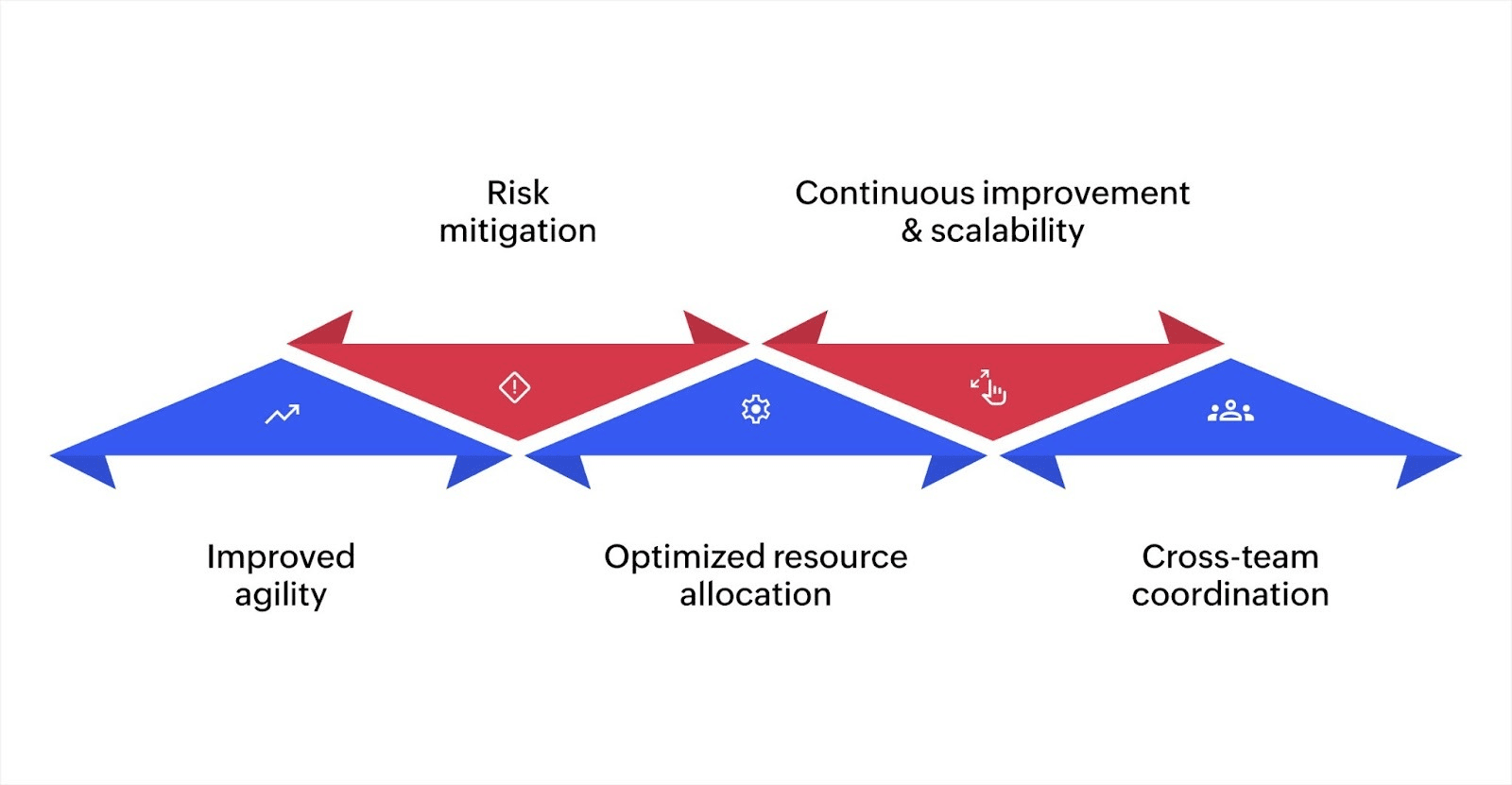
Scalable agile solutions offer several benefits in digital transformation. Some of the top advantages include:
1. Improved agility
Agile's iterative model lets organizations adjust rapidly to changing technical requirements and business conditions. This adaptation speed proves essential in modern environments where market demands shift quickly.
For instance, when a retail company notices customer preferences changing toward mobile shopping, agile teams can reprioritize mobile features and adjust delivery plans within days rather than months.
2. Risk mitigation
Implementing gradual changes and validating them in each cycle significantly reduces the risk of large-scale failures. This matters particularly for complex enterprise systems that cost a lot to change after full deployment.
For example, when introducing a new financial reporting system, agile teams can test with one department first, identify data quality issues early, and adjust before rolling out across all business units.
3. Optimized resource allocation
Agile solutions allow prioritizing resources and features based on immediate technical and business needs. This reduces wasted effort and focuses investments on high-value areas.
For instance, a manufacturing company can allocate developers to the automation features showing the highest cost savings rather than following plans created months earlier when priorities were different.
4. Continuous improvement and scalability
Each sprint contributes to continuous system improvement using real-time data to inform future phases. As organizations grow and needs evolve, digital tools continue adapting, ensuring alignment with business objectives.
For example, an ecommerce platform can add payment options, shipping integrations, or analytics features incrementally as transaction volumes grow and customer needs become clearer through actual usage data.
5. Cross-team coordination
Agile frameworks provide structured ways for multiple teams to coordinate work, share information, and align on priorities. Regular planning sessions and synchronized delivery schedules ensure teams work toward common goals without duplicating efforts.
For instance, when building a customer portal, separate teams that handle authentication, profile management, and order tracking can work independently while coordinating through shared sprints and integration points to ensure all components work together smoothly.
How to scale digital transformation with agile solutions
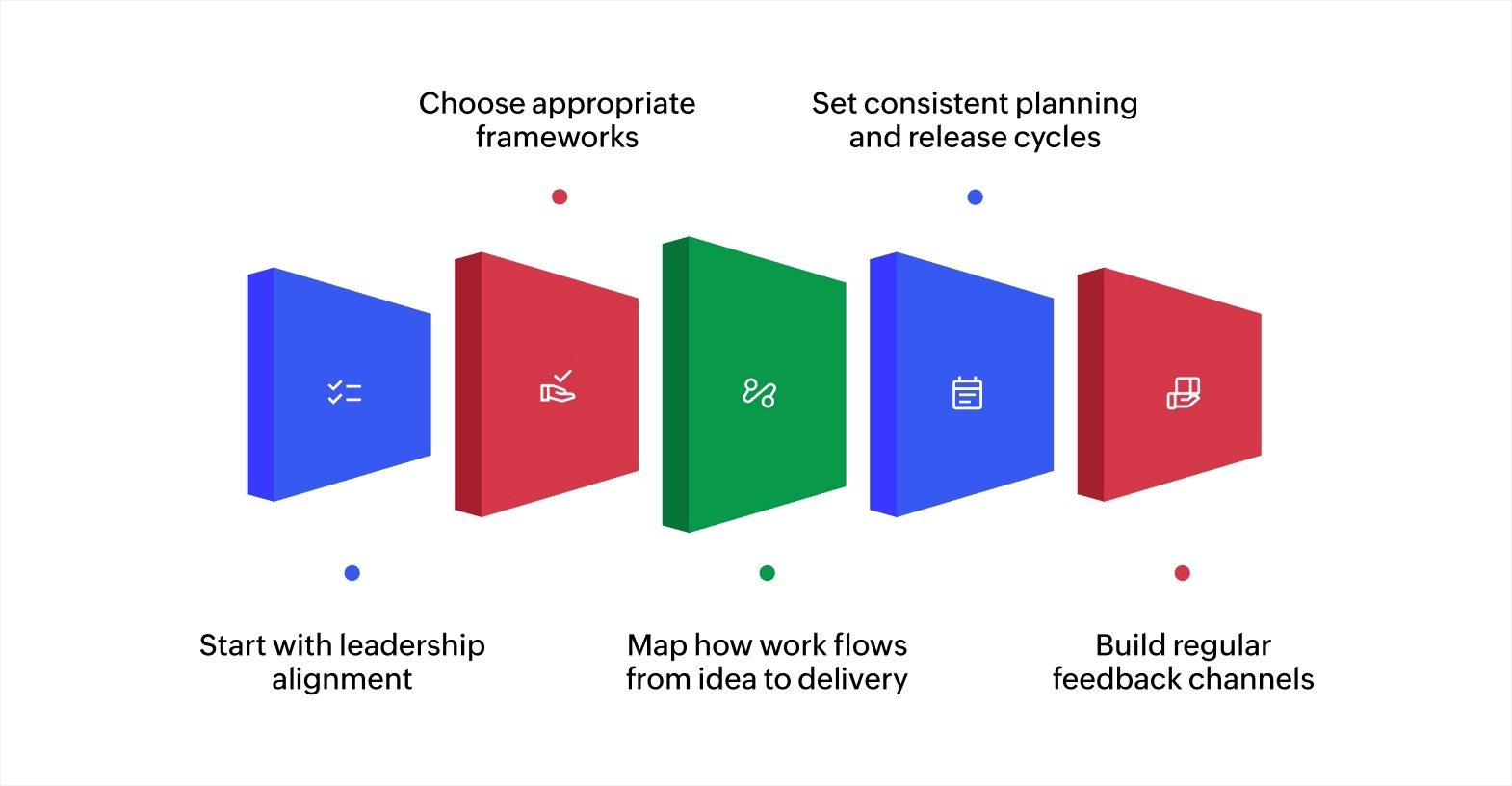
To scale digital transformation with agile methods, organizations need structured approaches to coordinate multiple teams, align priorities across departments, and maintain consistency while preserving the flexibility that makes agile effective.
1. Start with leadership alignment
Successful scaled agile begins with leadership agreement on transformation goals, priorities, and success metrics. Leaders across IT, operations, and business units need a shared understanding of what the transformation should achieve and how agile methods will get there. This alignment prevents conflicting priorities and ensures resources flow to the most important work.
2. Choose appropriate frameworks
Select frameworks matching your organization's size, complexity, and culture. Scaled Agile Framework (SAFe) works well for large enterprises needing detailed coordination. Large-Scale Scrum (LeSS) suits organizations wanting to scale while maintaining simplicity. Disciplined Agile Delivery (DAD) provides flexibility for diverse project types. The right framework provides enough structure to coordinate effectively without creating unnecessary overhead.
3. Map how work flows from idea to delivery
Trace how features move from initial concept through your organization to customer delivery. Identify where work stalls between teams, where handoffs create delays, and where approval processes slow progress. Organize teams around complete workflows rather than functional departments to reduce coordination overhead and speed up decisions.
4. Set consistent planning and release cycles
Establish regular time periods when all teams plan work together and release completed features. Set fixed cycles in which teams synchronize planning at the start and deliver results at the end. This rhythm creates predictable coordination points and eliminates constant deadline negotiations.
5. Build regular feedback channels
Create specific ways to gather input from customers, stakeholders, and team members at consistent intervals. Schedule monthly user sessions, weekly team check-ins, and biweekly metric reviews to validate whether work delivers expected results. Use this feedback to adjust priorities before investing heavily in features that might miss the mark.
Key components of scaled agile for digital transformation
Several interconnected components work together to make scaled agile successful. Each component addresses specific coordination or execution challenges that arise when multiple teams work on related transformation initiatives.
Agile release trains for delivering value
Agile release trains (ARTs) bring together multiple teams to work toward shared goals and deliver value step by step. ARTs coordinate multiple teams effectively, ensure timely delivery, and break projects into manageable tasks.
This structure ensures consistent, predictable results while aligning with transformation objectives across departments and functions.
Program increment planning for team alignment
Program increment planning aligns all teams within an ART on shared objectives, sets priorities, and maps out work for the next increment. This ensures clear focus and reduces silos between teams.
PI planning provides clear visibility on goals and timelines, increases alignment and collaboration, and prioritizes tasks based on business value. These sessions ensure transformation stays focused on high-value outcomes.
Continuous delivery pipeline (CDP)
A continuous delivery pipeline automates building, testing, and releasing software, enabling faster and more efficient feature delivery. CDPs accelerate release cycles, reduce errors through automated tests, and help teams respond quickly to market and customer demands.
A CDP ensures teams deliver value quickly and efficiently throughout the transformation journey.
DevOps and agile technical practices for software quality
Combining DevOps with agile technical practices improves collaboration and software quality. This approach supports faster, more reliable software delivery by identifying issues early, strengthening collaboration across teams, and improving quality through automated testing and continuous integration.
DevOps and agile practices help scale agile initiatives and refine digital transformation efforts by catching problems before they reach production.
Selecting and applying scaled agile frameworks
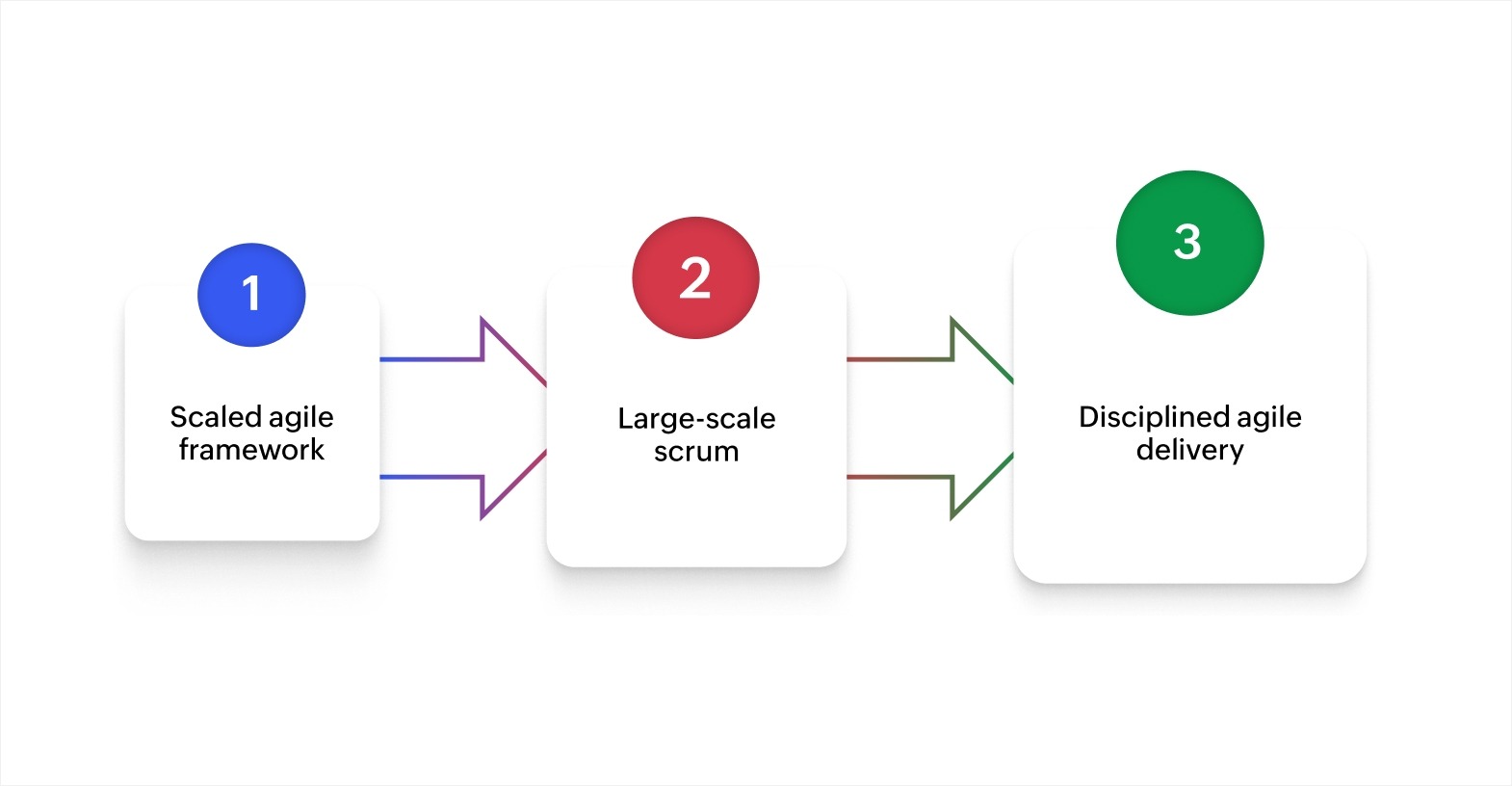
Choosing the right framework ensures better coordination, faster delivery, and smoother workflows. Here are some frameworks that offer different approaches to scaling agile based on organization size, complexity, and preferences.
1. Scaled Agile Framework for coordinating enterprise teams
Scaled Agile Framework (SAFe) is designed for large enterprises, aligning multiple teams with business goals. It organizes teams into ARTs for synchronized planning and execution.
Benefits include cross-team collaboration toward common goals, clear roles and responsibilities for better accountability, and continuous delivery through coordinated trains. SAFe helps scale agile practices across the enterprise while ensuring efficient delivery.
2. Large-Scale Scrum for transparent task management
Large-Scale Scrum (LeSS) extends scrum principles to larger projects while focusing on simplicity and transparency. It emphasizes minimal complexity with fewer processes, quick iterations for faster delivery, and maintaining core scrum values at scale.
LeSS works well for companies seeking frameworks that keep things simple and transparent without adding unnecessary overhead.
3. Disciplined Agile Delivery for aligning strategies
Disciplined Agile Delivery (DAD) is a flexible framework that aligns business and technical goals across multiple teams. Key benefits include comprehensive lifecycle management, adaptability to various project types, and strategic alignment across teams.
DAD suits organizations with complex structures needing unified, disciplined delivery while maintaining flexibility for different project approaches.
Best practices for implementing scalable agile solutions
Implementing scaled agile requires thoughtful approaches that fit your organization's needs while maintaining flexibility for growth. These practices help organizations scale agile successfully while avoiding common pitfalls.
1. Align transformation to measurable business outcomes
Connect every agile initiative to specific, measurable business results rather than just completing projects. Define what success looks like in terms of revenue impact, cost reduction, customer satisfaction, or operational efficiency. This focus prevents teams from losing sight of whether delivered features actually matter to business performance while optimizing delivery speed.
2. Build leadership capability in agile principles
Leaders must understand and model agile values, not just sponsor initiatives. Invest in training for executives and managers on lean-agile thinking, decision-making at appropriate levels, and creating psychological safety for teams. Leadership behavior determines whether organizations truly change or simply add agile terminology to existing practices.
3. Integrate planning across business and technology
Conduct program increment planning sessions that include both business stakeholders and technical teams. This integration ensures technical work aligns with business priorities, business requirements reflect technical constraints and opportunities, and both sides understand dependencies and trade-offs.
4. Embed automation early in the transformation
Build DevOps capabilities and continuous delivery pipelines at the start, not as afterthoughts once processes stabilize. Early automation investment speeds up feedback cycles, reduces manual coordination overhead, and enables teams to focus on creating value rather than managing deployments.
5. Track outcomes, not just activities
Measure whether agile transformation delivers business value through metrics like cycle time, deployment frequency, customer satisfaction, and revenue impact. Avoid focusing solely on process compliance measures like story points completed or sprint velocity.
How to measure the impact of digital transformation with agile solutions
Tracking the right metrics helps determine whether your scaled agile transformation delivers expected value. Focus on outcomes that matter to business operations and customer experience rather than just measuring process compliance or activity levels. Here's what to track:
| Metric category | What to measure | Why it matters |
| Velocity and throughput | Work completed per sprint and features deployed per cycle | Shows improving efficiency and predictable delivery |
| Cycle time | Time from work start to customer delivery | Reveals how quickly teams deliver actual value |
| Lead time | Time from idea to production deployment | Identifies delays in coordination or prioritization |
| Quality metrics | Production defects, bug rates, and system downtime | Indicates whether agile practices catch issues early |
| Business outcomes | Revenue growth, cost reduction, and customer satisfaction | Shows real impact beyond process improvements |
| Team satisfaction | Collaboration effectiveness, workload balance, and clarity | Signals sustainable transformation and culture health |
| Deployment frequency | How often new features reach production | Demonstrates capability to deliver value quickly |
| Deployment reliability | Percentage of successful deployments without issues | Reflects quality processes and effective testing |
These metrics work together to show whether transformation efforts improve both delivery speed and business results. Regular tracking helps you spot problems early and adjust approaches.
Overcoming digital transformation challenges with scaled agile
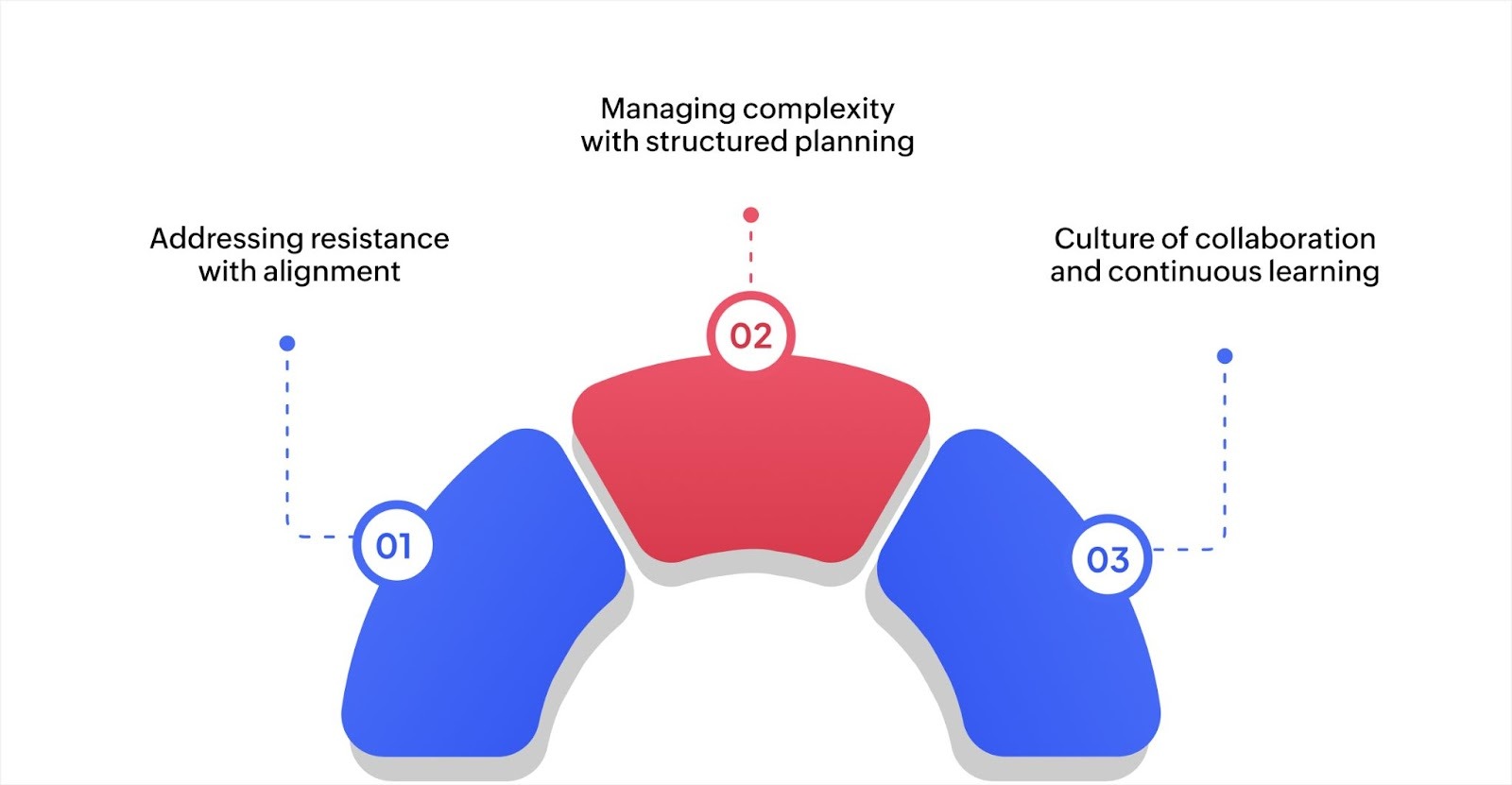
Implementing scalable agile solutions during digital transformation also comes with several challenges. Here's how you can address these obstacles effectively.
Addressing resistance with alignment and transparency
Resistance to change emerges naturally when teams face new processes, tools, or ways of working that disrupt familiar routines. People worry about job security, increased workload, or their ability to adapt successfully. Here's how to reduce resistance:
- Communicate goals clearly: Explain the transformation purpose and how it benefits both the organization and individual team members.
- Involve key stakeholders early: Engage leaders and influential team members from the start to create ownership and reduce pushback.
- Provide regular updates: Share progress, challenges, and wins consistently to build trust and show that leadership values transparency.
- Address concerns directly: Create forums where team members can voice worries and get honest answers without fear of consequences.
This approach builds understanding and cooperation across teams. When people feel heard and informed, they're more likely to support change rather than resist it.
Managing complexity with structured planning
Multiple systems, dependencies between teams, and overlapping timelines create complexity that can overwhelm organizations without clear coordination approaches. Without structure, teams duplicate effort, miss integration points, or work toward conflicting goals. Here's how to manage complexity effectively:
- Set clear objectives: Break the transformation into manageable stages with specific, measurable outcomes for each phase.
- Create a roadmap: Outline milestones, timelines, and resource needs so everyone understands the path forward and their role.
- Use coordination tools: Adopt platforms that automate workflows and provide visibility into what each team is working on.
- Establish dependencies early: Identify which teams need outputs from others and schedule work to prevent delays and bottlenecks.
Structured planning simplifies the process and keeps teams focused on priorities. Regular checkpoints ensure coordination stays on track as work progresses.
Driving a culture of collaboration and continuous learning
Siloed departments, limited knowledge sharing, and fear of experimentation prevent organizations from adapting quickly to new information or changing conditions. Teams working in isolation miss opportunities to learn from each other or coordinate on shared challenges. Here's how to build a collaborative culture:
- Encourage cross-team collaboration: Create opportunities for different departments to work together on shared goals and understand each other's constraints.
- Support knowledge sharing: Provide regular training sessions, documentation practices, and forums where teams can share lessons learned and best practices.
- Enable experimentation: Give teams permission to try new approaches and learn from failures without negative consequences for reasonable risks.
- Celebrate collective wins: Recognize achievements that required multiple teams working together to reinforce collaboration as a core value.
Creating this culture ensures teams stay adaptable and innovative throughout the transformation. When learning and collaboration become habits, organizations respond to change more effectively.
Examples of digital transformation with scalable agile solutions
Organizations across industries apply agile approaches to solve operational challenges and adapt to changing conditions. These real-world examples show how businesses use flexible solutions to coordinate work, respond quickly to new requirements, and improve outcomes.
Here's how different organizations approached transformation:
Telecommunications: Managing data from multiple sources
MTN, Africa's leading telecom operator serving 223 million subscribers across 24 countries, needed a solution they could implement quickly without complex integration challenges. They chose an agile approach that prioritized speed and adaptability.
Working with Zoho Creator, an AI-powered low-code app development platform, the company went live with their custom procure-to-pay tool in just three months with around 400 users across the globe. The agile nature of the platform let them easily edit workflows and add new elements as they encountered different situations. When they needed adjustments based on user feedback, they could make changes themselves without lengthy development cycles or technical dependencies.
Hospitality: Building solutions for rapid demand changes
Bourne Leisure, one of the UK's largest holiday operators managing over 40,000 caravans across 37 parks, faced surging demand and new safety requirements after pandemic restrictions lifted. The company used agile development to rapidly build solutions as specific needs emerged.
The team built over 30 custom applications, responding to requirements as they came up—including restaurant booking systems, food allergen trackers, and delivery management tools. Zoho Creator's rapid prototyping and short deployment times proved critical for meeting tight timelines. When requirements changed or user feedback came in, they could make adjustments quickly without lengthy redevelopment cycles.
Sustainability services: Digitizing waste management operations
Zecomy, a company managing dry waste for corporate clients across 250 cities in India, used an agile development approach to build four connected applications over time. They started with one application and expanded based on lessons learned.
Their first application rolled out in three weeks. Following this success, they began work on additional applications, taking about six months for the initial version. Their agile development approach on Zoho Creator enabled rapid feature development, with new features typically releasing in one or two weeks. This iterative method let them refine applications continuously based on actual usage patterns and evolving business needs.
Implement digital transformation with scalable agile solutions
Managing digital transformation with disconnected tools, manual coordination, and rigid systems creates visibility gaps and slows decision-making. Traditional software development takes months, making it difficult to adapt as requirements change or new priorities emerge during transformation initiatives.
Zoho Creator is an AI-powered low-code application development platform that helps businesses build custom transformation solutions matching their specific processes and requirements. You can create applications for workflow automation, data integration, process tracking, or team coordination without extensive coding knowledge, enabling the iterative delivery that agile transformation requires.
Development teams can build, test, and deploy applications in weeks rather than months using visual builders and templates. The platform supports integration flows connecting existing systems, real-time dashboards for tracking progress, and mobile apps for team coordination across locations.
Organizations using Zoho Creator for transformation initiatives can modify applications as requirements evolve without waiting for development cycles or external vendors. This flexibility supports the continuous adaptation that makes scaled agile transformation successful. Sign up for free today to build solutions matching your digital transformation needs.
FAQ
1. Which scaled agile framework works best for large enterprises?
SAFe (Scaled Agile Framework) works well for large enterprises needing detailed coordination across many teams. It provides clear roles, planning cycles, and practices for aligning multiple teams toward common objectives.
2. What role does leadership play in scaled agile success?
Leaders establish vision, align stakeholders on priorities, remove organizational barriers, and model agile values. Their support enables teams to make decisions quickly and experiment without fear of failure.
3. How does continuous delivery support agile transformation?
Automated pipelines enable faster, more reliable releases by handling build, test, and deployment tasks. This reduces manual coordination, catches issues earlier, and lets you deliver value as soon as features are complete.
4. What causes most scaled agile transformations to fail?
Lack of leadership support and resistance to cultural change cause most failures, not technical issues. When leaders don't model agile behaviors or teams aren't empowered to make decisions, frameworks and tools can't overcome organizational barriers to change.
5. How do you get stakeholder support for scaled agile transformation?
Start by demonstrating value through small test projects that show tangible results within weeks rather than months. Share clear metrics on improved delivery speed and reduced risk from these pilots to build confidence before expanding agile practices across the organization.
 Ashwin Raj S N
Ashwin is a Growth Marketer for Zoho, with a passion for learning new things. In his spare time, he enjoys spending time with his family and friends, watching anime, and travelling.